
Executive Reality: The Buyer Has Taken Control
For years, revenue teams believed they controlled momentum.
Cold calls created urgency.
Funnels managed progression.
Email sequences forced next steps.
That model worked when information was scarce.
Information is no longer scarce.
Today’s buyers research independently. They validate in peer Slack groups. They compare vendors on LinkedIn. They consult review platforms and AI tools before engaging.
This shift is why buyer-led conversions now define sustainable growth.
According to Gartner, B2B buyers spend only 17 percent of their purchase journey meeting with suppliers. The majority of decision-making happens without direct interaction.
When your system does not align with buyer behavior, friction increases.
And friction is expensive.
Higher CAC.
Longer sales cycles.
Lower trust.
Weaker retention.
Modern B2B Marketing must align with behavior, not internal process.
The question most revenue leaders ask about this shift is whether sales still controls the journey?
And the answer is no. Buyers control timing and research depth. Revenue teams must align systems to that reality.
What Buyer-Led Conversions Actually Mean
Buyer-led conversions occur when the buyer controls:
- When engagement begins
- How deeply they evaluate
- What proof they require
- When sales interaction occurs
Traditional funnels assume the company controls stage progression.
Buyer-led conversions assume behavior defines progression.
Instead of gating prematurely, you clarify value early.
Instead of hiding pricing, you explain structure.
Instead of forcing demos, you create self-education paths.
This is operational buyer-centric marketing.
It is structured. It is deliberate. It is measurable.
When implemented correctly, buyer-led conversions increase:
- Conversion quality
- Sales efficiency
- Trust formation
The question most teams ask is how buyer-led conversions differ from inbound funnels?
And the answer is that inbound still prioritizes internal campaign sequencing. This approach prioritizes buyer timing and decision readiness.
Why Buyer-Centric Marketing Produces Compounding Revenue
Short-term tactics generate spikes.
Structural alignment generates stability.
McKinsey research shows companies that prioritize customer experience achieve 5 to 10 percent higher revenue growth than competitors.
Forrester research shows customer-obsessed companies grow revenue 2.5 times faster than peers.
Buyer-led conversions operationalize these insights.
Consider revenue math:
If your website converts at 2 percent and friction removal increases it to 3 percent, that represents a 50 percent lift without increasing traffic.
If retention improves from 85 percent to 92 percent, lifetime value increases dramatically.
If sales cycle shortens by 15 percent, working capital improves.
These improvements compound.
Modern B2B Marketing without buyer alignment becomes expensive.
Modern B2B Marketing aligned with buyer-led conversions becomes predictable.
The question most marketing leaders ask is whether buyer-centric marketing slows growth?
And the answer is no. It filters low-intent prospects earlier and accelerates high-intent buyers.
The Hidden Power of B2B Communities
Many buying decisions now begin inside B2B Communities.
Private Slack groups.
Founder roundtables.
Peer advisory circles.
Edelman’s Trust Barometer consistently ranks peer recommendations among the most trusted information sources in business purchasing.
Buyer-led conversions often start with a simple question inside a community:
“Has anyone worked with them?”
If your brand is absent from those conversations, your influence begins too late.
Participation inside B2B Communities strengthens trust before formal evaluation.
This extends buyer-centric marketing beyond owned channels.
The question most founders ask about B2B Communities is whether conversations can be controlled?
And the answer is no. Influence comes from delivering measurable outcomes that others are willing to validate.
The 5-Stage Behavioral Alignment Framework
To operationalize buyer-led conversions, structure your system around five stages:
- Friction-Free Discovery
Clear positioning. Immediate value articulation. - Transparent Evaluation
Visible pricing logic. Honest differentiation. - Accessible Proof
Case studies. Testimonials. Peer references. - Intent-Based Sales Activation
Engage when behavior signals readiness. - Post-Purchase Reinforcement
Onboarding clarity. Measurable ROI. Expansion alignment.
This structure aligns internal systems to buyer movement.
Strong B2B Marketing mirrors real buyer behavior.
The question most operators ask is where to begin?
And the answer is friction mapping. Identify where buyers stall and remove that obstacle first.
What Breaks Without Buyer-Led Alignment
When organizations ignore buyer-led conversions, predictable breakdowns occur:
• Inflated top-of-funnel metrics
• Low demo attendance
• Poor qualification
• Long sales cycles
• High churn
Marketing celebrates MQL volume.
Sales complains about quality.
Customer success struggles with onboarding misalignment.
Without buyer alignment, internal friction replaces customer trust.
This is where strategic leadership becomes critical.
The question most executives ask about stalled growth is what typically causes it?
And the answer is misalignment between messaging, process, and buyer expectations.
Case Example: HubSpot’s Self-Directed Growth
HubSpot built its growth engine on education and transparency.
They invested in:
- Open content
- Free CRM tools
- Transparent pricing
- Customer proof
Customer stories are available at: https://www.hubspot.com/customers
Instead of forcing early sales interaction, they enabled self-education.
This model reflects buyer-centric marketing at scale.
By reducing friction, they strengthened buyer-led conversions across every stage.
The question operators ask is whether this approach only works in SaaS.
And the answer is no. Any organization that reduces friction and increases clarity can apply similar principles.
The Strategic Role of a Fractional CMO
Internal silos often block execution.
Marketing wants volume.
Sales wants a pipeline.
Customer success wants retention.
A seasoned Fractional CMO aligns these objectives around buyer behavior.
A strong Fractional CMO focuses on:
• Buyer research
• Messaging precision
• Revenue metric alignment
• Cross-functional collaboration
Without leadership clarity, buyer-led conversions stall.
With leadership alignment, execution compounds.
The question growth teams ask about hiring a Fractional CMO is when it becomes necessary.
And the answer is when internal misalignment prevents buyer-centric marketing from translating into measurable revenue improvement.
Implementation Roadmap
To embed buyer-led conversions into your operating model:
- Audit friction across your buyer journey
- Remove unnecessary gating
- Surface value and differentiation early
- Align sales engagement to behavior signals
- Strengthen visibility inside B2B Communities
- Track conversion quality and retention metrics
Transparency builds trust.
Trust strengthens conversion quality.
Quality improves revenue stability.
Modern B2B Marketing demands structural clarity.
Buyer-led conversions provide that clarity.
The question most B2B leaders ask about implementation timelines is how quickly results appear?
And the answer is typically within one to two quarters when friction and alignment improve.
Why This Is Not a Trend but a Structural Shift
The future of B2B Marketing is not louder campaigns.
It is clearer alignment.
Buyers expect:
• Control
• Transparency
• Proof
• Respect
Buyer-led conversions meet those expectations.
Companies that embrace buyer-centric marketing build durable growth systems.
Organizations active in B2B Communities influence decisions earlier.
Strategic leadership, including guidance from a Fractional CMO, ensures execution discipline.
This is not a tactic.
It is structural evolution.
The question most executives ask about the future is whether outbound still works?
And the answer is yes. Outbound works when it supports buyer-led conversions rather than attempting to override buyer autonomy.
FAQ
The question revenue teams often ask about buyer-led conversions is whether they reduce sales authority?
And the answer is no. They increase sales efficiency by aligning outreach with buyer readiness.
The question marketing leaders ask about buyer-centric marketing is how ROI should be measured?
And the answer is through revenue metrics such as conversion rate, retention, lifetime value, and sales cycle length rather than surface engagement metrics.
The question founders ask about B2B Communities is how influence can be tracked?
And the answer is through indirect indicators such as branded search growth, referral traffic, improved win rates, and shortened deal velocity.
The question executives ask about hiring a Fractional CMO is how long measurable improvement takes?
And the answer is often one to two quarters when alignment gaps are corrected early.
The question growth teams ask about implementing buyer-led conversions is where to start?
And the answer is with friction analysis. Identify where buyers hesitate and eliminate unnecessary barriers.
The question leadership teams ask about long-term impact is whether this approach scales?
And the answer is yes. Buyer-led conversions create systems that compound over time rather than relying on short-term campaign spikes.
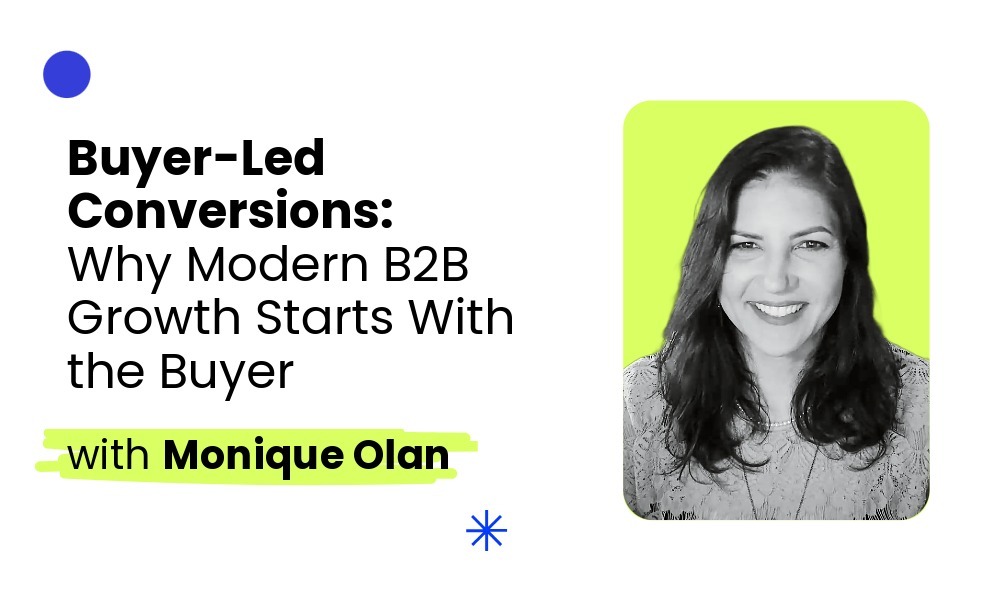
Get in touch with – Monique Olan