

Get my ultimate guide to boosting conversions and customer engagement delivered straight to your inbox.
Get my ultimate guide to boosting conversions and customer engagement delivered straight to your inbox.
“You’re trying to take two steps over without frankly earning those two steps. And I think that’s really what trust is. It’s an earned quality.”
Ellza Malok
🎧Episode Title: Building Trust in the Digital Age with Ellza Malok
Description:
If you’re a marketing leader constantly fighting to hit pipeline targets, defend your budget, and prove ROI to skeptical this episode will feel like therapy.
In this conversation, Ellza Malok and Terry Wilson go deep into the real reasons high-intent buyers bounce… and why trust is quietly becoming your biggest competitive advantage.
You’ll discover:
Whether you’re battling sales over lead quality, explaining numbers to the board, or just wondering why your funnel is leaking episode gives you the clarity, confidence, and strategy to fix it.
No fluff. Just hard-earned insights you can use right now.
🎧 Hit play. This might be the most important 25 minutes of your week
A guide for key moments and insights from this episode.
[01:02] – The Hidden Cost of Assumptive Marketing
Listen for:
[03:29] – The Power of Outside Perspective
Listen for:
[04:41] – Re-Humanizing the Buyer Experience
Listen for:
[07:15] – Real Buyer Behavior in Live Chat
Listen for:
[08:58] – Anonymous Conversations Build Trust
Listen for:
[13:30] – Trust is Earned, Not Asked For
Listen for:
[16:31] – Story-Driven Data Wins
Listen for:
[19:33] – How NOT to Use Live Chat
Listen for:
[22:11] – The Problem with Gated Content
Listen for:
[24:16] – Advice to Her 16-Year-Old Self
Listen for:
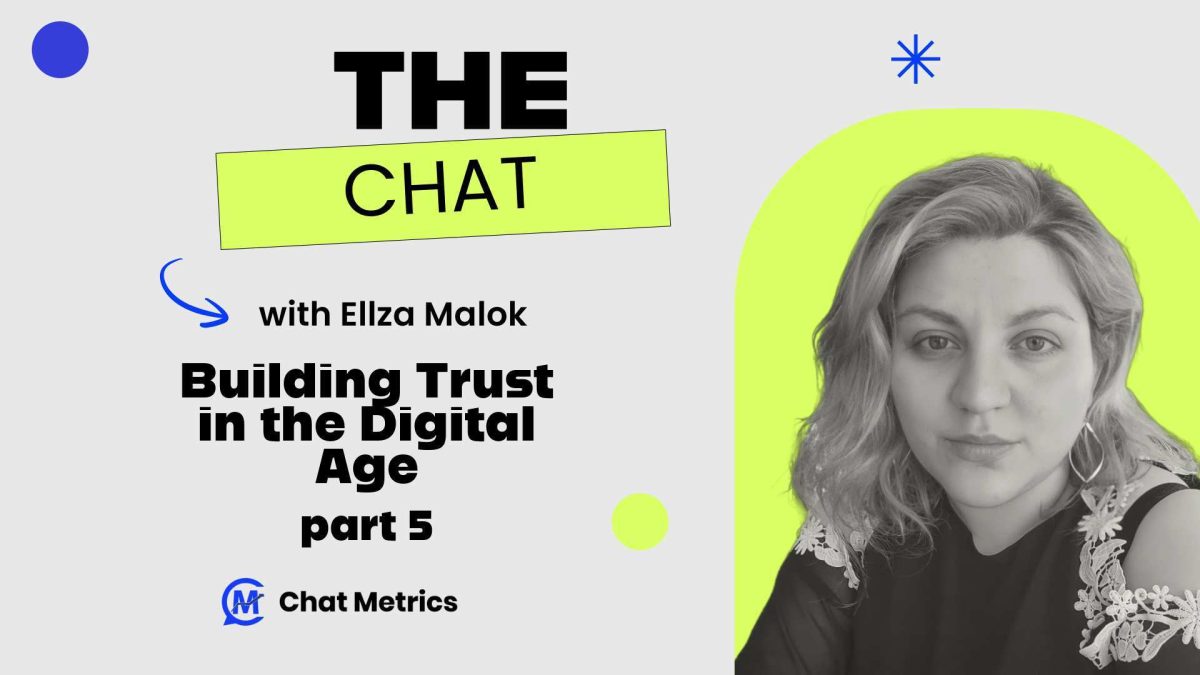
🎙️ Podcast Notes – The Chat with Ellza Malok (Part 5)
Theme: Building Trust in the Digital Age
🔑 Key Takeaways:
1. The Cost of Assumptions
2. The Power of Objectivity
3. Human Touch is Making a Comeback
4. Live Chat: Still a Competitive Advantage
5. AI + Human = Smart Strategy
6. Trust is a Process, Not a Tactic
Ellza’s Trust Framework:
People remember stories, not stats.
7. Fast Track to Trust in Marketing?
8. Gated Content is Broken
📚 Recommended Reading from Ellza:
00:00- Terry Wilson:
Welcome to the chat, come behind the inbound scenes of some of the world’s fastest growing companies for the past 10 years. As chat metrics. We’ve had an exclusive inside view of how these industry leaders are revolutionizing inbound marketing and sales. Across diverse sectors. Each week we bring you conversations with top minds in marketing and sales who share insider secrets and strategies for driving inbound success.
00:36- Terry Wilson:
Join us on the chat, your front row seat to the future of inbound.
00:48- Terry Wilson:
In your experience then, you mentioned working with with both e-commerce and business to business, but in your experience working with brands across the board, what’s one common marketing mistake that you see even seasoned professionals making and how they can, how can they avoid it?
01:02- Terry Wilson:
Oh
01:03- Ellza Malok:
I think the most across the board, the most common thing that we hear is we did this, we made a decision on this campaign and. When they tell me it’s not working as you dig into the ideation of that campaign and you dig into the rationality of why they did it, how they did it. Some of those marketing still is quite assumptive. And I go back to the conversation we had at the beginning. There are so many areas of research. You don’t even have to use BMG. You can use any other one. You can Google what have you. It’s still so incredibly assumptive that I actually worked with a company that did not know the newest number of potential customers. Because they’ve been using the same data for three years and I googled it and it’s three times larger and they’re still underperforming. So it was just one of those where this is assumptive mindset of, Hey, we’re going to, we think this amount. And they can use their own internal data. It’s the external data that they’re missing out on. It’s the what’s going on in the marketplace. What are people saying? Not just what your customers are saying, because your customers have already bought into you. They’ve already drank your Kool Aid and are paying you. So their information is already inherently different. Then people who’ve never heard of you and people who didn’t buy from you. And so you’ve got to go outside and you’ve got to talk to not only just existing customers, but future customers to say, why didn’t you buy from me? I genuinely want to know, because I think we’re competitors of X, Y, and Z only for you to hear. And in this instance, they’re like I didn’t know they were in that market. That’s why I was confused why they called me.
02:56- Terry Wilson:
Yeah.
02:57- Ellza Malok:
and the amount of times we saw that in this particular instance, and without them realizing that they’re and again, they were only going a third of the actual market they had they happened to be in a space that AI could actually pivot really well, which is why they’re tam three X over the course of three years which should have been an amazing thing, but they didn’t even know it. So there’s just this assumptive first mindset of you can look at your internal data as much as possible. The external data is more important because that’s where the market’s going.
03:29- Terry Wilson:
Absolutely. Absolutely. So it’s really making those assumptions and not being other centered in terms of
03:36- Ellza Malok:
Not validated or thinking about around it. It’s one of the reasons I think actually fractional roles play a really strong element to it, regardless if it’s C suite or up and down anywhere in those space, but bringing in freelancers, bringing in fractionals to say, Hey, I’m seeing this with these other elements that augmented team that can, that not only support you from a, Where you need people, but also support you as just what’s going on in your space or potentially in other spaces. A lot of life sciences and tech experience, but now that I work in many others I’m much more versatile and stealing from what works in one region and then applying it to a different industry.
04:15- Terry Wilson:
So the acumen helps, but it’s also the fact that you’re coming in with a lack of bias as well.
04:21- Ellza Malok:
Exactly, because you’re not married to, you’re not married to the idea. You’re married to the performance.
04:27- Terry Wilson:
Yeah, the idea or the organization or the personalities. Yeah. Yeah. Amazing. If you had to predict one major shift in consumer behavior over the next few years, what would it be and how should marketers prepare for that?
04:41- Ellza Malok:
I think we’re actually already seeing the biggest one. I I, and I don’t think it’s realized. I think it’s starting to trickle. It’s that human to human experience and how much more valuable that will be. Meaning to your point, when we got rid of bellhops and bellman’s and all these other people in the process, the. It diminished the entire customer experience dimension diminished, and therefore you became much more of a commoditized model. The more you remove the humans from this process, I think commodity commoditization will follow very soon. Much sooner than maybe we’ve seen in past modern history. So bringing back that human touch, even if it is that phone call or chat conversation or what have you that. And I actually think that customer support roles they’re even their salaries may increase because of having, being able to do something really well and build connection with customers that will go, that will come into play. Much more drastically. And those, none of those even require technical skills. They’re all soft skills around. Can you connect with another person virtually or in person or what have you? So I think we’re already starting to see that. I think it’s just going to start paying in spades. Once we get through this past, I think there’s another two years or so where we see the bottom line benefits. of automating technology, but not the perception shift that will come because perception is often a delaying factor. Unfortunate part though, is once you have a perception filled, at that period, then you have another delaying factor before you can change it again. You’re, you go through these peaks and valleys and it takes a while to run up the next mountain.
06:28- Terry Wilson:
In really interesting It’s one of those things that as a business owner myself, consider what are the potential risks, where’s the next opportunities. And we’re a people business, our purpose is people, it’s as simple as that. We’re focused on making sure that as we can help as many people as possible become financially independent.
06:47- Terry Wilson:
And so when I see what’s happening with AI, it’s almost with a heavy heart, I think, is our business at risk?
06:53- Terry Wilson:
There’s AI chatbots, will it get to a stage where it can have those conversations? And it will most definitely, I have no doubt that AI will get to the stage where it can have very credible conversations. But there’s one thing that underlies it that I watch in our business like a hawk, and that is the percentage of people that chat with us that ask and want clarification, whether they’re speaking to a chatbot or to a person.
07:15- Terry Wilson:
And that is a big number. It’s so before COVID that used to sit around 18 to 20 percent since COVID. It’s running at about 33%, nearly a third of every conversation we have, the person is clarifying whether there’s a person there or not. There’s another 6 percent that we’re seeing now that assume that they’re speaking with a chatbot.
07:36- Terry Wilson:
You can tell it starts off very staccato conversation, one words, very demanding. And then when they realize, without asking, but when they realize it’s actually a human on the other side, it becomes conversational, and everything softens again. And so seeing that, I’ve got goosebumps as I’m talking about it, actually, because seeing that is the one thing that’s actual real evidence that tells me that there will never be a time, I think, in my lifetime, when we see an acceptance that AI is the best place to have all of these conversations.
08:08- Terry Wilson:
And it does vary, the percentages vary across our different clients and depends a little on the demographics and the the type of product or service or problems that are being solved, there’s a lot less open conversations, for instance, in the cyber security sector, they tend to be much more closed than and would, quite frankly, would probably prefer to have a conversation with a chatbot, or they certainly, There’s a real tendency not to want to hand over any information in a conversation at all, quite frankly, online in the chatbot, and you can understand that.
08:39- Terry Wilson:
And then, other fields where it’s more to do with sales or marketing type solving problems. Even things like cloud storage, There’s the ability to have an anonymous conversation without asking for an email address up front just changes the the persona when somebody is going from thinking they’re talking to a chat bot to a human being.
08:58- Terry Wilson:
And it fills me with confidence that, yeah, no, look, we are in a good place. It’s a very, it’s a very good place. tight niche that where we are, all we do is live chat. All we do is focus on, that lead generation. And I think we’re, we’ll be okay. We’ll be okay for a little while. And we are also working on some software to make sure that we’re not excluding ourselves where people want to have a combination or a mix of AI and chatbots and so forth.
09:24- Terry Wilson:
So we’ve got that covered as well. But I don’t see us changing our, our unique offer at this point in time anyway,
09:32- Ellza Malok:
and I think that’s a really poignant way of, again, it’s not that we’re ignoring AI, certainly not, and we’re not, we’re even embracing it. It’s this concept of knowing where it has driving innovation in areas that make an impact and then putting the human back into the buying process because at the end of the day, a human is going to make that decision. Regardless of what decision making tools or artificial intelligence analysis it’s going to do they’re going to follow that emotional sentiment to go forward.
10:09- Terry Wilson:
I can actually see a day In enterprise, they’ll have the resources to achieve it where on the provider side, there’s an AI API effectively, which is open to buyers, AI APIs, where the API looks across the organization and says, these are all the things that we do, this is the tech that we need, this is the best way to set this up, I’m going to go to the market, find it out where it is, I think it’ll be a service that’s offered.
10:40- Terry Wilson:
And then those providers, AI speaks to AI, so we’ve got these solutions, these are the problems, what do you do, what are your features, etc. etc. And you get to the point where, in a very short amount of time, the procurement process will change, in that, there’s a recommendation made by AI, and the whole white paper effectively saying, these are the recommendations made by AI, and the whole white paper says, these are the human, will still make the final decision. And, it’s problems we’re solving for, this is the consideration. Businesses in any way to that level of of,
11:13- Ellza Malok:
I would actually argue that some elements of those already exist. And that across all of it. Not to the point where there’s two APIs talking to each other and conversing, but. For those that are using AI today, it’s that search engine, which is why we’re even promoting more organic content to be generated, because then the AI can say here’s a reference that you should use. Our clients are seeing a bump in traffic from websites like. Chat GBT and Gemini and some of these others because they’ve generated enough good content based on the questions that are the prompts that someone is filling in. It’s not the whole procurement process, but it is part of the decision making factor
11:56- Ellza Malok:
that I think is really important for you to consider. And it’s already happening. So that’s why I, circle creating a full circle around, like, how do we, how are people engaging with these systems? It’s going to be that enabler and to your point, how many times have you like done an analysis and you’re like, Oh, that doesn’t look right or gone against the grain around it and then done some more research, I think that’s actually a very common thing to do, especially with personalities that. Are in the C suite where they’re seasoned experience is why you bring them to the table.
12:30- Terry Wilson:
Because transparently, if we’re going to get to that level, then why do we need a CEO? True. You still need, yeah, you still need someone to make the decision at the end. But yeah,
12:37- Ellza Malok:
But if we’re always just going to default to the AI model,
12:42- Terry Wilson:
Oh, if we default to the AI model, why do you need anyone in management?
12:47- Ellza Malok:
why do you need any workers?
12:48- Terry Wilson:
Yeah you still need somebody to do the work. It’ll be yeah, to
12:51- Ellza Malok:
Another AI to do the work
12:54- Terry Wilson:
goodness, that’s too much of a mind play this time of the day. Look, there’s one common theme in nearly every conversation we’ve had, and it seems to be that.
13:05 Terry Wilson:
Trust is a common theme in every conversation. I’ve had on this vodcast, With consumers more skeptical and savvy than ever, what’s the key to building trust quickly in today’s fast paced digital landscape that’s moving at light speed, it seems, where they have access to almost all the information that they need, want, don’t need, and don’t want often at their fingertips.
13:30- Ellza Malok:
Personal level. I have a process on how I build it and it leverages a lot of the things that I value. I value transparency. I use reciprocity as my trust building kind of lever and going from a value first mentality. Because I think we’re in a world where the hustle mentality and some of these other elements are great because it means that people are driven and ambitious and so on, but it also opens up a ton of opportunity for the bad actors out there.
13:58- Ellza Malok:
And that’s why consumers have to be savvy. So my, my process is actually taking it slower, maybe in your benefit, because. From the, especially the work that I do and a lot of my customers that are in, really heavy enterprise organizations like pharmaceutical or cybersecurity or some of these other elements, they have to, in order for their message to be heard, they have to remove themselves from that cognitive overload from that massive amount of information that cannot be absorbed. So actually going a slower pace. Maybe in your benefit, especially if you’re having that conversation to conversation model at least in that medium. Around it, and we do that even in our, in our messaging across the board. I personally leverage that and everybody has a slightly different identity and personality around it. But it’s a great process to think about that. There are about 8 pillars of building trust and the 1 of them is consistency. And you can’t really be consistent if you’re not yourself. Once you figure out how you adapt to the others around, how are you going to show commitment and fulfill that commitment?
15:07- Ellza Malok:
How are you going to show empathy and display that even in areas. that you can’t relate to but you can still empathize. I think compassion and empathy have different can be conflated, but they are two very different elements around that. So those are the things that I recommend people kind of work through is go back to thyself and then identify how you’re going to build trust around it because of those eight pillars, I think actually consistency is the hardest one to fulfill because you.
15:37- Ellza Malok:
You’re in a market like this and transparently, if you’re on the market inherently the faster you build trust, the faster you’re going to solidify those relationships and then they will be more willing to hear what they. Not only what they need, but they, what things that they may necessarily may not necessarily want to hear and will appreciate that, openness for you to share that with them. We experienced that a lot, especially between exec HQ and BMG bad news. Here’s what it is. Good news is, there’s some pathways to figure it out. But. Most clients aren’t going to want to hear just the bad news without an opportunity there. Being able to deliver that in a way that’s compassion is important.
16:19- Terry Wilson:
And what about through your marketing? What about in the, in when you getting out there and trying to grow pipeline, how’s, what’s the fast track to to trust with prospects?
16:31- Terry Wilson:
I think part of it is everybody likes data, but no one actually remembers the data. They remember the story behind the data. As you think about. Where your goals are and how much pipeline you want to grow and how much you want to close. It goes back to that goal, that gaps model of figure out what the psychology of your buyers is and figure out what they buy and where they buy. And. What is the sentiment and perception you need to have for them to be able to trust you? Because if they’re, if I’ll use a really good example, a few years ago, I was working with a, an accounting company. They had a plethora of tax services that was incredibly brilliant. They saved organizations so much money just from being able to reallocate funds back into their employee systems. That obviously their customers would happily do if it gave them an opportunity to reduce their tax risk. But they wanted to be on Tik TOK and I’m like, but your average buyer is here. So how much would they appreciate that? Maybe the junior accountant or the staff accountant may see that and, what are they going to do forward that Tik TOK to their CFO, who’s makes all these decisions. It’s not really a normal buying pattern. What they probably will do is the CFO will attend a conference at one of these elements and that’s where you should be having conversations around it, or they will go to their peers or their communities. Cause that’s what a lot of tax advisors do. So it’s going through that process and yeah. Yeah, true. It’s interesting, from a personal experience, we’re very focused or have exposure to a very small range of the buying process. It’s really that first from the recent where they start researching through to they’re ready to reach out to the organization. And we find that the best way to lose trust is when you’re asking up front, it’s like when there’s a chatbot that’s asking for an email or even just asking for contact information, where a chatbot asked for an email up front, we sit in live chat software for other for other, for clients in other live chat software, that’s not our own.
18:41- Terry Wilson:
And often they’ll ask, Or they’ll have a chat bot on the front end and the chat bot says, do you want to talk to sales or support? Somebody clicks sales. So you know that they’re definitely coming down that path. The next question is, Oh, can I just have your email address in case we get disconnected? One, who’s going to get disconnected.
18:57- Terry Wilson:
And if we do in this day and age, is that someone I really want to. Be working with.
19:01- Terry Wilson:
And two why? No, you don’t even, I don’t even know. I haven’t been able to ask you the first question yet. Why would it give you my email address? And then conversely, the approach that we take is exactly the opposite.
19:14- Terry Wilson:
So one particular customer I can quote when they checked the drop off right from people that click sales and then didn’t put their email address in. It was 96%. So 96 percent of people that wanted to speak to sales dropped off when they were asked for an email address. Now, that’s not breaking trust.
19:33- Terry Wilson:
I don’t know what is. Conversely, the way that we handle things on a day to day basis, what we consider to be a best practice is that. When you’re entering into a chat, you want to find out somebody’s first name, but you never ever ask for any contact details until you’ve almost at the end of the conversation.
19:49- Terry Wilson:
If it turns out that they might be a good prospect, if they fit your client’s ideal client profile, then, and only then do we start and we’ve qualified to a certain extent, then do we ask for an email address. And it’s usually in the way would you like us to book an appointment for you so that you can take the conversation further.
20:06- Terry Wilson:
And in doing that, You end up with 10 times more email addresses than you do by having the chatbot ask for it at the front end. It’s the trust that you get when you have an anonymous conversation with somebody is phenomenal. Because allowing them to stay anonymous, they share so much more information.
20:22- Terry Wilson:
Rather than, and there’s a level of trust there that when you, to me when you ask for contact details up front, it shows neediness. If there’s no neediness and you’re happy to share the information and give answers to their questions. It just takes that, that croc brain component down to a level of relaxation and go, Okay, they’re not trying to get my contact details that they don’t look too needy.
20:44- Terry Wilson:
It’s might be a good place to continue this conversation. So I think that’s a good way to do trust.
20:50- Ellza Malok:
I think we go back to that comment around this is a game and our buyers have figured out the game. You’re trying to take two steps over without frankly earning those two steps. And I think that’s really what trust is. It’s an earned quality around it. So to your point, the more we can show value on the front end, the better it’s going to be at the tail end. And I think marketing sometimes says what if we just ask for this thing or just ask for that thing? I’m like, The more barriers you offer, the more, the harder it is. It’s the whole like gated model, the gated content model. It worked for what a minute and a half. And then you had all these, fake emails in your database. Or your temporary emails, because now that’s a whole industry that we’ve created because of because of the game that, that we’ve self developed in, in our own model. And I think that having those honest conversations and just saying, Hey, this is what we do. It, it goes, you it drives way farther and the neediness component. I think that is one of the biggest perception killers. In our world is you’re coming off way too needy and desperate and I’m going to sell you as much as I can easiest path to get a sales, but somebody who is genuinely interested in potentially buying your product. To
22:11- Ellza Malok:
run away the other direction, and then you can your competitors can thank you for that sale because they actually had a particular need.
22:18- Terry Wilson:
Exactly. Exactly. Exactly. Elsa, I have to ask you, there’s a question I always like to ask at the end, or two questions I like to ask at the end, firstly are you reading any good books at the moment? Are there any books, or you’ve read any books that you’d like to recommend?
22:32- Ellza Malok:
I just finished, I haven’t started my next one because transparently I haven’t decided what my next one is, but I just finished Outlive by Peter Attia. It is a longevity health span, lifespan book. It’s really interesting for those of you that are in a, how do I balance? Everything transparently, I’m reading it because I just finished reading a bunch of blue zone books. And it was a recommended environment. It was very interesting. Everything from where we are today in the state of medicine and so on. And if you read it, you can actually see the person as we’re talking about trust, you can see the person building trust throughout the story telling process.
23:14- Ellza Malok:
So it was it was a really great read in that element to say, he’s, there are things that the author is doing to build off of it. And, it comes from Peter comes from both a medicine and a corporate background. Specifically a analytical background on the corporate side, so being able to slice that in a. In a different way when it comes to. Overall health and longevity is really interesting for those of you that are interested in that topic.
23:45- Ellza Malok:
I’m going to be deep in that world.
23:47- Terry Wilson:
It seems to be trending. I’m certainly very interested in it, but it’s that there’s and there’s more and more available these days, or maybe I’m just seeing more in my feed because I’m showing some interest in it as well. So thank you. I haven’t heard of that one. So I’ll definitely read that.
23:59- Terry Wilson:
And the other question is, looking back, is there one piece of advice or something that you would say to Ellza Malok, who was 16 years old, ready to launch into the rest of your life?
24:16- Ellza Malok:
Oh I think the biggest thing that I would tell that person is the world is your oyster. I transparently, cause my moving here, we didn’t necessarily have the access to, aunts and uncles that worked in corporate life or what have you. So I saw the world as very like I could be a lawyer.
24:33- Ellza Malok:
I could be a doctor. I could, be some of those things. And neither of those two things I would entrust myself with. Cause that feels like a lot of guilt to carry with me if I want something goes wrong transparently. And I think actually the newer generations have way more access just due to social media and some of these others, but that’s what I would have told that person.
24:53- Ellza Malok:
Because I remember, being 16 and taking all those careers. I’m like, I don’t know what most of these mean. I was so confused to a point where I thought I wanted to be an actuary. I did not want to be an actuary after learning what actuaries actually do. Great question. not for me around it.
25:13- Ellza Malok:
I think that’s probably what I would tell. It’s you can create your own career you
25:18- Ellza Malok:
don’t like
25:18- Terry Wilson:
who you want to be,
25:20- Ellza Malok:
Yeah.
25:21- Terry Wilson:
possible, anything, great advice, and true, very true. What will be the best way for people to get in touch with you?
25:28- Ellza Malok:
With me, LinkedIn is probably the fastest way to get ahold of me. So it’s just all the Malik
25:34- Terry Wilson:
We’ll have the link,
25:35- Ellza Malok:
Yep,
25:36- Ellza Malok:
and then for any inquiries on BNG, we’ve got a whole library on our protocols. If you have questions and then there’s a link to talk to myself for 1 of our team members if you’d like to further the conversation and heck, if you just want to talk about Outlived I’m happy to.
25:52- Ellza Malok:
It’s actually a really interesting read, especially on sleep. I learned a lot about the lack of sleep and the impact on longevity that I need to take seriously.
26:01- Terry Wilson:
Deprivation mode at the moment for the last week or two, look Ellza, thank you so much. It’s been an amazing conversation today. And as always when you and I have a chat, it’s like there’s, it broaches the subject that the next conversation could be twice as long. This certainly is the longest session that I’ve ever had to date, we’re only sort of 11 podcasts in the can now, but cracking onto nearly three hours at the moment, we’re definitely going to cut this down into different sections.
26:26- Terry Wilson:
Thank you so much for your time today and your insights. It’s been wonderful.
26:30- Ellza Malok:
absolutely. Thank you so much for having me. This has been a delight.
2026 © All rights reserved Chat Metrics
Made with ❤ in Melbourne, Australia


