

Get my ultimate guide to boosting conversions and customer engagement delivered straight to your inbox.
Get my ultimate guide to boosting conversions and customer engagement delivered straight to your inbox.
“Attribution without scale is just guessing.”
– Juliana Pereira
Episode Description:
What if everything you’ve been taught about B2B marketing is… wrong?
In this episode of The Chat, we sit down with Juliana Pereira, a B2C-turned-B2B growth leader who’s built revenue engines at some of the fastest-scaling SaaS companies. She breaks down what B2B marketers can steal from the DTC playbook – and how applying consumer marketing tactics to the B2B funnel can dramatically accelerate results.
We cover everything from attribution myths and sales/marketing alignment to pipeline velocity, SDR strategy, and the real KPIs that matter.
You’ll learn:
Whether you’re a demand gen leader, RevOps strategist, or GTM marketer, this episode is packed with insights you can apply immediately.
👉 Listen now and learn how to rethink the funnel, rebuild trust with sales, and turn marketing into the growth engine it’s supposed to be.
[02:15] – The Funnel Flip: What B2B Can Steal from B2C
Juliana shares how B2C marketers move fast, optimize in real-time, and why B2B teams should be doing the same – especially when sales cycles are long.
“In B2C, the funnel is a mile wide and an inch deep. In B2B, it’s the opposite – and that changes everything.”
[05:00] – Attribution Is Broken (Especially at Low Scale)
Juliana breaks down why most B2B attribution models are flawed- and what to focus on instead when you don’t have massive data volumes.
“Attribution without scale is just guessing.”
[06:15] – Why Qualified Meetings Are More Valuable Than MQLs
She explains how to align on meetings and opps as KPIs, not form fills.
“MQLs are a performance metric – not a business metric.”
[13:30] – ABM Without the Buzzwords: How to Align on ICP + Account Lists
A tactical breakdown of how marketing and SDRs should co-own a target account list and why alignment unlocks speed.
“Every meeting with the right person at the right company is a win – whether it converts or not.”
[20:25] – How to Handle Attribution Without Data Paralysis
Juliana shares how she buckets lead sources and focuses on “influence” – not perfection.
“You need scale for attribution to work. Until then, focus on opportunity creation and feedback loops.”
[28:10] – Sales and Marketing Should Share Numbers, Not Fight Over Credit
She shares how to avoid finger-pointing by aligning your metrics from the start.
“Sales and marketing should be one team. Meetings should be co-owned, not argued over.”
[35:00] – Campaign Triage: How to Prioritize Fast Wins
Juliana walks through how she enters new companies, fixes the highest-impact issues first, and balances strategy and execution.
“At night I’m writing strategy by candlelight. During the day? I’m fixing the biggest, highest-impact stuff.”
[42:30] – Building Your First Campaigns Around Existing Spend
She explains how to build marketing momentum by aligning campaigns to already-planned events.
“You’re spending $20K on a booth? That’s where your first campaign goes. Don’t reinvent the wheel.”
[49:15] – Balancing Long-Term Brand with Short-Term Pipeline
How she manages the push-pull between strategic brand building and urgent growth targets.
“You’re building the car while driving it – you need a plan, but you also need to act fast.”
[52:00] – What to Do When There’s No Marketing Function (Yet)
Juliana recounts her experience standing up a marketing function from scratch – messaging, brand, site, and strategy in 7 weeks.
“There’s less to fix when nothing’s in place. You get to start clean – but you still need to move fast.”
[01:02:20] – The Paid Ads Problem: Making PPC Work Again
She dives into the challenges of paid media in today’s AI-dominated search environment and what tools she’s exploring.
“Is PPC dying? Or are we just doing it wrong? I want better results with lower cost per meeting.”
[01:05:00] – Marketing as the Funnel’s Intelligence Engine
Juliana explains why marketing’s role is bigger than demand gen — it’s the insights layer that informs product, pricing, and positioning.
“Marketing should be the intelligence engine of the entire GTM motion.”
[01:10:00] – Final Advice: Don’t Wait for Perfect Data to Act
We wrap with Juliana’s thoughts on making faster decisions, staying focused, and staying aligned with sales — even in the messiness.
“You’ll never have perfect data. Move anyway. Learn anyway. That’s how you grow.”
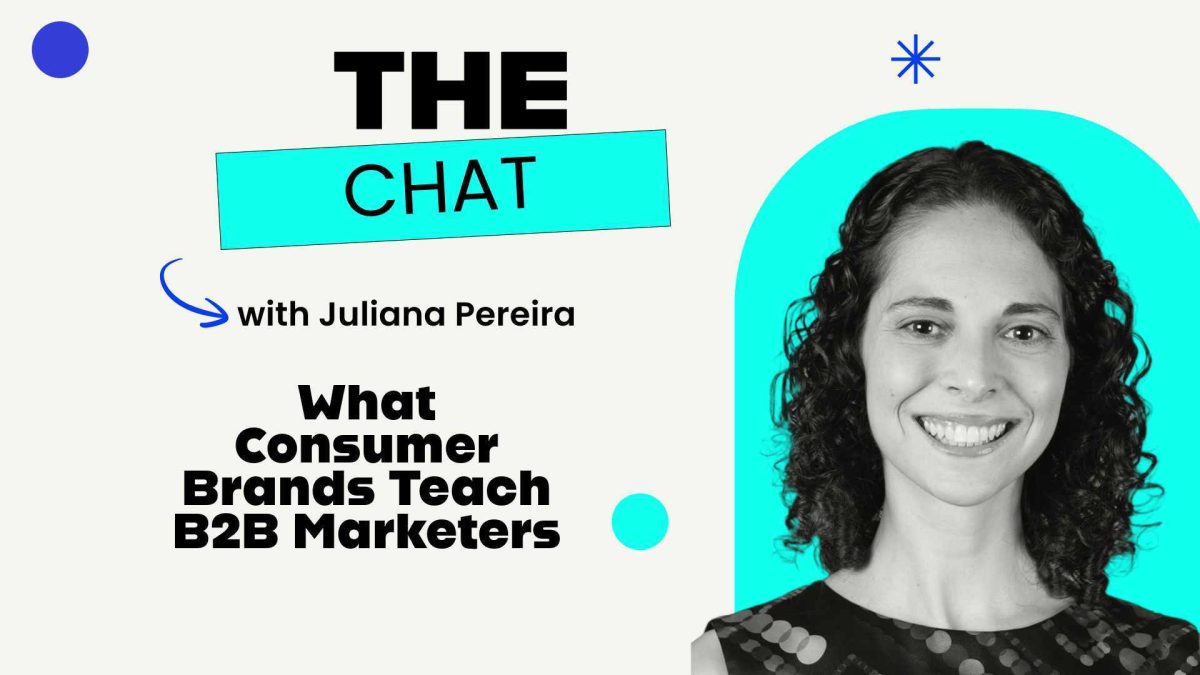
Breaking the B2B Marketing Myth with Juliana Pereira
Guest: Juliana Pereira – B2C growth marketer turned B2B RevOps and demand gen strategist.
Host: Terry Wilson – Co-founder at Chat Metrics, Host of The Chat
Episode Overview:
B2B marketing is full of broken playbooks – from MQL obsession to attribution confusion. In this episode, Juliana Pereira shares how her experience in high-speed, data-driven B2C environments helped her rethink B2B from the ground up.
She breaks down why sales and marketing need to run as one team, how to replace vanity metrics with real buying signals, and why everything – yes, everything – should be account-based.
If you’re tired of “fluffy” marketing talk and want real strategies that drive pipeline, this one’s for you.
What You’ll Learn:
Key Quotes:
“Attribution without scale is just guessing.”
“MQLs are a performance metric, not a business metric.”
“If they’re in your ICP and the meeting happened – that’s success.”
“Your drop-offs are telling you where the next revenue stream might come from.”
Episode Chapters:
0:00 – Intro & Juliana’s shift from B2C to B2B
5:32 – Why B2B marketers need to think like DTC
13:20 – The attribution problem no one talks about
20:45 – Replacing MQLs with meetings that matter
32:10 – ABM without the buzzwords: what real alignment looks like
41:33 – What chat drop-offs and form bounces are trying to tell you
50:12 – How to spot pipeline opportunities hiding in plain sight
1:00:00 – Closing thoughts + what to rethink in your funnel today
Resources & Links:
Leave Us a Review
Enjoyed the episode? Drop a quick rating and review on Apple or Spotify – it helps more B2B pros discover The Chat.
00:00- Speaker:
Welcome to the chat. come behind the inbound scenes of some of the world’s fastest growing companies for the past 10 years. As chat metrics. We’ve had an exclusive inside view of how these industry leaders are revolutionizing inbound marketing and sales. Across diverse sectors. Each week, we bring you conversations with top minds in marketing and sales who share insider secrets and strategies for driving inbound success.
Join us on the chat, your front row seat to the future of inbound.
00:49- Terry:
Welcome back to the chat. Today, I’m thrilled to have a very special guest, Juliana Pereira, a powerhouse in growth marketing and revenue operations. Juliana has built a stellar career leading marketing efforts, optimizing revenue systems, and scaling businesses with data driven precision.
She’s worked with some of the most innovative teams in the industry, not to mention a shift from a business to customer to business to business. And today we’re going to unpack her expertise in demand generation, rev ops, and the future of B2B growth strategies. Juliana, welcome to the chat. I’m excited to have you here.
01:25- Juliana:
Hi, thanks so much for having me, Terry. It’s a pleasure to be here.
01:29- Terry:
So I’d really like to jump straight in. Your background, your expertise really started in B2C. In, in e commerce type businesses and, and consumer brands, and you’ve shifted to B2B.
I’m fascinated to learn about what you’ve seen now with your B2C insights, what you’ve been able to bring to B2B, what the differences are, and what B2B can learn, but what, what made the shift in the first place? Why, why did you move?
01:59- Juliana:
That’s a great, a great question. So, yes, I did start my career in e commerce, mostly, and retail, but yes, very B2C driven, um, and Throughout my career, I was in the beginning mainly managing e commerce or B2C revenue channels at companies where maybe that wasn’t the primary focus, but it was a really important revenue channel.
So, I was embedded within a larger ecosystem of not just marketing but also business. Um, and so I think that that already kind of helped broaden my thinking, kind of having access to a lot of different departments and working with a lot of different people in different functions. And very cross functionally.
Also, before I jumped over to B2B SaaS, like on the tech side and services side, I actually had a little stop in between. Um, I worked at a fashion company, and a Ralph Lauren, and I was there, and I was actually working in B2B marketing. Team. And so that was kind of, even though it was a B2C brand, I was on a B2B team where I was working with their wholesale partners, um, to sell the Ralph Lauren product.
So it was a little bit of a shift over already. And I, I didn’t think about that at the time, but now when I look back at my career, I think, Oh, that was kind of interesting that I started making that shift already on the B2C, um, type business side of the house, but actually I was very lucky to make the jump to B2B.
I was hired into SaaS, uh, company, translation management, um, and translation services company. And the VP there had made a similar shift from a consumer brand over to, uh, B2B SaaS. And so when he met me, he said, that I I made this jump and I think that you’re, you’re smart and you’re sharp and you’ll be able to do it too.
And so he kind of took a chance on me, which I was very excited about, but he asked me the same questions. Like, how do you think B2C tactics can, uh, translate into B2B? And I said, well, you know, the way I see it working on e commerce sites and. Direct to consumer, you know, the funnel is a mile wide and an inch deep, but in b2b sass, it’s an inch wide and a mile deep.
Right? And so, how are you kind of inverting those tactics? So I found that in e commerce, um, in that b2c side, it’s so transactional that you’re getting so much data so quickly. Because people are buying things, you’re seeing the activity on your site immediately, so you can shift gears very quickly and you can test things faster.
Um, on B to B, it’s a little bit different because you have this whole handoff between marketing sales and, um, and all these people kind of involved to really pull those businesses to the finish line for these larger deals. So, you know, there’s a lot of thought around how do we apply some of those tactics and marketing strategies to be more transactional and accelerate those Um, and there’s some, some different ways to do that, but mostly a lot of it is testing and thinking about, you know, how can we, how can we make it more transactional?
Right? And that’s kind of the ultimate goal to accelerate that. So you can turn a nine month sales cycle into a. Three month or one month sales cycle.
05:14- Terry:
And, and Chris Walker often talks about this problem with attribution and trying to find, you know, where is the starting point and last touch often is can be quite deadly in the basis that last touch might be an inbound SDR when it was actually, you know, through social circles and brand awareness is where the, the, you know, the lead, the prospect potentially really generated from.
What’s your perspective on that?
05:44- Juliana: Yeah. It’s, it’s really hard and B2B, but we were already struggling with that on the B2C side, there was a lot of double counting because you would have someone who would search for a red sweater online, click on an ad, but then they would, you know, click on some other, they would read, I don’t know, travel magazine and they’d see the sweater featured in there and then they click on that.
And, you know, so you would. Get that double counting a bit as well. But again, you’d see the data very quickly. And so, and you’d get a lot of it. So you could kind of build out attribution models faster to some degree. But when you’re scaling at a at a B2B company where you don’t have quite as many leads or activity happening in that way, cause it’s longer sales cycle, it is really challenging.
So I’m actually working with a company right now that is that that’s exactly the big question is how do we keep marketing and sales from having. Friction where then, you know, does sales get the credit? Does marketing get the credit? And so my ethos on that is that it shouldn’t matter. Marketing and sales are, it should actually be one team.
Um, and with the same numbers, MQLs matter, but to be honest, that to me is more of a performance metric than it is like a very firm KPI. That the leadership team needs to be looking at every week, the ones that matter more to me, um, at a leadership level or at a, at a more senior level is meetings and the pipeline generated the number of opportunities, how many qualified meetings are happening because of qualified meetings are happening.
That means a salesperson said this is worth having the meeting and then the opportunity obviously we know that means that this is a viable Uh potential client right and then of course closed deals once it gets further down the funnel So in that sense, I promise i’m getting to the point but the uh Yeah.
And so, so with that, it helps alleviate a lot of the challenges because then you’re not fighting between marketing and sales saying that the lead originated with me, what you’re doing is now looking at the meetings that happen and look back and say, okay, so this might have originated on. PPC ad, but because the SDR followed up when they looked at the website and saw that that contact came through the site or whatever, they followed up, they were able to bring that person actually to take the meeting.
You know, um, the person might’ve just come to the site and poked around. They didn’t fill out a form, but then the SDR is following up with people from that company. They get in touch with them and they get them on a meeting. Like marketing should obviously that’s the lead sources marketing, but the sales team should.
Absolutely get credit for that, too. And so you have to have like, you have to have the. The reporting around lead source where they first find out about you and then all the different campaigns or activities that influence that now building out attribution models is challenging. If you don’t have, if you’re not operating at scale, then you don’t have enough data to really make assumptions and then, or to be able to make data driven decisions on how you’re going to build the attribution model.
And you’re kind of just guessing. Um, And so that’s why, like, you know, you have to reach a certain scale to really build out a meaningful attribution model in my, in my
No, so if you can’t, the aim of attribution is to determine what’s working and what’s not working. From a marketing perspective, where are you going to shift your investment to? You need scale for attribution to work; you need to have a a, a large enough chunk of data to actually look at that and say, okay, this is viable information.
09:16- Terry:
What if you didn’t have that? What if you were with a startup that didn’t have that volume of inbound leads? To be able to, to look, come in and look at it. Where would you start? What, what would be the place that you would start at?
09:29- Juliana:
Yeah, so I mean, I build it out the lead sources in in a few buckets. So you have the, the unpaid lead sources, the paid lead sources, the prospecting lead sources. Um, and then usually there’s like referrals and then a partner one, like channel partners and whatnot. Um, and referrals are typically, you know, anything from like investor referrals, employee referrals, customer referrals, like anything in your ecosystem that’s, that’s sending someone over to you.
So I break those down. Like I have categories in a way that I break that down. Um, And yeah, I mean, it’s about tracking all of those activities. So I, I do track every single activity that influences the lead, right? Or the deal. The challenge is you don’t want to just look at the first touch or the last touch.
You need to see all those pieces in the middle, but the challenge is saying, Oh, well, 20 percent of this. Should go to social media for whatever reason, or 30 percent to this. It’s like, I don’t break out those pieces. Um, but what I do look at that point is balancing, uh, volume from the different, uh, campaigns.
So I break out all the campaigns and activities and look at how many, uh, How many opportunities they influenced? Uh, so then there you can start making more directional decisions saying, Wow, this is really interesting. We have our highest value, uh, opportunities, let’s say, uh, are coming from channel A. Uh, and maybe there’s only three or four of them that were influenced by channel A, but we’re seeing that channel C, we have almost Every opportunity is influenced by those, um, but they’re all the smaller deals, you know, like several of the smaller deals.
So then you kind of think about like, okay, so what’s the cac on that? Like, let’s start, like, let’s start making, building out some models, right? And calculating that. So maybe the ones that were impacting the bigger deals were events. That makes sense because you’re meeting people there depending on the event.
You might be talking to someone who’s, you know, very visible or whatnot, like bigger clients you’re meeting there. So that makes sense. Um, and so then you can easily find out which events are working and which aren’t. That’s pretty quick and dirty. Um, but for the smaller deals, you can start digging in to see inbounds, like which ones are organic search, which ones are paid.
How is that playing together? Are there leads that are influenced by both? Like where someone is searching, multiple people in the company are searching in both channels. So they’re kind of playing nicely together and what that looks like. So, you know, I, not to get too granular. But you have to kind of dig into those performance metrics for each of those channels and just think really critically, looking at the size of the deal, the number of deals, the pipeline, um, and what’s dropping out of the pipeline.
I love to see what drops out of my pipeline because if it’s like all this great channel is generating a ton of opportunities, but none of them turn into, like,e into customers and. You know, we’re going to have to rethink that strategy. Something’s happening, something’s going on there that’s a little bizarre, you know, so I hope that answered the
12:28- Terry:
Uh, a hundred percent. And, and look, I think from the, your earlier comment about, You know, MQL is okay, but you’re really looking at the S, SQL or sales accepted lead. You mean that’s a, that’s in my mind when we talk about the engine, which is what this is. It’s a factory.
It’s just like any other factory. You’re starting with nothing. You’re creating awareness, getting attention, interest, bring it through into the sales funnel where you’re trying to get it to a point that make a decision and fall out the other end as a customer. Fall’s probably not the right word, but on the conveyor belt, they, they end up
13:00- Juliana:
On the conveyor belt.
13:02- Terry:
But the, the challenge for B2B, and I’ve seen that even with our own clients, is that Because the sales cycle can be so long, from first touch to closed deal, that it’s almost like marketers have this sense of, well, we don’t really know until the deals are closed, you know, what’s necessarily working all the way through.
So it tends to be so slow and cumbersome. Yeah, our B2C customers move at lightning speed compared to it. What I hear you’re saying is that you’re looking further up the funnel where you can get a better sense. You know, if it’s an SQL, you’ve got an idea roughly that, well, certainly, you know, there are potential customer, then there’s going to be something fall out potentially through the, whatever the sales conversion rate is, but that gives you an earlier indication, um, that you’ve got an outcome and not just taking the last touch point in consideration, but the entire process that they’ve, that those leads have come through to understand.
I mean, that seems to make sense to me.
13:57- Juliana:
it
13:57- Terry:
It’s looking at it as an engine or a, as a factory, as opposed to,
14:01- Juliana:
Absolutely. And the thing is. I keep forgetting if I’ve posted this on LinkedIn or not, but I wrote an article at some point and I think it’s sitting in my draft somewhere that pretty much says like all marketing is account based marketing. Like there is, there’s no other type of marketing. If you’re just kind of putting marketing out there, it doesn’t make sense.
Like you have to know exactly who you’re going after, at least in B2B. B2C might be different. You’re looking at bigger segments and larger swaths of audiences and stuff, but in B2B it has to be super targeted. after. So the way I see it, when I work with SDR teams and salespeople is, okay, let’s build out these account lists so that we can really tightly coordinate the marketing activities that are supporting the sales efforts and, and vice versa.
So that everything is just really in sync. Um, And then it’s like any meeting that an SDR, BDR, whatever you call them, you know, whatever you want to call them, AEs, anyone, any meeting that they generate that is with that right person at that right company and the right function, the right seniority, the whole thing.
Like, that to me is a highly qualified, like, that is a very strong indicator that that campaign or that channel got to the right
15:13- Terry:
So that that’s
15:14- Juliana:
So that, like, so
15:15- Terry:
That’s success for marketing, isn’t it? Yeah.
15:18- Juliana:
Exactly. And so that’s why it’s like, you can already see a lot with a meeting. That it doesn’t turn into an opportunity means that there isn’t banned.
And it means that marketing doesn’t know that sales doesn’t know that until they pay, right? That happens on the call. You can’t do anything about some of those things. So that, that’s why like the, as long as, and we would, uh, compensate SDRs this way, which is if you get them from this list, or if the company is not on the list for whatever reason, but it’s this size and has these.
This criteria and looks like these companies, that counts. Like even if it doesn’t turn into an opportunity that’s really meaningful. And so that guides a lot of the decisions on marketing and what to continue because then at that point it’s like, it’s a selling challenge. Now how can we get those people more interested?
That’s a different type of marketing. So now we can move into the sales acceleration portion of
16:08- Terry:
Absolutely. Absolutely. 100%. It’s one, you know, one of the challenges we have when we’re talking to organizations, um, you know, through our sales process is that that very point about, well, If your pay per lead, your incentive is to book more leads, then how do we know that it’s going to be quality leads moving through?
Well, my offset to that, well, my offset to that is, well, well, it’s no locking contract. So at any point in time, we have to have 100 percent focus on quality. And when you’ve got such a tight criteria around the SDRs saying, if they’re in this ICP, if they meet Or, or if they’re not in this list, they meet this ICP, and you can book a meeting, then, then that’s an outcome.
We operate on a very similar, so, as you were saying that, I’m sitting there nodding, thinking I absolutely get this 100%, this resonates. It’s the only way we operate with our clients; they have to give us that ICP, and our biggest job is disqualifying rather than qualifying. Well, most of our clients have got great website traffic coming in, and there’s a lot of visitors coming through. We’ll handle, I mean, we handle.
70 to 100 000 chats a month. What you do see in those conversations is that there are a lot of people that have questions to ask that may not be potential clients at all. Many times, it’s researching or, you know, it might be students or it’s somebody looking for a job. They’re, they’re the easy ones to disqualify.
17:31- Juliana:
That’s easy.
17:32- Terry:
The harder ones are the ones that want the product, they actually want the service. The organisation has their ICP and know that the, the, this person you’re chatting to is not of a scale where it’s actually commercially viable for the organisation. And you have those difficult conversations to say, look, you know, you really don’t fit.
As, uh, as we’re not going to be able to solve your problems for you because it doesn’t work for us from a commercial perspective. I mean, that, that’s not exactly what you say. There’s a whole host of, of,
18:01- Juliana:
No, of course, there’s a script but, but that’s really interesting data, too, because you start seeing that volume, then you can think, like, is there a product led motion? Like, kind of a freemium sort of, I mean depending on the product. I don’t know the clients you work with, but I’m assuming it’s really across the board and the spectrum.
And so that’s really interesting in that channel to then, and that’s what I love about marketing, um, which is you can uncover a lot of potential revenue channels that weren’t there that are kind of not quick wins necessarily, but could materially actually transform the business. By saying like, look, we’re seeing this kind of requests coming in.
Like, this is what people are actually looking for. This is informing how we’re seeing the market. Maybe there is a smaller segment. We don’t focus. on, but that we can find a way to service them. Um, and I did that at one of the companies I worked at where we were looking at, like, how do we do a more modularized service, you know, like, can we give just like one module of our whole SAS platform, or do we have to sell the whole thing?
Like maybe there is a play where it’s more of the land and expand or another company where they decided to do a more transactional, like how about we have something more like a freemium play? Um, so yeah, so that’s, that’s kind of marketing can help. Um, and then I’ll inform that too, which is
19:16- Terry:
We’ve, we’ve seen, and so we’re mainly in the B2B, um, tech space with, with SAS companies. And what we’ve seen is the, um, changing offer to adopt. And bring on those land and expand, but we’ve also seen the opposite where they’ve become firmer and what they’ve done is adjust their marketing because they’re attracting too many of those smaller clients or those non ICP clients.
And so that’s helped adjust marketing campaigns. On the flip side and the other, the other side, um, has been product. Product has been super interested in those conversations. Because they’ve been able to see requests for features and those sorts of things as well. So, I mean, and that’s all through marketing feedback, because effectively that’s where the live chat comes through, is from a marketing perspective.
Marketing’s been able to go
20:04- Juliana:
That’s right.
20:05- Terry:
What, we’re getting a lot of requests for these types of features. And so it’s, it’s um, it’s fascinating. Have you seen in that type of environment where you’ve had to shift marketing because there’s a larger quantity of non ICP inbound?
20:22- Juliana:
So we shifted our marketing or did
20:24- Terry:
Oh, change the, change the campaign or, no, no, change the campaign. So you, the product is, is set to what it is. Adjusting campaigns to get the right audience.
20:33- Juliana:
I’ll be honest, typically before launching a campaign, I’m, I’m pretty secure that I’ve talked to enough people or done enough testing or really checked that the messaging is going to resonate with that audience. Um, Yeah. But of course, you tweak, right? So, I mean, for example, you’re talking to an enterprise business.
You’re talking about, you know, maybe scaling globally or, you know, growing their operations, reducing their costs, things like that. Whereas with a smaller business, you, your messaging might be more like, you know, go up against the big guys. Like here’s how you can cut through the noise.
Here’s how you can be more competitive, you know, so that, like, naturally, you know, that like what the messaging is going to be depending on your product, um, assuming you’ve done that ICP work, right? Cause then the messaging comes on the heels, come off of that, right? But in terms of, I mean, there’s constantly testing.
Uh, I had that at, at flow commerce, uh, company. I was at really exciting growth. I was there for three and a half years. I was among the first executives on the funnel on the commercial side. And in three and a half years, we sold for half a billion dollars, starting at, you know, 1 million in ARR. When I arrived, we didn’t even have a marketing team, a couple of sales guys.
I mean, it was, it was really the wild west. But super, super exciting. And we had to make the shift and very deliberately from more kind of mid market, uh, to enterprise. And so that was, and it was. The messaging wasn’t even the hardest part. It was actually kind of the resourcing for it, which was like, okay, now we need, then we need to invest in better tools.
We need SDRs. We didn’t have SDRs. So we were like, well, if we’re going to do this, then we’ve got to have the engine, like the full engine. And, um, and so we, we brought in salespeople, we brought, you know, so we really kind of built out a more robust team. And I also, hiring on the marketing and product marketing side.
So I think that’s, you know, it’s, it’s a lot of it’s in the execution. Um, not to say that messaging isn’t important. It’s everything, but I think if you’ve got your ICP locked up and all of that, and you know who you’re going after, the messaging is going to be much easier. And the bigger issue is going to be the execution and what you need to do that effectively.
22:45- Terry:
and to that point, execution, one side of it is the sales process and getting to the end point where you close a deal. Did you find in that organisation that shifting from and moving into an enterprise that, that the, the ongoing management and support was a, was a higher cost? Was there a more, was there a higher demand from enterprise businesses?
23:09- Juliana:
For our product,
23:10- Terry:
uh, high demand for support and more immediacy like was there a cost of building like was it, was it different to serve those enterprise customers compared to the, the mid market where do you come from?
23:21- Juliana:
Oh, that’s very interesting because of the nature of that. If I understand the question correctly, the nature of that product was really enterprise. It was very complex. It touched on a number of areas in a very, um. A, a, yeah, a complex sort of ecosystem is cross border e commerce. And there’s a lot of things that go into that from duties and taxes to localizing the website checkout and, um, international shipping.
So there, there’s a lot of pieces to that. So when you’re working with smaller clients, you have to figure out a way, how to do all those complex things, but on a smaller scale. And so it could be, it ended up being the challenge. A lot of businesses have where they put a lot of time and effort. To get a smaller client up and running, but it’s, you know, is it worth.
The, the time and effort to do all that. Whereas with enterprise, you know, the deal size is much bigger. You can invest more into, you know, being able to plug and play into those big CMSs or the, you know, the big, um, e commerce platforms or whatever it might be, um, or even to do a custom build for the client cause they’re paying a lot more, so it’s worth it.
To put those resources into it. So that that was part of the reason that we really wanted to shift to enterprise was that we were realizing we were doing a lot of work for smaller clients where there were honestly. Small point solutions out there that could help them with what they needed. And I had, I actually did a lot of inbound.
I loved it. Taking inbound lead calls. Um, I love talking to those folks and there were so many I would speak to And I would even work the deals for a while, you know, depending on on the size of the company But I would tell them, you know Listen, i’m not going to say the name of the competitor because I never say a competitor on a on a call But I am going to say that I don’t think you’re ready yet for what we have, because it’s just not going to be worth the money or the investment for you.
And it’s going to be a hard implementation. Like I think you’re maybe start with a point solution, and then let’s talk in a year and see where you are. Cause if you’re scaling quickly, then that’ll totally make sense. So, you know, you kind of have to know when you’re going to fire a prospect or a client, you know what I mean?
Like it kind of goes both ways to some degree in SaaS.
25:32- Terry:
And so it sounds like that in that particular business you were already there. You already had the complexity to manage the enterprise businesses. It was, it was enterprise ready.
25:42- Juliana:
We did, we had some enterprise. Um, our co founders came and were successfully exited, had successfully exited other businesses in the past. And one of them was a major, uh, retail, uh, in the retail vertical. Um, and so he had connections at some big retailers and stuff. And so we already had some very good marquee clients there.
Um, but you know, that’s more of the friends of family. So it’s not that was pre demand generation, everything happening. So we, we were building for enterprise, but you gotta get more customers to get more funding. You know how it is. It’s always that cart before the horse. So yeah, we had to take some SMBs and
26:23- Terry:
Of course. What, The reason I asked that question, I actually had a conversation yesterday with a company, um, 30, 000 paying users, so they’re not small fish, um, but most of their customers are the small to lower mid size. They want to move into enterprise, but what they’re finding is that the move to the enterprise, they have to change their internal operations so much to actually support the high demand for support. enterprise businesses. And so that was what drove me to ask that question. There, um, they’ve tried it once, um, and really backed out of it because they found that the cost of building their inbound cap, their, their internal capability to support enterprise was outweighing that, the enterprise that they were bringing on.
So they’re, they’re in a really good place at the moment. They’re in a, they’re in a situation where a new CRO they’re bringing in, um, build, building out that enterprise team. Again, now they’ve learnt from the first round, the support that’s required internally. So they’ve built all of that in the background.
27:28- Juliana:
That’s, yeah.
27:29- Terry:
was what I think will allow them to quickly start to step in and grow their enterprise side of, um, the business.
27:36- Juliana:
Yeah. You have to start to look like the customer you want. You know how they say, like, dress for the job you want? It’s like, you have to start looking like the customer you want, like, in terms of your scale and how you’re operating. So that makes.
27:48- Terry:
Yeah, exactly, exactly. Since you’ve been involved in revenue operations, what’s some of the biggest shifts you’ve seen in the last couple of years? Hmm.
27:59- Juliana:
So revenue operations, I sort of managed it by accident and I love it. And so now I end up getting really deeply involved because it has to do with data, which frankly, is the only way you can prove that marketing is doing anything is using data and data is. It’s really challenging, especially because nowadays you can measure almost anything, right?
Um, there’s just so much data. And I think, you know, 30, 40 years ago, I don’t know, data was harder to come by. It was much more broad mass marketing. And so there was just, you know, there weren’t as many data points. Now it’s so granular, um, that it’s, it can be overwhelming because A lot of what you’re measuring, you might not actually need and what you’re actually looking at might not be telling, it might not actually uncover the right insights.
And so, so there’s, there’s a lot of challenges there, and Rev Ops is really sits at the middle of that for the whole funnel, but also through to customer success. So I see, you know, revenue operations should be a completely across the entire commercial organization, um, to be able to bring all those pieces together in an operational and of course, like financial.
In terms of, uh, you know, revenue sense. Um, and so I see. Really, there’s three functions within Rev Ops when I think about it at its core. And people can disagree with me on this, but I see it as a matter of technology. Um, I see it as a matter of process and data, right? And so those are to me, the three biggest areas that I typically with a Rev Ops person or someone that’s usually in sales ops, where I say.
Sorry, but I’m going to have to pull you over into marketing apps as well. And you’re going to start dealing with all of it. Um, those are kind of the three areas is what’s the tech stack doing? Like, what are we using? Are they playing nicely together? Do we need to consolidate? There’s a lot of tools out there.
People like to Frankenstein them together and then suddenly, you know, HubSpot builds this in it, so you might not need this tool anymore, or this one now has this and you don’t need, you know, so like, how do we consolidate that and be really efficient and smart about it? Um, Then, the process part, that’s the hardest part, because that’s the whole handoff we were talking about before, like, someone needs to hold the keys to the little lockbox where all the qualification criteria is locked up, where everyone can say, like, we know this is here, like, this is what an SQL is, this is what a MQL, whatever it is, like, Someone has to create guardrails around that and gating and be very, very like checking that and pulling reports on that.
Like, are these leads being worked? Are these not what happened? Like, what’s going on with this deal here? Like, why did this become a deal and not like really digging into those conversion rates and all that stuff. Um, But yeah, that a lot of that is process that plays into that, like making sure that those guardrails are around, like the way the teams work together.
And then, of course, like I mentioned before, the data, there’s so much data cleanup, like right now I’m working with a client. Um, where HubSpot, we’re not sure that the data is being captured, and I’m not sure what happens to certain leads when they come in. Um, and so, you know, so there’s constantly the sense of, you know, trying to figure out, like, where is that data?
And we’re having, and the reason why this got uncovered is because I asked for a very, what I thought was a very simple report. Um, I’m a fractional CMO there, so I said, okay, this is easy. I’m going to show this at the leadership team on Monday. Can you pull this report for me? We can pull some of that. And I said, okay, let’s have an hour meeting and dig into why you can only pull in some of that.
And then realizing like, okay, this is not set up. The database isn’t set up correctly. And the workflows to pull in the data to those spots aren’t. So to, to get to your question, I promise I’ll get there is with RevOps today. I think that it’s, you know, having that. Really delicate balance of those three things.
Like oftentimes, you don’t have one person that really understand. They might get it just for sales ops or marketing ops because those used to be separate functions, but now it has to be all of it. And they have to think horizontally and not just kind of vertically on their own tech stack, like how it’s layered now.
It’s like how it’s layered but across all these teams. And so. I find that Rev Ops people have to think so much more broadly that way, um, in terms of the full business and not just on like one piece of it. Um, so like in terms of the tech and the process same thing you’re looking across the funnel. It’s not just You know, passing from one team to the next, there’s a lot more kind of interaction going in between the teams before a lead gets to where it needs to get to or a deal closes.
And, and data cleanup has gotten more complex. Um, I think that there’s a lot of AI that is going to support, I mean, every biggest buzzword on the planet right now, right? A lot of AI is going to help clean that up. I’m hoping that there will be more AI built into the tools people are already using that can clean that up and say, Hi, we see your data is a mess.
You know, it would be great knowing what you’re trying to do and seeing what you’re trying to build in your workflows is if you just like, let us do it for you. Like, wouldn’t it be great if you had that in your CRM, right? And maybe there’s a tool out there and I don’t know it, in which case, please get in touch with me because that would be.
So fantastic. So I think that there’s a lot of AI that’s going to be able to support the data side and the process side as well. And, um, but having someone to really understand those mechanics is so key in the.
33:14- Terry:
So there’s a product idea for anybody. Build an AI tool that allows you to build a lucid chart workflow, upload it into AI, into the tool, and it goes through and builds everything out for you.
33:25- Juliana:
Yeah. Exactly. Like, I just want to have a conversation with it for like 20 minutes, explain exactly what I want, and then plug them into the database and say, make this happen, you know, and that’s
33:38- Terry:
You know, one thing that strikes me, I think there’s one word that you’ve used so much through the conversation so far, and it’s complex. And the complexity in today’s B2B marketplace is mind blowing. I know for ourselves, I mean, we don’t get into anywhere near that level of detail. Um, for us it’s a much simpler play.
I see our clients and I see the multitude of different channels that they’ve got to deal with to start with. Then you lay across that the multitude of different technologies, um, stacks they’ve got to deal with, technology applications. You layer into that the variation in vendors now, everything from, you know, the days are gone of, of ringing a newspaper salesperson to do it, to send an ad, you know, I mean, that’s, that’s all gone.
With the digital landscape we’re operating in, you know, you’ve got huge media buying organizations and media platforms that then start to place it. I just wonder how anyone can truly. Put attribution even to a simple advertising campaign, placing of ads in front of people on web, we see that there’s the, the early last year, I think it was a controversy of, of say Forbes magazine that had a total fake separate website that the Forbes magazine was running all of the ads to.
That they were driving, that the ads weren’t even appearing in the, in the normal, um, the normal website. So it’s like ad fraud, the complexity, the platforms. Now there’s even, as you’ve mentioned, Rev Ops, Rev Ops, I know that terminology has been around for a little while, but it’s still relatively new, the concept of bringing it.
35:22- Juliana:
it’s relatively new.
35:23- Terry:
Um, you know, CROs, um, Chief Revenue Officers, as opposed to CMOs and, and, and VP sales that you’re moving into now, this whole, um, um, Go to market roles that they’re starting to come to the fore. It’s um, the level,
35:38- Juliana:
Yeah, uh, chief growth officers, things like that, and go to chief, go to market. Yeah, I’ve
35:44- Terry:
what do you think it is that separates, in such a complex environment, what is it, What do you think it is that separates the best demand gen strategies from the rest?
Yeah,
35:56- Juliana:
Demand gen strategies from the rest? Oh, that’s a, that’s a really interesting question. Um, let me think about that for a second. Um, hmm, well, there’s definitely at this point, you know, I, I was talking about ABM before all marketing is ABM, but definitely the, there is this skew over to one on one sort of marketing one to few or one to one kind of, uh, marketing.
I mean, obviously, that’s really challenging. You can’t just go after one account, but the hyper personalization that goes into that is really important. Yeah. I’ll be honest, as a marketer, as I’m sure is the case for you, I get, especially now that I’m a consultant, a little less so, but when I was CMO or SVP of marketing, I get hit up by SDRs all the time.
I do read those emails if they have A few characteristics that are very meaningful to me. One super pithy just draws me in. They don’t talk about their cat or how they, like a friend of their bestie from high school went to college with me. I don’t, I don’t really care, but I saw one that had a screenshot of like my website and I can’t remember what they did, but they simulated like what their product would do on the site.
And I was like, Yeah, I, I gotta at least see what this is because this looks at least like there’s something and they, you know, and I’m sure that they have an automated way, maybe using AI, um, where they were, they do that, they go to people’s site, they generate, you know, they take a, an instance of it or whatever, and then generate some sort of image, like showing what their product is like, they probably have a pretty well baked way to do it.
But it was very personalized because it was my website, and so I knew exactly what they did just by seeing it. Um, so I think those, that’s, you know, those are some ways to kind of, like, really cut through the noises, figure out how can you make it feel as one on one as possible, but you can still operate at scale.
So there’s some different ways to do that. Um, definitely like the, uh, super engaging, like fun, um, like web, uh, either web apps or, you know, interactive content. Um, it’s really engaging. I started doing quizzes at one of my last jobs. Like the last few jobs I did, I would do quizzes and things like that. It’s a great way to gain data from your audience as well, because guess what?
Now, you have a blog post. Throw up a quiz where people answer a bunch of questions. And then, you know, not only lead gen, because they give you your email at the end to see their, you know, score or whatever it might be, but now you have a blog post where you can say, you know, blah, blah, blah, blah, blah. Um, so that’s, that’s a really interesting thing.
And people like to play around with things. I’d like to, I’d like to get a little bit more sassy on the websites. I work on having like more of those kinds of slider things where you can see different, um. I don’t know, like some, some cool different sort of thing, maybe I work in the translation localization industry, for example, or I have in the past, like what if you had content that was in English and then you just kind of have a slider that goes over and it’s in Spanish and then you do it again, it’s Arabic, I don’t know, like, Even if it doesn’t really serve a purpose of showing what exactly they do, it sort of gives you that simulation of like, Oh, they translate, they know how to deal with languages on a website, so I want to call them so they translate my website, you know, for my French market or whatever.
So I don’t know, like, I’m just making this up, I don’t know if it’s a good idea, I’d have to sit and think about it, but things like that that get people to stay on the site, I think that’s the big thing. How do you get people to stay on the site these days, right?
39:28- Terry:
Yep.
39:29- Juliana:
So,
39:29- Terry:
Look, I’m the same, I think, if, if, to get my attention, so frustratingly I had the opposite experience this morning. Um, when I wake up, one of the first things I do, we run a 24 7 business. I go through quickly, check the Slack channels, check the emails to make sure that there’s no disasters happened overnight.
Not disasters, but anything that I need to, um, get involved with. Um, there very rarely is, but that’s just the way I operate. I like to be on top of things. This morning, um, it was almost like the first five, uh, emails in my inbox were just absolute spam. It was an email about them, um, you know, and, and I’m really, I’m so, I’m very frustrated with it because by now we should all know better.
We should all know better. We do email outbound. It’s very personalized, very, well, it’s very relevant. I won’t say it’s personalized. We don’t talk about high schools and, and football teams, et cetera. Um, but it’s very relevant to their role, to their position, to the organization name. We try and make it as time, timely as possible.
And about them, not about us. And when I see the absolute opposite to that come into my inbox, I get so frustrated. I’m, I’m desperately don’t want to hit the spam button because I don’t really want to do that to anybody. I don’t want people to do that to us. So, you know, a karma. Um, but the last couple this morning actually was so bad that I replied and said spam.
Like this is literally spam. Stop doing this. Um, it was terrible. I’ve seen some amazing examples as well. One of the things that we and we made some terrible mistakes early on with our outbound. Um, particularly with the email. Um, We found that with our ICP, pointing out things that they were doing wrong was not such a good idea.
What we started to do was point out things that their competitors were doing wrong and right. And that got a much better response.
41:25- Juliana:
Oh, that’s smart. Yeah. That’s right. That’s right. Yeah, you don’t want to call their baby ugly.
41:30- Terry:
Exactly right. That’s exactly right. But from a demand gen, I think it’s different depending on the product and the audience and, and, you know, um, the medium that you’re using.
What are your thoughts on social media? I mean, B2B probably, in saying that, you can just hear me say LinkedIn. Um, what’s your thoughts on social media?
41:53- Juliana:
Yeah, I mean, it needs to serve a purpose, and it needs to be aligned with the goals of the brand across the board. You know, I mean, you’re a B2B SaaS brand, like what? The first thing I would ask is like, What are you doing on Instagram if you are on Instagram? I know that seems fun But okay if you’re using it because you have like your culture is that selling point and like, wow, you guys go bowling every Thursday night, and you go on vacations together, and you do fine.
Okay, cool. You’re a really tight knit team It makes sense that you’re on Instagram and you’re all following each other having a good time because that speaks a lot to the culture But I don’t really it’s not one of those things like you shouldn’t be on every channel And I think there’s a sense of like, well, people are hanging out in these places.
I have to go there. And it’s like, but it might not be appropriate or make any sense. And also if you’re not going to update those channels, if you don’t have someone to do that, then like, you know, you can’t just have them sitting there with the last post being like last November or like two years ago in January.
Um, and I’ve seen that before. I’ve inherited things like that, where I look at it, I was told you have to. Twitter feed. I’m like, no one’s going to, who’s going to update it. Like, I’m going to update it once a month. It’s two, or I guess X, like you can’t update X once a month. You know that you need someone who’s like really understands the strategy there.
So I think that brands do need to think about what’s. It’s the best for them. There are some B2B brands that play well on Facebook or Instagram, like they do have like kind of a fun thing, like, you know, fun things that they can do there, like especially B2B to C brands. Um, but I think that, you know, that’s easier because you’re kind of ultimately speaking to an end consumer.
So you can kind of play back something very, do something playful with that. Um, but. Yeah, I think for a lot of just pure B to B, that’s, that’s a bit harder to do. And also, is your audience really looking to be interested, like, learn about a B to B sass when they’re hanging out, like, at the end of the day, like, scrolling through their feed, looking at photos of their, like, the trip that they want to take or whatever.
Um, so that, that’s tricky. LinkedIn ads are great. You can really target and do all sorts of cool things there. Um, which is good, but they are expensive. So that’s a big challenge. Um, I really. I haven’t had as much time as maybe I, I should invest more time into this as really thinking about like, how can you boost organic growth more on LinkedIn?
Um, to really kind of, cause then that helps obviously with the visibility and that I think is, it’s obviously more cost effective, especially as the LinkedIn ads get more expensive over time. I did see some different types of ads that, um, they were in beta, I believe a couple of years ago or a year ago, and I haven’t seen many since.
But it was one where essentially it was someone, it was a boosted post, as I found out later, it was actually sponsored, where they talked about their experience about, like, kind of what they learned in the product, like it was something that felt so organic, um. And it was really just kind of about, I’ll have to find my notes on this, but it was really great.
I read it, and I was like, this is great. Like what a good post, like it got a ton of likes, a ton of followers. And so there are some innovative things there, uh, that can be done, but it just has to be really smart and, and thought out and stuff. Otherwise, it’s just. It’s not a huge ROI driver in the organic side unless you have a bajillion followers, and on the paid side, it’s expensive and really fast for small brands.
So, so yeah, there’s definitely something that there’s got to be a Key to unlock a little like more value out of that somewhere, you know.
45:31- Terry:
I always challenge, um, challenge I really don’t like social media. I’m not active on anywhere other than, you know, I was in LinkedIn a couple of years ago. I’ve started again in November. And we’ve got some good leads come through LinkedIn, uh, since I’ve been active again on, on, uh, in November, which is great.
But it’s one of those things I find it quite cumbersome. Um, you know, we’re in a very, very tight niche, it’s a very specific thing that we do, there’s specific problems that we solve, you know, you try and post regularly, it almost feels like you’re saying the same thing over, you just gotta find different ways to say the same thing over and over again, you know, like, man, I don’t know whether really there’s, you know, I want to be delivering value, if I’m going to do a post, well I don’t, it’s not, it’s not just about selling what we do, it’s actually saying, hey, look, here’s a lesson here, this is one thing we saw, we found, you know, you should do the same thing, um, but I’ve sort of struggled
46:21- Juliana:
Those videos, oh,h sorry, those video posts I’ve been seeing like a lot of friends of mine, especially in sales, they do those shorter video posts and everything. Those are engaging, and those are really interesting because the thing is now with social media, you can’t just get everyone in your company to like the post, it actually cares more if you share it and comments.
Comments are really big. So it’s also kind of like, how do you galvanize the team to then be like, guys, don’t just like the post. You need to go on LinkedIn, share it, but then also put a comment and tag your friend, like get other people to comment on it, you know? And so we we have to figure out ways to make the content more engaging that way.
So it feels natural for people to do that. But that, that’s really the strongest indicator now is more of the commenting..
47:08- Terry:
And shareable. Is it shareable? Is it interesting enough that somebody would want to share, share with their friends or peers or colleagues? Yeah. Yeah, true. So then what are you experiencing from an organic and advertising perspective? There’s been a lot of News lately about what happened with HubSpot and there’s also been a lot of speculation about what happened with HubSpot’s blog How they have lost a massive amount of traffic search engines, you know, Google in particular changing algorithms all the time Have you noticed anything or had any impact in in the last 12 months with the organizations you’re working with?
47:44- Juliana:
Yeah, that’s interesting. Um, not quite so much, but it seems so far I’ve seen. Uh, actually, I was just looking at the Google Analytics of a client a short while ago. Um, it seemed more cyclical. Uh, so it wasn’t it didn’t seem like anything out of the ordinary. I haven’t really dug into it yet. I literally just got access today.
Um, and then before that, I haven’t been looking at a lot of the Google analytics of a lot of clients. I haven’t been in there quite as much. I’ve been looking more on the sort of CRM side. Um. So I, I haven’t seen huge impacts on companies, but you know, it really kind of depends on how they’re, they’re set up.
Right. Cause like, Google is constantly changing their algorithms because of like the way people are searching and, and whatnot. And so it’s like, if your website isn’t, is really built. Like five years ago, like if it still has that same structure and you’re still building the same type of content you did five, 10 years ago, then, you know, obviously that you’re going to get really hit by that.
Yeah. Have you been seeing that with your clients or.
48:48- Terry: No, I haven’t actually. And that’s why I asked the question. It’d be, it was very interesting. We, we have the same cyclical nature. We have some clients that spike through the holiday period. We have others that are quieter through the holiday
48:59- Juliana:
Yeah, exactly.
49:00- Terry:
but it’s, it, the, the cycle hasn’t, doesn’t really seem to have changed over the last three years or so.
So I was, um, but there’s been a, uh, you know, We mentioned AI again, you’re talking about the increase or impact, bigger impact on AI on the Google searches and that there’s a lot less, a lot less actual landscape or organic landscape on the home, on the front page of Google these days. Um, there’s AI suggestions coming up there, but yeah, I’m not seeing a huge, huge impact in, in traffic across, across our clients.
Um, So, to that end, we talked about, you know, organic and advertising and, and LinkedIn or socials. Yeah. How do you balance long term, um, brand building efforts with, you know, the short term pipeline goals?
49:54- Juliana:
Oof. Yeah, that’s always a tricky one because you have to, it’s always like the, do you execute tactically or wait until you have a fully baked strategy? And it’s always, it always feels like when you’re at a smaller company or, you know, fast growing company that you’re sort of like building the car while you’re driving it.
Um, which is a bit terrifying. So, it’s, you know, and that, I don’t know. So I, I definitely pair a parallel path thing. So when I arrive at a company, I pretty much have the two paths. One is I’m taking the first two or three weeks to figure out the strategy, put something together. Like we need some sort of path forward.
Usually at that point for a marketer, when you’re getting into a full time job, at least you’ve probably done some sort of marketing presentation that is likely going to be. 60 percent of your strategy when you walk into the role. So you already got some of that work done. Um, as a consultant, I usually start with a strategy, you know, that’ll, that’ll kind of be the first thing before I kind of get into either a more fractional role or, or sort of deeper work.
But either way, if I’m coming in and it’s like, you have all of this to do and balance those two things. So the way I do that is I really, really focus. Razor sharp on the low hanging fruit and just the biggest problems that would make the mo like the most material impact on the business if they’re fixed tomorrow.
Um, and so it’s like, okay, I am writing my strategy at night by candlelight, but then during the day it’s just like, okay, this stuff needs to be in place now. ’cause this is just, or just turn this on. Like sometimes there’ve been things like I saw where I was like. Why isn’t the nurture running? I don’t know.
I mean, it’s set up in HubSpot. Oh, I guess it is. Like, let’s put it out there. Let’s upload the list and lets start nurturing our leads you know, like sometimes it’s things that are that simple. Sometimes it’s not, but you know, it’s really that triage. At the end of the day, you’re really triaging the low hanging fruit. Lowest effort, highest impact, and like, and chipping away at all the high impact ones, like, in that order as you’re, as you’re doing that.
And then with the strategy, making sure that as you’re already kind of buttoning it up, you’re already thinking about those campaigns you need to launch. Like, we know there are going to be campaigns. There are people in the business, hopefully, unless you’re the first person there. You’re being hired in, there’s some events.
that you already, they’ve already invested in that you know you are going to. Gee, then that’s probably the campaign you should probably be structuring if you’re going to a, I don’t know, FinTech event because that’s one of your target verticals. You probably need a campaign to support that with some other channels around.
52:27- Terry:
maximize your ROI on those existing events. Yeah, yeah, yeah.
52:31- Juliana:
Exactly.
It’s like you’re going there, okay, you guys spent 20, 000 on a booth. I guess like, this is, this is clearly an important vertical. So there’s a lot of kind of obvious things that people will miss because they’ll try and reinvent the wheel, but you don’t have time for that. reinvent the wheel when you got the time and you have the people in place.
But so that’s how I, I don’t know if that answers the question, but it’s really kind of the triage on the low hanging fruit with the highest impact and really being razor focused on that, being like, that is what I’m fixing this week are these three things. And they were just. Getting done, um, with the strategy happening alongside of it, but just and then being mindful of the strategy if you’ve already got certain events or and not just a physical event, but other events that you’ve already invested in and that the team is doing, like, why not just align the rest like your first campaigns around that?
Like, no reason to be focusing on all these other verticals and overworking yourself, right? Because the execution is like, the devils are in the details for execution. So, um,
53:26- Terry:
And that is that the, is that the type of organization that you’re usually involved with that there’s, there is already a, a, a marketing play in place.
53:36- Juliana:
Oh, no, not necessarily. Um, one of the last companies I was at, they hadn’t even launched at a stealth mode. So I walked in, they had a designer, but they didn’t have like a proper marketer. Um, so that, that was interesting because I had seven weeks to Design the brand, the visual identity, all the messaging and positioning, write the website and get it all stood up and out in the press and everything in those seven weeks.
So it was a really, really fast project. Um, so yeah, that was pretty clear. Like there wasn’t really a marketing strategy behind that. It was like, we have to hit the state and get this up. So that was a very obvious. Um, but because I had like, that was the short term triage. I had to during that time start planning for what happens after that, you know, like what’s the, what’s the strategy through the end of the year.
Um, and so that, you know, so it was the same thing was happening there. Uh, flow commerce, I mentioned before we had a great exit. There was really no marketing in place. I arrived, they had put up a couple of pages on the website, nothing real. They had an agency they were working with that just literally launched the blog the week before I arrived.
Um, they said, we got excited. We wanted to get it up before you got here. I was like, Okay, well, I guess that’s fine, but sure you could have waited a week, but that’s all good. Um, and so, yeah, you know, at that point, um, in those cases, you’d be surprised there’s. There’s less to fix, like, there’s less stuff that’s broken if it hasn’t been put in place yet.
But there’s a lot of stuff that you need to do to kind of lay the foundation to be like, Oh, we, again, a data problem, for example. We have to make sure that this is happening so that then I can segment my list to be able to then do X, Y, and Z. So, you know, it’s like Usually it happens that either if there is a marketing team or there is no marketing team, like, it’s all the same.
You’re going to find like, that the pattern is similar and in the plan of attack.
55:28- Terry:
I’m curious, what was it that made, was there a catalyst or an event where you shifted from full time to fractional and you started to help multiple organisations as opposed to one at a time?
55:42- Juliana:
Yeah, I mean, the exit was three years ago now, and I’ll be honest, it was one of those days I wanted to stay forever. I was so happy there. We were a family. I mean, I also arrived really early, post Series A, super small team. Um, and there’s a group of us, a core, from the beginning that were and still are very close.
Um, and so, you know, it was a really fun time when you sort of feel like you’re building it with you know, a little group of friends or family kind of thing. And after that, I went out and sort of tried to find the next, the next big thing, like kind of do the same thing again, join a post series A company.
Um, and I, I don’t know, I, I didn’t quite I looked around, I worked at a couple of places and they were great experiences, but it wasn’t, it wasn’t quite what I was looking for. And so I didn’t know, is it the right vertical for me or is it the size of the company? And so I decided to take a step back cause I never actually did after the acquisition.
I just kind of jumped in. I was like, Oh, I’ll go work at this company. It looks kind of cool. And I was like, Oh, I’m not sure if that’s quite right on both. sides and then another company and, uh, where I launched them out of stealth. And I love that. And it was good, but then it was a very different kind of market.
Things changed. And so I was thinking, well, maybe this is not quite, quite it. Um, and so now I, I took a few months to really think about what I wanted to do. And I explored everything. You’d be surprised, like the types of companies I was talking to and colleagues and stuff. Um, And when it came down to it, I really realized I kind of like being a, like a Mary Poppins.
I like coming in and putting things in place and building. I, I call myself a builder and an architect, like an architect and a builder. So I like to architect and get those things there. It’s not that I don’t like to grow and farm and nurture. It’s just that I’m stronger in the kind of crisis mode. The, okay, we, how do we get this off the ground?
Or I come in and fix things that are broken. Or it’s just like, okay, we kind of have to scrap it. Start from scratch or we’ve got a like. You know build it back up. Um, so so that’s kind of where I thrive and because of that I felt You know consulting could be really good because then I can come in and do these types of engagements Um and focus on those areas and then help them bring in that cmo that can Or the VP of marketing that can do that growth piece there.
Like now they’ve got, I can hand them the keys and they’re like, okay, I got it from here. Sort of thing. Um, I think that they are different skill sets and I found that the parts of my job as a head of marketing full time that I really enjoyed was the building and the architecting
58:14- Terry:
Mm hmm.
58:15- Juliana:
sort of nurturing and growing was a bit less.
It wasn’t as exciting to me. It was just kind of like, oh, I’m used to this. This is fun. I like my team. I like the people I work with. But it wasn’t, somehow, it didn’t drive me quite as hard. Um, or as much. Yeah.
58:30- Terry:
It really brings a question to my mind that I think that, you know, that architect and that building side, there’s so many skills and capability that’s required there. And a very different type of skill set than the nurturing and ongoing management. I wonder, you know, with AI and automation changing the game, how do you, how do you see the role of that, you know, nurturing marketer, the, the, in, in business marketer evolving over the next three to five years?
59:03- Juliana:
specifically for the more farmer? Like the nurture one? Wow, I think that they are going to benefit enormously. I think they already are. Um, the more AI tools, like especially imagine being someone who walks into a role and you already have all these AI tools talking to each other, like, that’s amazing.
You’ve got a lot of, you know, yeah, there’s a lot you can do with that. Um, I think for them, it’s. definitely there’s going to be some different challenges for sure. I think that, you know, the structure of marketing teams is going to change, not because like AI is going to replace people, but people are going to need to have different skill sets, obviously to deal with AI and understand how AI works, like a deeper understanding.
I think marketers are going to become super like the, if. they’re good marketers, they’re going to be super experts at understanding the ins and outs of AI, I think, as a function. Um, and so I, I’m really interested to see how that evolves in, in marketing. But yeah, I mean, they’re going to benefit enormously from that, like having systems that talk to each other better and learn and together, and that can play nicely and play better continuously together to be able to nurture that and help with cost savings, like all the stuff that happens to a marketer after they’ve been around for a while and they’re growing.
It’s like, okay, now we’re cutting your budget in half. You have to do the same thing you did last year, but with less budget. It’s like, okay, that’s actually more possible with AI tools at your disposal. Right. Um, so yeah, I think that’ll be, yeah, there’s going to be a lot of interesting things there to
01:00:33- Terry:
I, look, I, I, I agree with you. I think that, look, there will be some marketers that if you don’t adopt, you’ll die. I mean, it’ll be the ones that, you know, you really are, there’s going to be a time of change. That’s for sure. And, and, you know, as they say, it’s the adaptable in the species that survive. And I think that’s very much case for, for marketers and marketing teams moving forward.
And the same with the next levels underneath the marketing leadership team, I can see a lot more being able to be done with a lot less. And so. There’ll probably be, as you’ve said, less, um, There’ll be a much more reliance on AI skill sets and people understanding the ins and outs of AI and how to leverage that because I think, you know, AI, you’re not talking, I even know in our business, you’re not talking 1x, 2x, you’re talking 10x, 20x, you know, when it comes to AI and, and outputs and things that it can do for you, particularly around, I think, um, analysis and taking a step back to be able to look at a huge data set and then start to draw some conclusions and take you down paths.
I mean, that, that for me is probably one fascinations I have. Um, that our clients are starting to use across massive, um, you know, volumes of chat, chat transcripts instead of a person having to, you know, are you these are the conversations I’m having now? He’s he’s the real insights that are coming. The top 10 questions that are being asked.
Maybe we need to adjust our website. You know, um, he’s the top.
01:01:58- Juliana:
right. But for a marketer to understand how the AI is responding to that and looking at that data to then be able to adjust their query. To be even smarter and pull like kind of even more out of that, you know, like an understanding how it’s trained or how it’s learning, you know, that, those things like, yeah, that’ll be so important.
I think marketers will pick up on it quickly. Like in general, marketers are good with like new tools. They tend to be early adopters, especially online. Yeah.
01:02:28- Terry:
Look, are there any emerging tools or platforms that you’re excited about right now? Anything that you’ve seen?
01:02:35- Juliana:
Ooh. Oh man. You’re asking me a question. I just, I got off a call with a digital agency a short while ago and I’m. Blanking on the name, but they were telling me about this new digital platform that is really cool. Um, uh, I’m trying to see if I can find it, but I have it open on one of my millions of tabs here, but because we’re, we’re looking to hire this agency to help us with digital media at one of the companies I’m consulting for, um, paid media.
Which was the whole conversation of like, how do we make social better? How do we make this work? Like, you know, ads, they’re exhausting. Like what can we do in paid media? And so apparently like this, this tool he was saying that, you know, they had been using had been showing really strong results and the types of ads that they were showing.
So I was, I was starting to dig into that before this call. So I apologize. I don’t remember the name, but that is an area that I am looking for tools in is like, how do you make paid media better, like better bang for your buck, more cost effective, like just. Get people to respond to it. Like, is it dead? Is it going to be dead?
Like, is PPC going to matter? I mean, especially with the AI bot at the top, you know, the, you know, the AI descriptions and everything. Those are actually very useful. Um, so yeah. Uh, so looking for tools in that area is really interesting. Yeah,
01:03:56- Terry:
It’s brilliant so much. I think that, um, one of the things that I do with these podcasts is break them down into snippets. And there’s so much of what you’re saying that my mind’s starting to spin and going, Wow, these are just going to be amazing little snippets. There’ll be, I’ll share them all.
I’ll share them all with you. We produce them out of the, um, the platform. So you can, if you want to use them in your own socials or whatever, that’d be, um, uh, yeah,
01:04:17- Juliana:
Oh, that’d be great.
01:04:18- Terry:
Uh, the, uh, and so in fact, um, getting back onto it. So we were talking about tools for AI. One of the tools that, um, one of the greatest AI tools that I use is actually the platform that we use for this podcast.
I mention it nearly every podcast because it’s used, it generally comes up. Squadcast is now owned by Descript. And I use Descript. It automatically loads from this recording up into Descript. And Descript allows you to edit the podcast. It uses AI to take out things like spaces and ums and ahs and so forth.
It uses AI to go through and break snippets out of the podcast so I can say give me 50 snippets of key moments and it will go through, you know, 1 minute long, 30 seconds long, 2 minutes long, you designate all of that and it does it automatically for you. But the really fascinating thing I like I’ve never really enjoyed, um, and I, uh, I’m at the stage now with this, um, podcast.
We’ve, um, uh, launched our 10th episode, published our 10th episode. We’ve got another six or so in the can. I’m almost getting to the stage where I’m ready to hand it over, but I do everything post ourselves at the moment. I’m one of those people that likes to fully understand the process before I hand it over to somebody else so I know what’s involved in the job.
And with Descript, you’re actually able to edit In the transcript itself. You don’t need to go down into the, you know, the bars underneath the timeline. You can change words, and it’ll AI word, voice your changeover and all that sort of stuff. It’s um, it’s quite fascinating, so. It’s a pretty, um, uh, it’s probably So literally it takes me 30 minutes post production on a podcast.
01:06:06- Juliana:
Oh wow. Oh, that’s
01:06:07- Terry:
That’s right. Then that’s why I’m at a stage where it’s like, okay, I’m enjoying it. I’m the one that’s had the conversation. I know the interesting parts. Do I really want to hand this over to somebody else at this stage? So, um, I will in the next couple of weeks, but at this stage, yeah, I’m at that, uh, it’s such a small effort after the recording that it’s just, it seems to make sense just to finish it and it’s all done, so.
01:06:28- Juliana:
Yeah. Oh, that’s fantastic. Yeah. I mean, things like that. I mean, it’s all about process and efficiency, right? Not all about that only, but I mean, that’s a huge saving of time and cost and, and all those good things. And that’s the thing, like being able to produce more with less is, is really the goal with tech at the end of the day.
So, um, yeah, that’s
01:06:48- Terry:
you think that you would start again in a full time role if there was a, if there was another one, another, um, opportunity like an early stage, um, or, or, or at whatever stage it is, but it’s something that looks like you could jump into and then, and then grow with, would you do it for, what circumstance would you do?
Would you do it with a view to an exit or would you do it to somewhere to sit in with for a little while or?
01:07:15- Juliana:
I would only do it if it was kind of similar to my experience at Flow, like, let’s, let’s do this. Let’s, I want to do it again. I want to do it bigger this time, maybe, um, or kind of a similar thing because it was, and I don’t know, maybe I’m just kind of chasing the past or something, you know, one of those people that just lives in the past.
Um, but it was, it was really exciting and it never, it never felt. Stayed or dull because we were constantly shifting. It was like, okay, now we’re shifting to enterprise. Okay. Now we’re going after this competitor, you know, and their, and their clients are now we’re going to kind of take a different approach to, you know, whatever this is, or like the type of offering we had, um, we were building out like a partnership area, like really important partnership relationships.
That required a lot of marketing support. I had full access to all the clients. And so I had a lot of clients I was talking to. So I was doing some really interesting things there with them. You know, so I had a lot of opportunity to get into a lot of areas, which is why I like being at earlier stage. The challenge is, is finding those early stage companies that has what it takes to get there, because it’s, it doesn’t matter what your marketer or your CEO or just one person can do.
It’s really about the whole team, right? So if you don’t have, and that’s really hard, you can’t predict that. And, and also market conditions can shift. I mean, there, there’s so many things that could happen, which is why such a small percent of companies post series actually make it past that. Right. Um, so I would want actually one of the The the reasons I like consulting for now because I just started like just four months ago So i’m still pretty new to this which is fun.
I’ve had several clients. Um, and it’s it’s been super interesting I kind of like the idea of dating before you get married, you know Where like maybe i’ll find a company like that and we’ll see Start with something where, you know, honestly, I’ve already talked to a couple of companies, I’m just doing projects, there’s nothing about full time jobs or anything, but it’s like, we don’t, we can’t get a marketing person.
We have an assistant on the team, you know, they’re really hungry. They want to learn marketing, but they can’t put together a strategy. We need someone to just kind of tell us what to do. And then we’ll, we’ll. We’ll put that person to work, and they’ll execute. Yeah, and then, you know, if that goes well in the future, stay on as an advisor, and then if it turns into like, look, we’re about to get our Series A, and we want to bring you in, like, if I, if I’m having a good time, absolutely, I’d consider going back full time.
That would be great. Um, but I want to be really Like I, I want to be really smart about it and I want to make sure at this point when you’re in a senior level, it’s so much about fit at this point. You’re not just going into a job to learn a skill set and the company is not just hiring you to like grow a future leader.
Like you are going in because it’s like a marriage. Like you are all in, they are all in and it’s got to work and you just don’t know until you’re in the position. If it doesn’t work out, you’ll find out pretty quickly, but it’s always, it’s just kind of frustrating, you know, it’s frustrating on both sides.
So, um. And there’s a lot of turnover, as you know, in sales and marketing as it is, like people tend to move around a lot, and it is tiring, so I don’t want to continue doing that, I want to be somewhere and stay, so, you know, hopefully I’ll find a client that, you know, we kind of fall in love, and have that whole rom-com happy ending, and, and it’ll work out, right?
01:10:30- Terry:
good. I love that approach. I think it’s great. That dating before you get married. And look, it’s a, it’s a really good way to do it because you do get to feel it from the inside. If you’re going through that process to find an organization to work, you know, if it’s a normal recruitment process, I know at executive level, it is a quite an extended process, but still until you’re actually in there, even at an executive with the extended process, you never really know.
Uh, and, and from, And from both sides, the, the organization never really knows whether you’re going to be a good fit until you’re
01:10:59- Juliana:
Never know.
01:10:59- Terry:
Yeah, yeah, so it’s good, it’s good that you’re able to get in and get that experience. Look, you’ve worked with some amazing teams and some amazing brands. Um, what’s one leadership lesson that’s stuck with you throughout your career?
Uh, yeah,
01:11:18- Juliana:
lesson. Um, wow. That’s, I’m trying to think back. I had such a great team at flow, and I’m trying to think like, what made it work so well or what did I do right? Or maybe it was just them. They were so fantastic. They didn’t even need me. Um, Leadership lesson, you know, I actually on that, that topic of, um, you know, fit and everything.
I actually I had a boss at one of the companies I was at, and she’s still a close friend. She’s so fantastic. Um, and we had the type of incredibly mature conversation where We sat down, like it was one day we were like, can we go for coffee? And we sat down and it was like, look, I don’t think I’m right for this role.
And she was like, I want you to be, but I feel like you need to do things that you might not like that you’re not as interested in. And I don’t know. And I need that performance to be like that, but you you’re better in this area here, but there isn’t a role in that area. And I was like. completely agree.
And it was a fantastic parting. We’re still close friends so that we celebrate our birthdays together because they’re three days apart. Um, and it was just so mature because we both saw it. So she was like, Look, let’s do three months. You’ve got things that you’re managing and people you’re managing.
Let’s keep that. But here are like three big projects I just need buttoned up and like just, and then let’s, you know, and in that time you’ll kind of, we’ll, we’ll make sure, you know, we’ll part paths and it’ll look all very much like an organic, natural thing, you know? And it was, and it was great. It was perfect.
Um, and it worked out so well. And I never thought of that before as a type A personality, which I think a lot of leaders are. You think like. I can make this work. Like, I’m going to make this work. Like, of course I can, I can do this job. It’s, of course, you know, it doesn’t matter if I’m not, don’t have the skill set or if it’s not, doesn’t come naturally to me.
I can do this. And sometimes you forget, like, relationships are 50 50. And that was what she said at the end of the day. She was like, you know, you got to meet, like, we have to meet halfway, you know, and it’s hard when it’s, it’s not. You know, we, we can’t come together. You know, it’s, it’s just, it’s both of us.
It’s not just you. A relationship is never one side, right? So, so that was a really big leadership lesson. And so whenever I do part paths with an employee, I always think about that where it’s like, keep in mind, it’s not about you being a bad employee. It’s just about this place not being right for you as well.
You know, like it’s a fit thing. So, you know, um, And that’s really important because it’s, it’s a better message, but it’s also true. If you were, you know, if you were perfect for them, you would have helped them learn that job. You would have helped them be successful, you know, and grow into it or inspire them to, you know, so I, and I think employers sometimes forget that, I think.
Um, and so I think that’s important for that empathy and compassion piece.
01:14:06- Terry:
I absolutely love that. I love that. I think that that’s probably, I mean, look, I’ve been in the unfortunate situation in my prior corporate career of managing, uh, integration, acquisitions and integrations, which inevitably means downsizing. You know, when there’s two businesses come together, generally there’s a, uh, you’ve got to, you’ve Get the synergies of the acquisition that’s been signed off by the board.
And that usually means cost, cost reductions are part of that. And you know, I, I was actually in a conversation earlier today. Um, we were talking about the, the challenge and struggle of actually exiting people from a business. And I think, you know, I’ve had the, I’ve had the un unpleasant, um, experience of doing that over 1500 times and like one-on-one conversations and it’s really been. What you’ve just described is the, almost the epitome of how I’ve approached things and I think it, it’s, it’s a, I’ve never really thought to that level as either, but it really is a case, it’s not you as an individual, it’s not you that’s caused this, you know, it’s not, it’s the, it’s the, it’s the circumstances that have arrived at this particular point in time, um, and I’ve found that in many of the cases, the conversations we’ve had, I mean, it’s always difficult, but You know, many of those conversations have actually have turned out to be some relief, um, because they weren’t necessarily happy there anyway.
I mean, there’s a reason you end up on the bottom of lists like that. You know, there’s a level of performance that’s not there that should be. Yeah,
01:15:38- Juliana:
director was like, Oh God, this is kind of a relief. Cause like, I was just trying to make it work and I was never gonna have the guts to say that like, I felt like it wasn’t working, you know? And then I was like, oh, thank God. Okay. Cause like, you know, this is, it’s not, it’s always harder on the person who’s exiting, obviously, but it’s always, you know, you, you want to make sure as an employer that they understand that it’s not.
Like, you know, they’re not being sent away from the party. It’s like, you know, it’s just time for us to part paths, you know? So, it’s, yeah. That, that, I’m sorry you’ve had to do that so many
01:16:15- Terry:
Look, the good, the good side of it is that I’ve always been lucky enough or strategic enough to be in organizations with very high integrity, so that when those conversations took place, the exit process was very formalized, it was extended, it was, um, you know, there was an enormous level of empathy there, there was time frames and remuneration, et cetera, et cetera, and, and outplacement programs and all of those sort of things that go along with it.
So it’s not just a, you know, Cut and dry, you’re out the door, see you later type thing, so, you know, I guess there was that, that one on the downside, but, um, Nevertheless, I mean, you know, those difficult conversations, whether it’s an exit from a business or even performance management, you know, sometimes when someone’s not doing the right thing and you need to adjust their behavior, they’re, they’re the, the conversations where, you know, it’s around outcomes, not necessarily who they are as individuals, as long as their heart’s in the right place, yeah.
01:17:04- Juliana:
Exactly. Exactly. And compassion at the end of the day. Like, these are people.
01:17:08- Terry:
exactly,
01:17:09- Juliana:
so, it’s like,
01:17:10- Terry:
If you could go back and give, um, your younger self, and let’s put a time frame on this, let’s say late teens, early twenties, if you could give yourself one piece of advice, what would it be?
01:17:26- Juliana:
One piece of advice, if I could go back in time. Well, I’d love to say like, you’re going to be just fine. Don’t stress so much. Um, but yeah, I mean, there is something about like, you know, when you’re, when you’re young and you’re trying, you’re like, what’s going to happen to me in the future, where am I going to end up?
I mean, I, I studied art history and I ended up in marketing for tech. I mean, I, I never would have imagined that I would own my own LLC. That was never something I expected to do. So, you know, I think sort of telling, maybe telling myself and reassuring myself back then, like things are not going to happen the way you plan.
So it’s okay. It’s great to have a plan, but just be ready for everything to change. And that’s. Totally fine. And that’s part of the growth is just be okay with that. Um, I’m very much a planner. I think that’s what makes like a good marketer is being very organized and planning. Um, and so just all these twists and turns in my career, it would have been.
You know, there was a lot of, you know, wow, what am I doing? What is going on? Like, am I right? Like, should I be here? Should I go somewhere else? Like, how did I end up here? So I think it’s just the kind of like, just go with it. A lot of change is going to happen and just, you know, embrace it and move forward because you’re going to be just fine.
01:18:40- Terry:
And is that the mindset you operate,
01:18:42- Juliana:
have told
01:18:42- Terry:
Is that the mindset you operate with now? Yeah,
01:18:48- Juliana:
I mean, I made a huge shift from full time work, so, I mean, at this point, I think I’m becoming, like, immune to, to, you know, all this, the madness of change where every day, you know, I tell my friends, just like, Oh, this happened today. Of course, you know, because, like, what’s going to happen tomorrow?
I have no idea. Like, do I have a client in two months? I don’t know yet, because I’m still figuring that out, you know, like, there’s so much uncertainty that. Like I kind of have to just embrace that at this point. I don’t have a choice to You know plan too much around it because otherwise i’m never gonna
01:19:20- Terry:
yeah.
01:19:20- Juliana:
So
01:19:22- Terry:
Yeah, very good. Is there anything that you’d like to talk about that I haven’t asked about at this stage?
01:19:30- Juliana:
Oh, um I can’t think of anything else we talked about we touched on so much I mean, I always love to learn from people like what demand gen like really high performing Like targeted programs, people are running because it’s like, I have my playbook, which I mean, I don’t like to say that because it makes it sound like very rigid, but I have a lot of these thoughts and ideas and things, but I know there’s just blind spots.
And that’s 1 of the things that is a little challenging as like a sole marketer, both in house past companies, but then also as a consultant is that you don’t have as much of that, like working with the marketer and being like, oh, that’s a good idea. Oh. Wow. I have, I wouldn’t have thought of that, you know?
And so it’s like, you know, I’d be curious to hear from you, how you get your information or stay kind of hooked in with other marketers to continue being innovative.
01:20:25- Terry:
Excellent, excellent question. We, we, a little bit about our business, so we really don’t do any marketing. We, we have, we have done zero marketing virtually up until about November last year. And when I, when I say marketing, I mean in terms of doing anything out there that’s going to create some sort of demand.
Our approach has been cold calling and cold emailing. That’s virtually how we’ve grown the business. We’re bootstrapped, we don’t have any investment, we’re all totally self funded, and our focus has been on, let’s do the things that generate sales immediately. Now, we’ve been doing it, doing it for 10 years now, and in hindsight, I wish if I’d have told myself something 10 years ago, it would be, start marketing straight away.
01:21:07- Juliana:
Yeah.
01:21:08- Terry:
Maybe we’d be in a situation where there’s inbound demand and traffic by now, but, um, look, it’s probably not fair to say we never did. We dabbled around with SEO and a few other things, and my business partner’s got expertise in those areas, but because of what we do, the keywords that we operate in, very expensive and highly, um, searched, but not necessarily, you know, it’s not staff live chat.
Everyone’s looking for live chat software and chatbots, not the staffing component. So we’re very, very niche in what we do.
and so, from our perspective, When I say marketing, we kicked off in November, um, started recording a podcast, which is this, and we’ve, you know, 10 episodes published now this week.
Um, I’ve become more active on LinkedIn, and in fact, since Christmas, virtually posting four, five, six times a week on LinkedIn. Um, up until, uh, Christmas, they got us some good leads. I haven’t had any since then, but it’s only sort of just into, uh, into February. Um, You know, we don’t really haven’t really gone through that whole.
Okay. Let’s put a strategy together the brand the messaging and all that sort of thing You know, we’ve sort of learned on the run from the cold calls and the emails that we’ve been doing So one thing I have done is started to join a few marketing communities. So Um, the marketing, and I think probably the one that’s um, the one that’s standing out for me the most at the moment is one that’s run by Dave Gerhart and it’s called, um, Exit 5.
Um, I’m actually finding,
01:22:35- Juliana:
hmm. Okay. I’m not familiar with that
01:22:37- Terry:
some stuff in there and I’ve asked for, asked some questions and, you know, the insights and, and, and helpfulness of that community is just amazing. You know, I posted, I put our website up there and said, look, you know, we’ve just revised this, you know, can I get some feedback?
And it was like, I think I’ve got 20 responses and, you know, everyone was almost concurring and saying, I agree with that, do this as well, do this as well. So we’re going through a big whole. You know, website rebuild in the back end now, in the background and I’ll put through look and say, here’s our staging copy, taking all your feedback into consideration.
Where do we go from there? So it’s like it’s, um, I found that to be super, super useful. I’ve only been in it probably about eight weeks now. Um, but yeah, met some good people and got some, got some great advice. So I think, you know, this whole, yeah.
01:23:21- Juliana:
That’s great. Yeah.
01:23:23- Terry:
and, and peer, peer communities, uh, where I’m finding that you can get some good insights and, and, and stuff today.
Look, I’ve got to say, having come
01:23:30- Juliana:
I’m still trying to, oh, sorry.
01:23:32- Terry:
Having conversations like this, I’ve, I’ve learned so much on the podcast. You know, we’ve, we’ve interviewed some CMOs and some fractional people and sales leaders. It’s, you know, it’s been the insights that have been, uh, uh, on there have been incredible as well.
So it’s, um, yeah, it’s, it’s, I think that for me, it’s, it’s really rubbing shoulders with people that are doing that type of work has made the biggest difference and that’s what’s changed probably since November. Yeah,
01:23:59- Juliana:
Uh, you know, one of the things I’m hoping to find at some point, like I have my AI newsletters and I have like kind of general industry news, newsletters or things like that, but I’m kind of like hoping at some point I can find like that. Yeah. Really smart curated like marketer like b2b marketer kind of newsletter I’m sure it’s out there where it’s like a section that says like the new tools you need to try here’s like, you know code to get a free three month whatever or free month like here and like Be like, here’s kind of the biggest trends like from this person or here’s the three podcasts.
You need to listen to this specific one It’s like i’m not going to listen to this podcast every week I got a million things to do but if there’s like a specific one that you’re like if you’re interested in this type of thing Like I don’t know i’m sure they’re out there those newsletters. It’s just I haven’t found the right one yet And so i’m on like the hunt for that one that I can read every morning really quickly, you know, so Yeah Um, Otherwise, it’s just kind of like this, like conversations casually with people, or at work someone mentions, Oh, we’re using this tool at this company, and I’m like, Oh, I haven’t heard of that tool, let me check it out, that seems interesting, you know, so, yeah.
01:25:09- Terry:
I would love to, um, the tool you mentioned earlier about the, um, the AI tool for advertising.
01:25:18- Juliana:
Yeah, I don’t know that it’s AI powered necessarily, that. that’s kind of what I’m hoping I’ll find in the future, I’ll, I’ll let you know, I’ll look. For the name of the company, but I know that they are doing something different in paid media. Um, and that it’s just like a different approach. I just can’t remember what it was like.
I apologize. I have to
01:25:38- Terry:
Yeah, no, that’s
01:25:38- Juliana:
Um, but I’ll, I’ll let you know what, what the name of that company was. I’ll send
01:25:42- Terry:
That’d be great. That’d be great. Now, I guess, look, the big question is, um, where can our listeners follow your work or connect with you, get in touch with you?
01:25:53- Juliana:
Yeah, so I’m on LinkedIn.
01:25:55- Terry:
We’ll put the links on
01:25:56- Juliana:
Probably the best way.
01:25:57- Terry:
Oh, great. So yeah, that’s, that’s the best place to follow me. I’m not as active on Instagram anymore, but I do love Instagram as well.
01:26:04- Juliana:
And it’s the same username.
01:26:06- Terry:
Okay. Very good, Well, we’ll put all those links on underneath there. And look, I’ve got to say, thank you. It’s been a sensational conversation. I’ve really enjoyed it. Is there anything else you wanted to talk about or any other questions you had for me?
01:26:20- Juliana:
No, no, this has been great. I really appreciate the conversation and great questions as well. Really had got me thinking there. So that was great. I really enjoyed it.
01:26:30- Terry:
you, thank you. Well, Julianna Pereira, thank you very much for coming on the chat and uh, we’ll speak to you again soon.
01:26:36- Juliana:
Thank you so much, Terry. It’s good to see you.
2026 © All rights reserved Chat Metrics
Made with ❤ in Melbourne, Australia


