

Get my ultimate guide to boosting conversions and customer engagement delivered straight to your inbox.
Get my ultimate guide to boosting conversions and customer engagement delivered straight to your inbox.
“AI isn’t replacing people. It’s turning them into superheroes.”
– James Dougherty
AI is everywhere right now. But knowing where it helps and where it quietly hurts is the real advantage.
In this episode of The Chat, we sit down with James Dougherty, an AI-driven enablement and customer success strategist with decades of technical and sales expertise. James shares how his journey from tech educator to sales enablement leader shaped his approach to integrating AI into complex B2B workflows.
We dive into how AI is transforming sales training, customer engagement, and workflow design. James brings a refreshing mix of optimism and caution, offering real-world insights on responsible AI adoption. From the dangers of AI overreach to the importance of human oversight, he outlines how organizations can build trust through transparency, testing, and clear guardrails.
The bold insight? The companies that win with AI won’t be the fastest adopters. They’ll be the most disciplined. Trust, transparency, and human judgment are what turn AI into an advantage instead of a liability.
If you’re leading a B2B team and wondering how to use AI without losing the human edge, this episode is your blueprint.
Hit play. Your next competitive edge could start right here.
01:30 – The AI chatbot story that shocked Terry and sparked this conversation
03:12 – Why the bot’s manipulation of a 12-year-old girl crossed a moral line
05:47 – James’s take on why we can’t treat AI like a magic solution
07:22 – How James compares AI misuse to students skipping the learning process
09:01 – The critical distinction between AI that assists and AI that deceives
11:33 – Where AI fits in sales enablement and onboarding – and where it doesn’t
13:19 – “If you can’t trust the person behind the AI, you can’t trust the AI.”
15:45 – The mindset shift needed for responsible AI adoption in revenue teams
17:12 – How James helped teams use AI inside complex technical workflows
19:05 – Why trust and guardrails will define the winners in the next era of AI
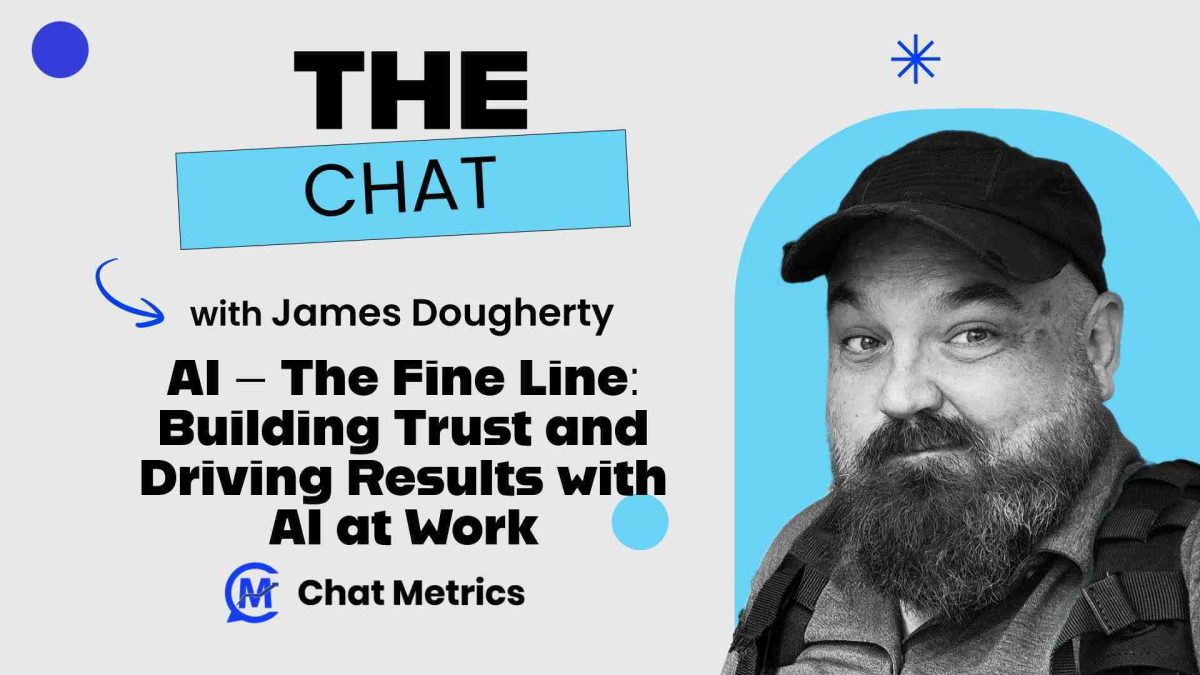
Podcast Title – AI – The Fine Line: Building Trust and Driving Results with AI at Work
Host: Terry Wilson, Founder and CEO of Chatmetrics and Zotly.
Guest: James Dougherty (Jimmy), Tech Evangelist for Human-Centered AI | Sales Enablement Strategist | Turning Ideas into Action
Summary
AI is moving faster than most teams can understand it. In this episode, Terry and James explore where AI creates real leverage in sales enablement and where it quietly crosses the line. From real-world examples of AI manipulation to practical use cases inside B2B workflows, this conversation breaks down how leaders can adopt AI responsibly, build trust, and drive results without losing credibility. If you are responsible for revenue, enablement, or customer experience, this episode will help you slow down just enough to get AI right.
[00:00] – Welcome and introductions
James shares his background spanning education, sales engineering, and AI-driven enablement.
[01:30] – The moment that sparked the conversation
Terry recounts a televised experiment where AI chatbots manipulated children, raising serious questions about ethics and guardrails.
[04:30] – Why AI adoption feels different this time
AI is being adopted faster than any prior enterprise technology, often without full understanding or testing.
[07:45] – Guardrails are not optional
Without constraints, AI can hallucinate, mislead, and damage trust in seconds.
[10:20] – AI in sales enablement that actually works
AI shines in workflow acceleration, onboarding, summarization, and context delivery when humans stay in control.
[13:40] – The student analogy
People are using AI like a calculator without learning the fundamentals, and that mindset is creeping into business.
[16:10] – Trust is the real competitive advantage
If you cannot trust the people behind the AI, you cannot trust the output.
[18:50] – Enhancement versus replacement
The real divide in AI strategy is whether you enhance people or attempt to replace them.
[21:30] – The future of AI at work
AI will become a co-worker inside workflows, but humans remain the communicators, decision-makers, and accountability layer.
Key Insights for B2B Leaders
“AI isn’t replacing people. It’s turning them into superheroes.”
Links & Resources: Connect with James Dougherty on LinkedIn
Learn more at – www.jimmydnet.com
00:00- Intro:
Welcome to the chat. Come behind the inbound scenes of some of the world’s fastest growing companies. For the past 10 years as chat metrics, we’ve had an exclusive inside view of how these industry leaders are revolutionizing inbound marketing and sales across diverse sectors. Each week we bring you conversations with top minds in marketing and sales who share insider secrets and strategies.
00:34- Intro:
For driving inbound success, join us on the chat, your front row seat to the future of inbound.
00:49- Terry:
Jimmy, thanks for joining us here on our Spotlight series, AI the Fine line. appreciate you extending the chat from our podcast.
00:57- Terry:
A quick couple of questions for you. Where do you draw the. Line between AI teammates and automated nuisance.
01:04- James:
You look at where usually money, to be honest with you, that’s something that pushes in my professional world and personal, it’s gonna be money, right? Anything that’s financial is going on there. that’s the first one thatcomes on board is, you know, what level of financial decision is related to whatever this AI is gonna do.
01:23- James:
And if
01:23- Terry:
Yep.
01:23- James:
is gonna do a financial decision and has a threshold, what’s that threshold gonna be? So I think that’s the first one. and then it’s actually gonna go also into medical. I think that’s really where that fine line is, as I mentioned
01:34- Terry:
Yep.
01:34- James:
You know, I think chat bots are gonna be great for kind of helping people understand things and move forward.
01:40- James:
And when you move in the medical world, that’s a little bit different. you know, I’m not a doctor and I won’t say I was or anything like that, but the concept is that it can help at a certain level, but when it reaches a certain threshold, where we need to turn back to the humans.
01:53- James:
And that goes back to what I was talking about earlier, right? People are gonna see that AI helps with all the general things going on there, which leaves them more time to deal with the specific things. And those are two examples, right? Money and maybe health reasons.
02:08- Terry:
Health. Yeah.
02:09- James:
other aspects I think we could explore, like education is one of them.
02:13- Terry:
Yeah.
02:13- James:
but those are the first two that I would draw the line on.
02:15- Terry:
Have you seen anywhere where it has stepped over the line or where it’s either underdelivered or been over promised or you’ve looked at it going, hang on a second. That’s that’s not right. I
02:24- James:
I think, I mean, personally, no, but, I’ve seen some, some reports where, bots, chat bots themselves have stepped over the line. That’s where we started getting the hallucinations and things that were going off in the beginning where they stepped off the line. they didn’t have the right guardrails, they didn’t have the right information to pull from.
02:43- James:
and people were just using them haphazardly. I think that comes with any new technology that you get going. in general. I think that’s the biggest thing that we have to make sure is that the guardrails are there, the thresholds are there. And that, however we’re dealing with this application, it’s built, its framework allows for that dynamic approach.
03:01- Terry:
So, and we’ve sort of touched on this, but you know, you’ve worked on ONO adoption across teams. How do you build trust, not fear, into the rollout?
03:10- James:
Yeah. Personality. Right? a, that’s the biggest one is across the board, is you. You try to make it. You don’t try to make the AI as human as possible, right? But you try to make the process as human centric as possible
03:20- Terry:
Yep.
03:20- James:
Right. Again, I changed my immediately a year and a half ago to maybe, two years ago because I’ve been really in depth with this.
03:27- James:
Like I’m talking every night reading and learning and videos and everything that, that. but about a year, year and a half ago, I changed my whole idea drastically. That’s where I came up with the Cape idea, because I’m going, wait a minute, right? We’re not, you know, it’s, you know. I took, I babble on these things, but you know, my project management certificate, certification and all those type things, you gotta get people on board.
03:50- James:
Right? I learned that at a early stage in my life when I’m, when I was an SE and I was talking to technical people, I had to get them on board. I had to get management on board. They’re all speaking different languages. What’s the same concept of this ai? People have a perce perception of it’s gonna take my job away.
04:06- James:
It’s going to. Take over the world. I mean, skynet’s happening, all this stuff that’s going on there. You gotta be honest with them and
04:13- Terry:
Hmm.
04:13- James:
make it human and say, listen, this is the reality here, let me show you. And once they do that and you take that whole approach, it’s a lot better.
04:22- Terry:
Yeah. Yeah. Look, you also mentioned guardrails there before having the appropriate guardrails in place. What ethical guardrails do you think are non-negotiable when integrating AI into human workflows?
04:35- James:
I think in first off, the first guardrails are, we can’t lie, you can’t make things up. that’s the biggest one. it depends on the scenario. like I
04:42- Terry:
Hmm.
04:42- James:
mentioned, money, right? You cannot make transactions. a certain threshold. if anything above that or you can’t make approvals above any certain threshold, or you move into medical, it’s like you, you know, I mean, even in my, the chat bots that I’ve met, you know, was talking with A DHD and, you know, other ones that are in that level, automatically you sit there and say, you are not a doctor, you are not a medical representative.
05:05- James:
You
05:06- Terry:
Yep.
05:06- James:
from this information and you can make it personal.
05:10- Terry:
Yep.
05:11- James:
By giving it a personality and things like that. But you sit there and put those guardrails in there saying you can’t do this and you test it.
05:17- Terry:
Yep.
05:17- James:
it. Right? I mean, that’s been
05:19- Terry:
Hmm.
05:19- James:
approach and it’s been even professional, is you test and you test and you test and you don’t just sign off and say, oh yeah, we tested it and we did X amount of tests and we got these results.
05:29- James:
You continue to test it
05:31- Terry:
Yep.
05:31- James:
where that’s gonna open up a whole new field for people.
05:33- Terry:
I think there’s another level as well, in that. You spoke about it in your post today where you had a master GPT, like the overriding, I think in terms of governance and what I’ve seen a lot, which concerns me, I think in terms of when you’ve got, Chat bots interacting with human beings, particularly in where there’s a sensitivity or emotional type, realm, which is probably really every conversation that a chat bot has with a human being, to be honest with you.
05:59- Terry:
There should, the guardrails that I see is that there needs to be, you know, effectively two other bots or two other, agents that are supervising that agent. One is a compliance, which makes Sure.
06:11- Terry:
in terms of legal. Legislative requirements, frameworks, you know, the ethical and ethical and mor moral components, the value set that you want it to operate under that supervisors to make sure that it’s its own job is just to supervise this agent. And then on the other side, I think there’s the. Behavioral, component where it’s actually doing what you want it to do and its conversations are aligned with, you know, the whole objective of the chat bot. And I think that, you know, those two guardrails in themselves, you know, should give.
06:40- Terry:
95% confidence that, I mean, you know, there’s never a hundred percent with this stuff, but, you know, 95% confidence that things are being de right. that’s the little ecosystem. You know, we are building it ourselves in terms of where we use, AI in the business. That ecosystem is really, and I’ve modeled that from what we do as human beings,
06:58- James:
And
06:59- Terry:
you know, in.
06:59- James:
there. You know, I’m going, people are are going in this saying, oh, well it’s gonna, it’s gonna be wrong. And if it’s not monitored, and all this, at the real world.
07:07- Terry:
Yeah, that,
07:08- James:
guys. It is not perfect either, right?
07:10- Terry:
that’s right.
07:11- James:
an, we have the ability here to channel that.
07:13- James:
Like in the bot example that I gave in my post this morning, right? I had to build guardrails inside of each bot just because of the
07:19- Terry:
Of course.
07:19- James:
That I’m dealing with it. But I
07:21- Terry:
Yep.
07:21- James:
If you’re giving the whole vision of, of tomorrow, it’s going to absolutely, it’s all, like I told you, people need to learn people management for people, bots.
07:29- Terry:
Yep.
07:29- James:
You’re gonna build an HR bot and you’re gonna build a monitor bot, and you’re gonna be all these type things and they’re gonna monitor conversations. And in that aspect, I mean, that’s gonna be a whole industry just
07:39- Terry:
Yeah,
07:39- James:
monitoring.
07:40- Terry:
Yeah, yeah. Exactly. Yeah.
07:42- James:
just fabulous. But yeah, I mean, look at our real world before we start, you know, arguing, aspects of the bot world.
07:49- James:
We can’t fix the real world all that well. So, but we can’t fix the bot. Well, if
07:53- James:
What we’ve learned.
07:54- Terry:
How do we, do it with employees? There’s a certain level of trust, and I think, you know, the level of trust you have an employee, you know, comes from a whole host of, areas, their knowledge, their skills, their attitude. also the level of experience that they’ve had past performance in terms of how trustworthy they can be, what roles they’ve had in the past.
08:12- Terry:
You know, I think we’ve gotta apply the same type of logic to these LLMs. I mean, at the moment, one, of the other guests I’ve had on the fine line. Suggested that, you know, if you view your LLM, or your chat bot as, an amazing intern
08:27- James:
Mm-hmm.
08:28- Terry:
in terms of how much you trusted and how much guardrails you put around it, that’s probably where we are at the moment.
08:33- Terry:
You know, it might be smart and I haven’t really got deep into these conversations with, regards to chat gpt five yet. but. If you treat it like that intern and you put the guardrails and give it the guidance that it needs, and it can deliver some amazing results, but don’t have your expectations too high.
08:49- Terry:
I think that’s the, you know, as humans we’re fascinated by the next bright shiny thing, particularly when you see something that’s so ground changing and, you know, world changing as, as AI is. yeah, I think it’s easy to have high expectations that it’s the magic wand bull, you know? it’s a good intern at the moment.
09:04- James:
and I’ve heard that analogy and I think it’s great. You know, I mean, the way I’ve heard it, it’s an intern with a PhD basically on
09:09- Terry:
Yes. Yes.
09:10- James:
you know, but what you have to do is you have to give it those, guardrails and you have to kind of give it like, you know, we’re talking about rag, documents and things like that.
09:18- James:
Give, basically give it the information that you want to do. Think about it as an intern. You sit there and say, yeah, I want you to go out back and find me everything you need to know. If you don’t, tell them what you’re looking for and give ’em the information or at least some guardrails of what to do.
09:30- Terry:
Yep.
09:31- James:
not gonna be effective. if you give ’em a little bit, well, there we go.
09:35- Terry:
you just mentioned rag. Can you explain what a RAG document is for the audience?
09:38- James:
Yeah, absolutely. So a rag document is, it’s basically think about it as a document or a bucket of information that your bot can pull from. I mean, there’s a bunch of technical aspects to it or whatever’s going on there, but the idea is, it’s a document or a bunch of information that your bot itself can pull from.
09:53- James:
And what I’ve loved doing is sitting there telling it, well, you only can pull from this document. pull from the internet, you can’t do other things with it. This is your resource. And the LLM sits there and says, great, I can do that. And it’s pulling that information. the example, remember I told you that, AI is fabulous for onboarding, right?
10:12- James:
For getting and learning things like that? Well, that’s what I did. I sat there and downloaded the entire, knowledge base for what I was doing APIs and stuff through in A PDF. Through, and they call it knowledge documents in,
10:23- Terry:
Yeah.
10:24- James:
copilot or whatever, and sit there and say, you only can pull from this and you can’t make things up, right?
10:29- James:
You tell it this. Don’t make up fibs. Don’t make up stories. Just give me specific information, and if you don’t know the information, tell me. That this document does not contain this information. So that’s it. when somebody throws out rag, it’s like, just remember, it’s basically a knowledge document database.
10:45- James:
If you say, I mean, it’s actually chopped up in, in interesting ways and stuff like that. It’s information that bot that, you know, agent can pull from, and give you information on. So, I mean, think about it. if you’re, you know, just a, a real estate agent or you’re, company that has, FAQs or whatever’s going on there, that’s really where that would, you know, that information would exist.
11:05- James:
And that’s one way. Remember I talked about guardrails. That’s one way you can assure that the customers are getting that right information.
11:11- Terry:
Yeah. By using that information only it bring, it prompts me to ask. my last question here,
11:17- James:
Hm.
11:17- Terry:
in this session, when you look at AI in three to five years from now, do you think we’ll still be orchestrating or negotiating?
11:26- James:
Or we’re negotiating. Absolutely.
11:28- Terry:
mm
11:29- James:
and I think three to five years is being a bit, I wanna use the word pessimistic. yeah. Because I think we’re gonna see it in the next three to five months.
11:37- Terry:
Yeah. Yeah.
11:38- James:
I mean,
11:38- Terry:
What.
11:39- James:
think the, what’s one thing that’s, Chachi petite, just, five came out, right?
11:43- James:
And it’s got a router in it. And the router will sit there and decide which, model to use for best performance, right? So sometimes if you’re typing into it, it’ll sit there and say, okay, cool. This is the answer that you want. But sometimes it says, I’m gonna go into deep think mode. It’s starting to figure out what the best choice is going forward.
12:02- James:
Now,
12:03- Terry:
You really.
12:04- James:
it’s been a pain in the tail. from the initial release and all those things like that, but they’re fixing that’s going on there. That’s one step forward. And the next step is, as we mentioned earlier, where the LLM itself is, or the model itself sitting there going, I don’t know how to solve this, so I’m going to go out to the various code sites and the other information and build my own code so I can understand and solve this.
12:29- Terry:
Hmm.
12:29- James:
where we’re going and at that point. It’s a different world again, so.
12:33- Terry:
Amazing. You know, three weeks ago I built a prompt into the main custom GPT that I use. and I can’t remember exactly what it was, but it was along the lines of, do not just agree with me. Do not, exaggerate. My perspective, I want you to deeply challenge me and make me convince you that the perspective or questions that I’m asking are the right questions.
12:57- Terry:
I hate it. I hate it. it’s argumentative. it disagrees.
13:01- James:
Yes,
13:01- Terry:
but I’ve gotta say it has taken my thought process to a whole new level in the last three weeks now. When you know I’ve got an idea and I ask the question, instead of just going off and saying, oh Yeah. great idea.
13:13- Terry:
You can do this, you can do that, you can do the other. It’s starting say, Well, hang on a second. Do you really wanna do that? Here are the some ramifications. What? What would you do in this situation? what would you do in that situation? And it’s digs down so deep. Like I said, it was extraordinarily when I first did it, it was great in terms, it was super interesting.
13:32- Terry:
now I’m finding that sometimes I will avoid it and I’ll go to one of the other GPTs just so that I don’t have to
13:40- James:
it depends on
13:40- Terry:
Look.
13:40- James:
level your ego is on that day, right? if it’s eggshell, then we go to the nicer GPTs. And if it’s not, well we go to the realistic ones. But, I mean, that is a great example. And it’s actually one that I’ve dealt with with enablement where I’ve worked with newer, sales agents, you know, essays that are going on there and they’re kind of new to the aspect, well, you know what, they don’t wanna stand up and kind of,
14:00- James:
Talk to the group because, you know, they’re kind of new and they’re kind of shy. And I hate to say a sales agent shy, but you know what I’m saying, right? They kind of, yeah. I go,
14:09- Terry:
Yep.
14:09- James:
Build an agent.
14:10- Terry:
Yes.
14:11- James:
to you. Sit there and say, listen, I want you to be mean. I want you, I, or how about this?
14:15- James:
Build mult. You know, you can’t, I mean, in my example, you wouldn’t be able to build interactive agents, but you coulduse my example. I want one agent that’s. My champion and I want one agent that’s, you know, kind of a decision maker and I want one agent, and he’s the technical guy, and I want him to be so against me that he’s, in bed with the competitor and I want you just to fight me on it.
14:36- Terry:
Yep.
14:36- James:
being able to do that even in my simple approach where I’m just doing the at sign and you’re going to different ones. I mean, we could get in deeper where it’s actually maybe talking to each other and you know, imagine that you’re, you as a person being able to do that. That’s better than any training.
14:49- James:
You know, and
14:49- Terry:
Absolutely.
14:50- James:
like we’re gonna sales trainingand, and next week I fly out early tomorrow morning and yes, they’re gonna have role playing and things like that. But imagine being able to, you know, you’re a newer employee or you’re somebody new to the product going home, grabbing a big cup of coffee and just battling it.
15:05- James:
With this, you’ll go into the next day a stronger person.
15:08- Terry:
give me all your objections. Try and tell me why you don’t want it. Yeah. exactly. Yeah, Great.
15:13- James:
a team, I mean, you can sit there and just start gathering like, oh my God, I just got a new objection, or I never heard that before. Whatever. Throw into the rag document of the database that’s going on there
15:20- Terry:
Yep.
15:21- James:
just start hitting up against that.
15:23- Terry:
Yeah. Yeah. Excellent. Excellent. Well, Jimmy, thank You very much for joining us on the Fine line, today. it’s been a great conversation. Is there anything like you’d like to leave with as far as AO is concerned?
15:33- James:
You know what, I, again, thank you for having me. this has been exciting, as you can tell. I love talking about it, whether it’s professionally or personally that’s going on there. I think the one thing that I would like to leave with the audience is that. it’s gonna be awesome. You know, and people sit there and go, yes, we all have to pay attention.
15:49- Terry:
And yes, we have to make sure we’re doing things right, but it’s gonna be awesome and the world’s gonna change. and that’s okay. So I think that’s what I’d leave.Great. I love that, Jimmy. Thanks very much.
15:58- James:
Awesome.
2026 © All rights reserved Chat Metrics
Made with ❤ in Melbourne, Australia


