

Get my ultimate guide to boosting conversions and customer engagement delivered straight to your inbox.
Get my ultimate guide to boosting conversions and customer engagement delivered straight to your inbox.
“If 75% of your pipeline comes from referrals, that’s not a strategy. That’s a risk.”
–Kirk Fackre
When 75% of your pipeline comes from referrals, it sounds like success. Until you realize it’s a red flag.
In this episode of The Chat, Terry sits down with Kirk Fackre, VP of Sales at ICorps Technologies, to unpack how B2B sales is being rewritten from the ground up.
Kirk shares what’s actually happening inside growth-stage companies. AI tools that overpromise. SDRs that underperform. Funnels that break the moment a buyer raises their hand. And why the old handoff between sales and marketing no longer makes sense.
Inside this 30-minute conversation:
Referrals are not a growth plan. They are lucky with a logo.
If your inbound feels flat and outbound feels dead, this episode will show you where the real sales leverage lives now.
02:26 – Why Kirk is comfortable with marketing running outbound – and why he sees the sales-marketing tech stack as interchangeable.
04:00 – The moment Terry breaks down how real-time buyer conversations flip the funnel – and what most marketers still miss.
06:24 – Kirk shares ICorps’ shift to account-based sales, and why outsourced SDRs aren’t enough to fuel the pipeline anymore.
08:42 – From English major to sales leader: Kirk explains how curiosity and communication still beat automation.
10:18 – Why ICorps scrapped regional sales teams – and how Zoom killed the “boots on the ground” growth model.
12:00 – The rise of full-cycle reps: why ICorps ditched the old SDR-to-AE model in favor of end-to-end ownership.
15:50 – What happened when Kirk went “all in” on AI and outbound automation – and why those campaigns dried up in 12 months.
17:59 – A wild outbound pivot: personalized letters, mechanical pens, no email. Kirk explains the new playbook.
21:11 – Is a 75% referral pipeline a risk? Kirk explains why it’s not a strategy – and how referrals can become RFP traps.
24:58 – “You can only go so far when the founder has done it the same way for 30 years.” Kirk opens up about internal politics and influence.
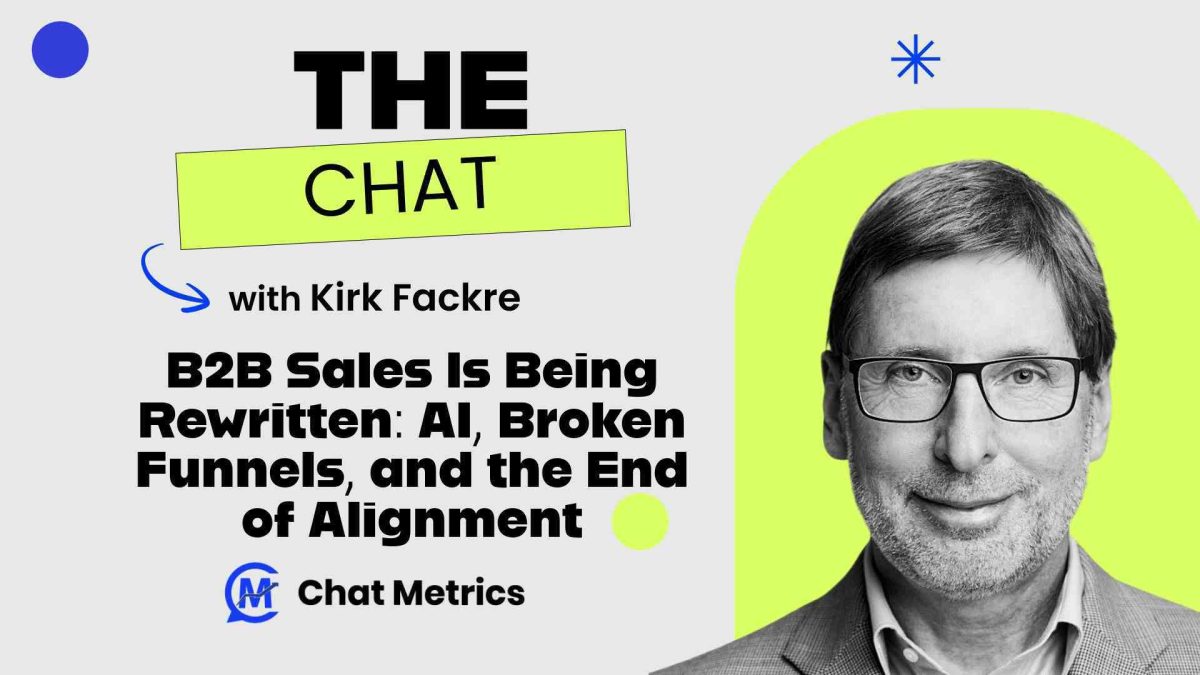
Episode Title: B2B Sales Is Being Rewritten: AI, Broken Funnels, and the End of Alignment
Host: Terry Wilson, CEO of Chatmetrics
Guest: Kirk Fackre, VP of Sales at ICorps Technologies
Episode Summary:
Kirk Fackre joins host Terry Wilson to break down why the traditional B2B sales playbook is no longer working. They cover the collapse of sales and marketing alignment, the dangers of referral-heavy pipelines, and why full-cycle reps are replacing the SDR assembly line. Kirk shares what’s actually working for pipeline growth today – from AI mistakes to handwritten outbound and direct sales-marketing collaboration.
[00:49] – Guest Introduction & Episode Setup
[02:26] – Marketing Running Outbound: A Major Shift
[04:00] – The New Role of Marketing in Sales Conversations
[06:24] – Account-Based Marketing + Ideal Customer Profiles
[07:52] – Breaking Down Silos: Sales and Marketing Must Intertwine
[08:42] – From English Major to Tech Sales Leader
[10:18 – Sales Leadership Inside a 70-Person Consultancy
[12:37 – Frictionless Sales Is the New Standard
[14:39 – From In-House SDRs to Outsourced Experiments
[17:34 – The Death of Automated Outbound at Scale
[21:12 – The Referral Pipeline Blindspot
[24:48 – Referrals Open Doors but Don’t Guarantee Revenue
[24:58] – Selling Under a 30-Year Founder
[27:42] – Final Reflection & Close
Links & Resources: Connect with Kirk Fackre on LinkedIn
Learn more at www.icorps.com
00:00- Intro:
Welcome to the chat. Come behind the inbound scenes of some of the world’s fastest growing companies. For the past 10 years as chat metrics, we’ve had an exclusive inside view of how these industry leaders are revolutionizing inbound marketing and sales across diverse sectors. Each week we bring you conversations with top minds in marketing and sales who share insider secrets and strategies.
00:34-
For driving inbound success, join us on the chat, your front row seat to the future of inbound.
00:49- Terry:
Welcome to the chat. Today I’m chatting with Kirk Fackre VP of Sales at I Core Technologies, a company with 30 years of experience in IT consulting, cybersecurity, and tech enablement. What I love about Kirk is how direct and honesty is. He’s lived through the evolution of sales from Rolodexes and cold calls to AI prospecting tools that over promise and under deliver.
01:08- Terry:
Today we’re gonna dive deep into what’s really working in B2B sales, the growing gray area between sales and marketing, and how AI is shaking up everything from buyer’s journey to job security.
01:19- Terry:
Good afternoon for you and welcome to the chat, Kirk.
01:23- Kirk:
Thanks, Terry, and good morning to you as well.
01:26- Terry:
It’s, just before we kick off, you made a comment then, with re or I made a comment with regards to your lighting. It’s something that I thought you’d be all over. I’ve, looks like you’re a bit of a movie star. I’ve seen the wonderful, YouTube production you did in the, earlier on in your career.
01:40- Terry:
How did that all come about?
01:42 Kirk:
You dug deep on that. So it was a startup I was involved with. It was, back in the days of Blackberry technology, which, it’s only a distant memory at this point, but, my startup at the time, had a tool to charge back attorney hours and expenses as they use their blackberries to talk to their clients. So we made kind of a funny spoof on that. And it was simply connected to like a Cape Cod vacation with my family. So low production quality, my daughter produced, edited a shot. It, and the rest of us just kind of stepped our way through it. it was a lot of fun.
02:15- Terry:
It Well, it looked like a lot of fun. I actually really enjoyed, it was one of those things that I watched all the way through. I didn’t just get a glance and go, okay, I get it. it was quite good. I enjoyed it. very good. Very good.
02:24- Kirk:
Thank you, Thank you for that.
02:26- Terry:
When we were talking, when we were chatting last time. You mentioned that your current marketing team is running outbound plays, even hiring an outsourced SDR that’s traditionally a sales move. What’s your take on this shift?
02:39- Kirk:
I’m actually very comfortable with it. I, wouldn’t have envisioned this being a thing even a few years ago. my traditional kind of view, which I think is probably old fashioned and outdated now, is that marketing was responsible for content. SEO, basically creating messaging that sales could carry forward. and traditionally in my career, I’ve used, S-D-R-B-D-R, whatever you wanna call them, whether insourced or outsourced, and that’s been the driver for appointment setting. What’s different now, I think, is that the tech stack of marketing and sales are almost interchangeable at this point. So for marketing organization that’s tasked with generating more top of funnel leads, they’re much more willing to kind of tap into this area that had traditionally had been more of like a sales motion. I think the, the tricky thing is getting it right ’cause marketing has credibility in the way that sales doesn’t always have credibility. So
03:37-
Mm.
03:38- Kirk:
Be careful to not overstep. and kind of. Lose the credibility of all that careful messaging and content they’ve created by being too aggressive in terms of trying to convert, useful content delivered in a way that’s helpful to more of like a crass SDR motion.
04:00- Terry:
and. Let’s dig into that a little bit more. I’m actually, I’m running, and it’ll be finished by the time this is published, but I’m actually running a webinar next week talking about how the best sales, the best, sales leads delivered by marketing actually start with sales. And by that I mean that it’s the marketing brings the attention of the buyer.
04:24- Terry:
They get the attention of the buyer. And in my mind, marketing are the ones that are almost like the billboard and have the nu phone number on there and say, call here, call me out. And whether that’s get to the website or make a phone call, but once there’s a two-way conversation and we’re actually backwards and forwards with the customer, I think that’s much more nuanced than traditional marketing has been.
04:47- Terry:
As you’ve said with the credible, information, it’s a lot easier. It’s a lot harder than to have those nuanced conversations for each individual than what I think marketing has necessarily experienced of in the past. And we’ve certainly seen that ourselves with the service that we deliver in terms of as soon as we are able to engage with the buyer as early as we possibly can, the whole conversation changes from being almost a one way marketing conversation of here’s some more information, here’s a download, here’s a white paper, here’s a case study to actually understanding.
05:21- Terry:
And the first thing that happens is a question gets asked, what do you need? What are you looking for? So that there’s that beginning of a understanding, that sort of tends to flip things around in the, in the conversation. And that it seems to be a sales position that’s happening in marketing now in, in your business.
05:38- Terry:
I’m curious, is that still, is it working yet or is it still trial and error?
05:42- Kirk:
The jury is out. And I think that’s, I think your perspective is exactly right when it goes from some useful contents, whether it’s a downloadable white paper or a little piece of video or, of 10 best practices for X, Y, or Z. it’s. if there’s a reciprocal move by what I’m gonna call the prospect at this point. ’cause these aren’t really prospects yet. If I think of marketing, I, I think your billboard analogy is correct. and it’s how I’ve always viewed it, but there, it seems to be a temptation now maybe just in my organization, but I think probably more broadly, to the lines. And so what we’re doing, and it’s still early, is, more of an account based approach.
06:24- Terry:
Hm.
06:24- Kirk:
So, we have developed like a, own ideal client profile and buyer persona. we know what we’re best at, what we should stay away from, traditionally like an SDR would be taking this forward and trying to, get those meetings teed up. we still do that, although we outsource it at this point. but marketing does seem to be, for whatever reason, Collaborating or, or trying to stuff the top of the funnel in a way that perhaps is outside the traditional comfort zone of a marketing organization.
06:55- Terry:
Which personally I think is excellent. It, one of the things that we find is that. When we move into an supporting an organization with our service, often there’s a huge friction point or a gap between sales and marketing. It’s like, okay, our job’s finished now. Marketing says, and sales says, your job’s finished.
07:12- Terry:
Now we’ll take it from here. Leave it with us. It’s like, stay out of myturf. This is what I’m looking after. That’s what you look after. The boundaries seem to be very clear in terms of a marketing qualified lead handed over to sales. Now that’s for you to look after and there’s the general to and fro of, you know, the leads aren’t good enough, you’re not giving us enough leads.
07:31- Terry:
Then it’s like sales aren’t following them up quickly enough, or they’re not following them up at all, et cetera, et cetera. So what we found is that when you can bring that sales conversation into marketing often. It actually brings those, removes those silos and breaks down those walls because you’ve got the two then almost completely entwined without that natural wall of handover.
07:52- Terry:
And so that, I’m very interested to see, how the outcome is, juries out. I get it. I know it is only early days for you, but it’s, it’s certainly is an approach that I think has been driven somewhat by the fact that the, the tools that are available now feel much more tech web tech type tools with, you know, the AI SDR component, even though it’s doing the function of a sale of a salesperson.
08:14- Terry:
So I think that’s probably driving that behavior and certainly anyone in the marketing realm, that’s using those tools to effectively, you know, bring traffic to a website. I guess it, when it’s all said and done, booking meetings for sales is the, ultimate endpoint for most marketers.
08:28- Terry:
The further you can get that down the funnel away from the NQL component, then the better. Kirk, take us back just for a moment. You’ve gone from English major to tech sales exec. What’s been the constant thread across all of that?
08:42- Kirk:
Well, I’d still use English. still a skill that has value, or any language. I know I came from, the English and then later the customer service and operations side into sales reluctantly. the through line, I think is that the same skills I use to, to write, to read, write, to process information. they, again, sort of a ‘ cause there’s also listening, which is not what all English majors do best. so I’ve had to kind of learn, the listening skills and add those to the processing skills and the communication skills. and it, what has come, how I approach it at this point is, with curiosity.
09:25- Kirk:
If you aren’t curious, and I think that probably is something the English majors are, then you’re not going to be successful listening and reacting to what you’re hearing from colleague, a boss. Under underlying, prospects. those skills translate I think pretty well. I’m not sure if that quite answers your question, but that’s my reaction to it.
09:48- Terry:
Of course, of course. And I think that from sales perspective, in reality, any effective communication for any human being, but particularly in a sales perspective, you know, I was taught very, very early on when I was in my sales career, you know, two ears, one mouth. the listening component, is where the real goal is in our conversations, particularly from customer perspective.
10:09- Terry:
You’ve led iCore now through some pretty big changes. what does sales leadership actually look like today inside a 70 person IT consultancy.
10:18- Kirk:
it really has changed. When I joined a bit more than seven years ago, it was all about scaling up the sales organization, getting. Regional sales managers put into as many locations as we could reasonably cover with our kind of more white glove approach. so we, would think about growth in terms of bodies, which would then translate to more sales and more territory and growth in that perspective. that’s no longer how we think about it. and what, happened as a result of the, pandemic among many other things is that clients became very comfortable with communicating over teams or Zoom or Google meet, whatever the mechanism is, to the point that it’s no longer important or even particularly helpful to have regional sales managers as paradigm.
11:11- Kirk:
So that’s one thing. and we’ve shifted more from like trying to. process. Okay. We always want leads, right? that’s been a constant throughout. But initially we were more about putting people in place in New York and Philadelphia and Washington and Chicago and, South Florida in order to kind of harvest what could be gathered from referrals or inbound. now the sales team that I have is, pretty senior people at this point. It’s not purely just waiting for the phone to ring, it’s about finding your own business, and, and scaling the size of the sales organization to the opportunity and hiring more experienced people that are gonna be successful with kind of a full cycle sales approach rather than just closing stuff.
12:00- Terry:
That is a theme I’m hearing a lot lately in that organizations are moving to much more a full cycle sales approach, particularly where there’s a higher value deal size in place. the days I think of I’m in the middle of reading Effortless, and resonating. It’s one of those books that you go, yes, yes, yes.
12:20- Terry:
I know, I know. That makes sense. It’s like you just, I’m nodding all the way through at this stage, I’m only about a quarter of the way through, but I think that the, at the days of the SDR where there was the, form fill. SDR gets back in touch, has a qualification conversation, then books a call with the account executive.
12:37- Terry:
There is so much effort and touch points for so much friction in the buying process for prospect through that, that I get it. and today it probably still does work in some places. but ideally being able to move and have that one conversation with the person that you need to be speaking to from the beginning, is really I think, key critical and taking friction outta the buying process.
13:04- Terry:
I know I’ve said that twice now, but the, the number of times that we’ve seen results jump when you’ve got the same number of leads coming through. but the difference is instead of being able to have that conversation up front and book straight to a meeting as opposed to form fill. SDRs trying to get back in touch.
13:24- Terry:
It just seems like there’s, the gap is, it’s not just friction, but friction, I guess, turns into things like, speed to lead a competitor will beat you to the punch. it, distraction, it’s not a burning, burning issue, and they get distracted with something else and move away. So don’t worry about taking the SDRs calls when they come back, but the conversion from that initial interest in inquiry, when somebody is actually solidly interested enough to hand their contact details over which these days means that they’re like 70, 80% of the way through their buying process, you know, if you miss it at that point, then there’s a good chance you’ll just miss it all together.
13:59- Kirk:
I totally agree. And we’ve done little things on the edges. Like we, we’ve always had a way to book a meeting, from a contact form to be able to schedule time with the pool of available account executives. that’s always been a thing. But we now kind of make that front and center. Right. we’ve gone from making that an option to being the suggestion, you know. Buy now. Not, not buy now, but like talk now. don’t have any, don’t wait for any kind of middle conversation. If, as you said Terry, if they’re already providing details, they’ve already done their research and they’ve already made some decisions about whether they want to talk to you. why not just remove any possible friction and make it really easy for them to do that?
14:39- Terry:
You in, in terms of, of the team that you’ve got now, and you mentioned before that you’re outsourcing as well. what has worked for you? and second question, based on our last conversation. For how long?
14:50- Kirk:
Yeah, so I’ve been here about seven and a half years and my first inclination was to do what I’ve always done, which is to bring in an SDR and have them set appointments. and to be frank, a lot of our. Best leads come from referrals. So we’re talking about at the edges here, hang on, not like the main
15:10- Kirk:
Strategy
15:11- Kirk:
so we tried that and, we didn’t, hire and, how do put this? economized on the position, and the person that took it was someone that had done like college and then selling life insurance over the phone. And that wasn’t the right thing to do because the people that we sell to are all senior executives.
15:29- Kirk:
So that was a, that was an mistake on my part coming from the SaaS world.
15:33- Kirk:
we went right to outsource and we tried numerous things, many of which worked for a period of time. and I was early into machine learning because I came from tech. Like I’m not an IT person by training. so the machine learning stuff I found interesting right away.
15:50- Kirk:
I’d been involved with expert systems earlier in my career. So this idea that we could, use technology to leverage our ICP and reach out to lots of people at the same time was extremely attractive to me. so we,
16:06- Kirk:
pivoted from the SDR to outbound only email, first kind of company did use some machine learning to make intelligent, outreaches.
16:18- Kirk:
And this is 2000 and16 or 17. So it,seemed pretty cool at the time, and positioned themself as an AI company and that they were, they’re more like ml, it seemed to work. And for a while we were getting a fair number of meetings from this source, and it sort of dried up after the course of about a year. so we, kind of a full stack SDR organization that did the calls and the social and the email, and that worked for a while. So we bounced back and forth. I wish I could tell you that any of this was a home run. but we, it was a series of experiments, many of which worked well for a period of time and some never worked at all.
16:54- Terry:
It is really interesting. What do, do you have a hypothesis as why it’s not sustainable.
17:00- Kirk:
I think recently, and I think this is where it paced to keep up, that, There’s such a flood of automated outbound right now. and now marketing’s getting in on it too. My goodness. what kind of world are we living in here? that you just, it, doesn’t come across as authentic.
17:15- Kirk:
It never did, but it’s, at least it was targeted and if not personalized, it was customized. So if some, if you were like fishing with a wide net, you would occasionally catch your fish. And if you had enough kind of nets out there, you can catch a lot of fish. that doesn’t work at all anymore. it hasn’t for some time.
17:34- Kirk:
It works less well every day. So we’ve gone from using, technology as kind of our. Leading edge for outbound to really being quite shy about it at this point and trying. And we, the company we outsource with right now, which has been somewhat successful, and it’s still early days for them, they actually, they start with by deeply cleansing a small number of accounts.
17:59- Kirk:
So they start like 2000 accounts in, our case, greater Boston was our experiment. and they, get that data to like 99% or that’s what they say. then they send letters. They literally send letters and they
18:13- Kirk:
Wow.
18:13- Kirk:
mechanical pen to make it, you know, so, it’s not quite authentic, but they, personalize letters and that’s kind of their air campaign.
18:20- Kirk:
And then they follow up with calls and they’re very reluctant to use email at all. So. I think it’s actually quite good. and one of the fun things is that they record all of their calls. I’m not sure that’s legal, but it’s what they do. not gonna call ’em out for it. So like when we get a lead from them, can listen into the conversation.
18:39- Kirk:
And my senior colleague that, has been here 15 years that works with me, he listened in on a call that we’re having next Thursday and he’s like, wow, this guy seems to really know what he’s talking about. So it’s kind of getting the best of both worlds. We’re getting someone that understands our business well enough, but has skills and the infrastructure around him, in this case a him to really go as deep with the prospect as an SDR code that we were paying directly.
19:06- Terry:
very interesting, very interesting. the fact that they’re not using emails is in my mind, I do have a bit of a hypothesis about why the, Environment’s changing. I think as far as outbound’s concerned and the fact that they’re not using email, I think that is one component of it. The email providers are, making it so difficult to try and land in that primary inbox.
19:29- Terry:
They’re really trying to keep spam out so that they remain relevant. The email is such a heavy and important way that we communicate every day in business. If it becomes too flooded with spam and becomes, irrelevant, then there will be other channels that they’ll move to. And I’m not sure exactly what that looks like, but we’re using messaging apps more and more now, messenger WhatsApp and tools like Slack.
19:52- Terry:
I can’t, I can’t immediately see them overtaking email, however the time could possibly come. I was involved in the community and about a year ago I heard somebody po float the idea around of a cold FaceTime call.
20:06- Kirk:
Oh my goodness.
20:08- Terry:
But that’s, you talk about, uh, invading people’s privacy. I mean, that’s sort of taking things to the next level.
20:14- Terry:
I also think that there’s a second component to it, and that is that when you are doing the messaging in outbound, particularly in emails, you’ll find something that works and then someone will tell somebody about it. And then some guru in some group somewhere will tout that this is what’s working great now.
20:31- Terry:
And then everybody starts doing the same thing and it doesn’t work as much. And so generally these things seem to have abouta life cycle. I mean, there’s always the human, psychology component that certain type of messaging and the size of messaging works. But I think when you. Find a small framework that’s working for you, even though it’s personalized and relevant, but a certain framework that’s working for you.
20:53- Terry:
If it sneaks out there and then everybody starts doing it, it doesn’t look different anymore and you just disappear into the quagmire of everybody else doing it. So I can, I think that’s what those two factors are having an effect on, on success at the moment. you said that 70 to 75% of your business is referral driven.
21:11- Terry:
is that a problem?
21:12- Kirk:
Yes. That’s what we’re trying to solve for. It’s not,
21:15- Terry:
Why, why?
21:17- Kirk:
a strategy. it’s the reality. I mean, we’re good at what we do. Like we are one of those kind of top tier providers of security advisory IT services. So we have a reputation and marketing, as you pointed out, is billboard and the communicator of that value. so we do see inbound working a little, in terms of that. but the trust having a referral we, at least in our business, and we sell to small to medium businesses. We sell to the business owner, to the CFO, to the chief of staff. that’s our, that’s who we talk to. So those folks. They don’t necessarily like wanna get a lot of email from a, from an SDR, nor do they wanna get like, banned on their LinkedIn profiles. they don’t necessarily wanna get a lot of phone calls. so I, I think that is a problem. I think, and not to go back to our current outsource provider, but think they’re pretty good at using the phone, not just to reach people, but I can tell you that when I get calls, I rarely answer them. But ultimately, if someone leaves a message, which I prefer that they do, then I get like an email, know, and I can scan it to see whether I care, or maybe, I listen if I’m really bored, if I’m not usually very bored. and tone of voice then matters. So I think the phone is still the best instrument for outbound, but this, the reality of our business is that most of our most reliable. In most reliable, prospects come from either a client referral or an employee referral. That’s just the reality of our business right now.
22:52- Terry:
So have you ever had a time where those referrals have started to dry up or they’ve dipped down and it’s been, you know, a bit of a dry patch there? Or they, go to people that have left the company, for instance?
23:03- Kirk:
Well, we’re pretty good about that. We have a lot of the people that work at Icorp have been working on icorp referral their entire career, so that’s less of an issue. And people that leave, they still send us referrals, which is cool. But, what it has changed, Terry, is that it’s no longer a slam dunk.
23:19- Kirk:
It used to be. If somebody was referred to iCorps, it was better than even that. We were gonna end up with a very nice deal and a new client.
23:28- Kirk:
Now
23:29- Kirk:
still end up being RFPs like an incredible amount of time. it’s quite to me that, you know,we’re in one now where, we were, and, and it’s fair because people can have referrals to more than one company, right?
23:42- Kirk:
So it’s no longer a kind of like, people are, less concerned about doing what’s easy and more concerned with doing what’s right. That has to do with more stakeholders, more accountability. less good old boys network and do more due diligence. So it’s wonderful to have these opportunities, but they’re no longer slam dunks.
24:01- Terry:
Do you get a sense that the PE firms, and leadership are missing something when they think referrals equals health healthy pipeline?
24:11- Kirk:
That’s a really, interesting question that would have to think about. I think referrals are still golden. They’re just going to guarantee you anything at this point. It’s more like, the front door is open, right? So if you’re going to like somehow try to calculate your of on investment on number of referrals, I think you probably have to throw some more math at that and just realize that used to be maybe a 50 50 proposition is maybe still now, maybe it’s one in four, you know, just to throw some
24:41- Kirk:
Mm-hmm. Mm-hmm. Mm-hmm.
24:43- Kirk:
But it’s not gonna be as much of a guarantee of success as it had been previously.
24:48- Terry:
You said. Something that hit me last time we were chatting. You can only go so far when the founder is your boss and has done it that way for 30 years.
24:58- Kirk:
yeah, that’s fair. We can
24:59- Terry:
I think a lot of people li listening, just yelled yes in their car when I said that. can you expand on that?
25:07- Kirk:
I can. And I’ve come to peace with this, but it was initially very frustrating ’cause I’ve always been, prior to my current role, which I love, a disruptor kind of person. that came in with a lot of energy and ideas and, was given rope to hang myself with. And that was fine.
25:23- Kirk:
You like that? You know, if I’m not successful, that’s on me. Right. it’s an adjustment for me to be coming into. A successful, steady business that’s grown purely organically for 30 years. that’s been an adjustment. cause I came in guns blazing. and, and what I’ve realized is that I can be a difference maker at the edge, but it’s more requiring me to be more of not a political operator, but more working inside the business to make change rather than demanding it or kind of leading change.
25:58- Kirk:
it’s been much more, been a lot more of internal politics than I would’ve expected. Now, these aren’t bad politics and it,
26:05- Kirk:
is,
26:05- Kirk:
Hmm.
26:06- Kirk:
me grow up a little bit because I’ve always kind of had my way, I mean, again, give me the rope, let me hang myself. Now I, it’s like I’m not fighting inertia exactly, but I’m having to kind of understand what my lane is and. Convince not just my boss, the CEO founder, but others that to come along with me if I have an idea, and also to take the feedback if if I think it’s a bad idea or going too fast. So that’s been.
26:29- Terry:
That’s an insightful, self-reflection. I think your background and career in terms of the newer businesses, the startup businesses, sales is king. Revenue and cash flow is virtually, you know, the lifeblood of those organizations. It’s not the only thing that matters, but it has such a enormous impact.
26:47- Terry:
There is so much power in those roles, and I can imagine that in very well established business, that is far from, Failing or far, from flailing around in the market, not sure what to do requiring a leader to come in. it’s a much more nuanced approach in terms of it’s already got most of their stuff Right.
27:06- Terry:
Here’s some, areas that need to be tweaked. So interesting observation and self-reflection. think it’s one of those people talk about, emotional intelligence. I think it’s one of those things where you come in expecting one thing and then find that something different. to work around that is a credit to you for sure.
27:20- Kirk:
Well, you’re kind to say that, I guess, you know, I’m a certain age, I’m kind of a mid to late career professional, and I don’t, you know, I’m kind of learning new tricks at this part of my career. I wasn’t expecting to be, adjusting kind of my strategy. certainly on a technology side of course, you have to evolve or die. But in terms of having to be more nuanced inside the business, has been an adjustment for me.
27:42- Terry:
Well, kudos to you because, it’s that self change and self-awareness that I think is one of the hardest things for all of us to do. I know I’ve had a couple of times through my career where I’ve struggled with it For sure.
27:52- Terry:
Exactly. Kirk, this is brilliant. Where can people find, you will learn more about the work you’re doing at I Corp, and we will include obviously all of the relevant links below.
28:01- Terry:
I might even put a link to that YouTube video, the Blackberry one. I love that.
28:04- Kirk:
Well, thank you for saying that. it’s a true joy. on LinkedIn, which is, I don’t go on lots of social channels, but I’m on LinkedIn. So it’s, LinkedIn,
28:12- Terry:
We’ll put the link in. That’s fine. Yep. We’ll put the link in. We’ll find that.
28:15- Kirk:
Yep.
28:15- Kirk:
of Icorp, it’s spelled with the s, so I-C-O-R-P s.com.
28:20- Kirk:
Yep.
28:21- Kirk:
the two best ways to get ahold of me.
28:22- Kirk:
I’m a zero inbox person, which is why that GVA Earworm is so annoying because it’s constantly up in my inbox.
28:29- Terry:
I think you mentioned before you’re a zero inbox. I’m zero inbox as well, and anything that comes in like that annoys uh, annoys me like crazy, so. Alright, thanks Kirk. Look, if you’re listening to this and you feel like your own pipeline feels a little shaky, maybe it’s time to ask a hard question.
28:44- Terry:
Are you building trust with your buyers early enough or are they already gone before your first touch? Kirk, thank you very much for joining us on the chat today and I hope to speak to you again soon.
28:55- Kirk:
Thank you, Terry. It’s been a pleasure. Thank you for the opportunity. Have a great day.
2026 © All rights reserved Chat Metrics
Made with ❤ in Melbourne, Australia


