

Get my ultimate guide to boosting conversions and customer engagement delivered straight to your inbox.
Get my ultimate guide to boosting conversions and customer engagement delivered straight to your inbox.
“Most companies don’t have a lead problem. They have a conversion neglect problem.”
– Mitch Bruger
What happens when a hands-on operator becomes a brand builder without losing his edge?
In this episode of The Chat, we sit down with Mitch Bruger, CMO of The Advanced Group, founder of SiteSmART and Shifting Forward, and the mind behind the MAVEN method. Mitch has spent two decades scaling infrastructure and compliance businesses in high-pressure industries, while also building brands that actually convert.
We unpack how Mitch aligns sales, marketing, and operations without the usual friction, why simplicity wins in complex industries, and how a clear mindset framework can unlock serious business growth. From turning site fencing into advertising assets to designing systems that create real momentum, Mitch’s approach is proof that practical wins over pretty.
You don’t need more tools. You need faster conversations and tighter alignment.
If you lead sales or marketing in B2B, especially in service-heavy or industrial sectors, this episode is a masterclass in cutting through noise and building brands that sell.
Hit play and learn how real growth happens when mindset meets momentum.
01:18 – Why businesses must shift from “the way we’ve always done it” and re-learn how customers actually want to be engaged.
02:57 – The surprising truth about why turning up on time can be your biggest competitive advantage.
04:45 – How live chat helped plumbers 5x their monthly leads by solving one common conversion mistake.
07:26 – The psychology behind why the first responder usually wins the deal, and what the CIA has to do with it.
09:48 – The brutal reason customers assume your product is too expensive if you don’t share pricing upfront.
13:16 – Mitch’s unforgettable story of the apple pie sale that never happened, and what it reveals about service mindset.
15:28 – Why the best leadership advice is to “walk the floor,” and how Mitch disguised himself to learn the truth.
20:12 – How SiteSmART turned construction fencing into scalable brand advertising, and what B2B marketers can learn.
38:37 – Mitch’s graph-based growth model: the wedge where most companies lose revenue without knowing it.
45:00 – Why your marketing will never outgrow your mindset, and the MAVEN method that helps teams align first.
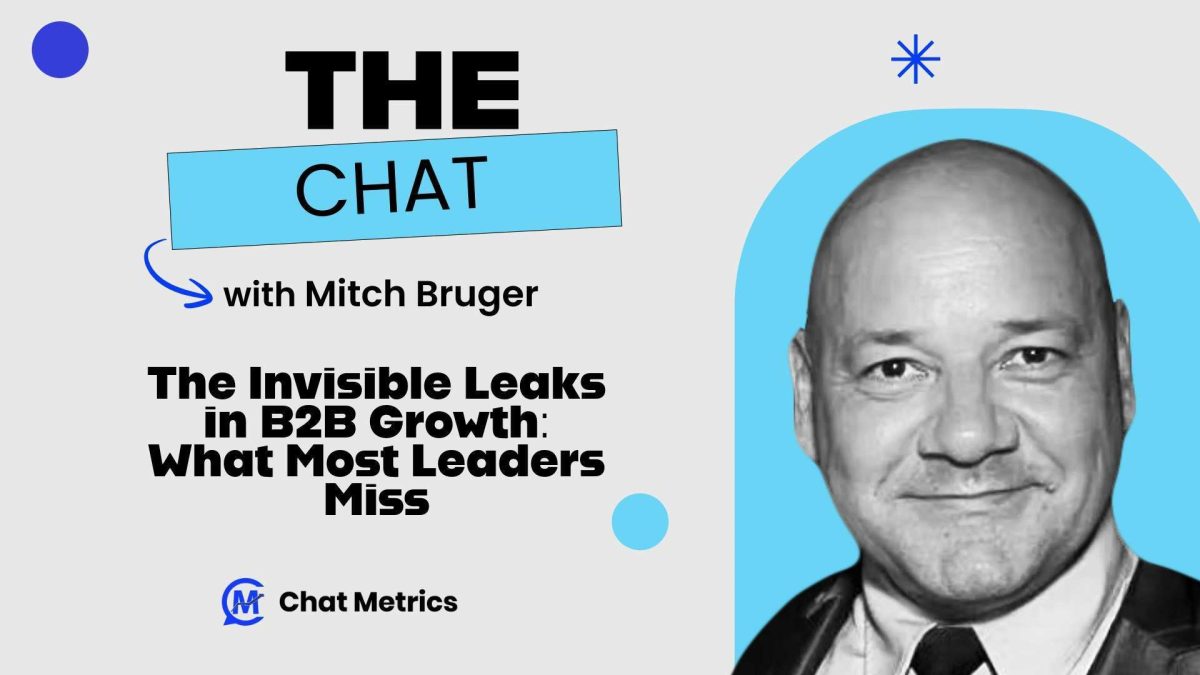
Podcast Title: The Invisible Leaks in B2B Growth: What Most Leaders Miss
Host: Terry Wilson, Founder and CEO of Chatmetrics and Zotly
Guest: Mitch Bruger, CMO of The Advanced Group and creator of the MAVEN method.
Episode Summary
In this episode, Mitch Bruger breaks down the unseen gaps slowing down most B2B companies, from missed web conversions to misaligned teams. He shares how the MAVEN method powers growth, why mindset clarity drives revenue, and how brand, sales, and operations can work together without creating more meetings. If you are in sales or marketing and want to close the gap between attention and conversion, this is the episode to study.
00:00 Intro: Meet Mitch Bruger
02:10 The MAVEN Method Explained
05:45 Why Sales and Marketing Misalign
08:30 Brand Is Behavior
11:50 Turning Job Sites Into Marketing Assets
14:40 Real Growth Lessons from the Field
18:25 Mindset Drives Sales Velocity
22:00 Making the Invisible Visible
24:30 Simple Systems Win
28:10 Leadership That Converts
32:00 The Bold Insight
34:00 Final Takeaways
Links & Resources: Connect with Mitch Bruger on LinkedIn
Learn more at – The Advanced Group
00:00- Intro:
Welcome to the chat. Come behind the inbound scenes of some of the world’s fastest growing companies. For the past 10 years as chat metrics, we’ve had an exclusive inside view of how these industry leaders are revolutionizing inbound marketing and sales across diverse sectors. Each week we bring you conversations with top minds in marketing and sales who share insider secrets and strategies.
00:34- Intro:
For driving inbound success, join us on the chat, your front row seat to the future of inbound.
00:49- Terry:
Today on the chat, we’re joined by Mitch Bruger, serial founder, marketer and creator of the Maven Method. From scaling service brands to building mindset frameworks, Mitch knows how to grow businesses that actually work. Mitch welcome.
01:00- Mitch:
Thanks very much, Terry.
01:01- Terry:
To The Chat.
01:01- Mitch:
How are you traveling this morning?
01:03- Terry:
Very well, thanks. Very well, and all the better for speaking for you, I’m sure. Shortly. Let’s jump straight into it. What’s one idea or approach that if more sales and marketing leaders used would totally transform their pipeline or team performance? what’s your, big stance on
01:18- Mitch:
Oh, big question, broad question. I think probably the key element in particularly in today’s market is to have the humility and the overview to be able to step back and have a look at exactly what’s happening around you in the marketplace, what your customers are looking for, what your team is able to provide, what you, how you exist as a company.
01:37- Mitch:
I think if you can step back from the ways we’ve always done it, you know, everybody’s out there chasing the Google ads and the ranking and the SEO and the all the other stuff that marketers sproke as the golden egg. That’s where it all comes from. the methodologies by which you get in touch with people or indeed have people get in touch with you, which is in my mind, always a better way,
01:57- Mitch:
In if you look at those things, if you look at the way you do the outreach, if you wanna call it that, the old door knocking. All of the stuff that used to work years and years ago, that stuff still works. But we’ve gotten a little bit too clever for ourselves. We’ve pushed past that and we’re all trying to chase this digital nirvana of being able to market to people and get to people, and it really comes back to people being human, being a good person, and building relationships with people.
02:22- Mitch:
That’s in my mind, that’s where business should start and really be originated from.
02:28- Terry:
I agree. I agree. And I think what I heard you saying there, a large component of was engage with the customers that they want, the way they want to be engaged with
02:35- Mitch:
Yeah. Yeah.
02:37- Terry:
not the way that you are necessarily thinking is the panacea in terms of the new digital
02:41- Mitch:
That’s true. And it may not even be you thinking that it may be the marketing agency that you’ve engaged, or it may be the marketing guy who you’ve hired directly outta university and he’s got all the latest bully on, you know, what to do with digital and how to get out there. and it may not align as it should with your company.
02:57- Mitch:
It probably will because he’s done his homework and everything, but, or she, but the methodologies by which you grew your business to where it is at the moment. So expanding upon that and keeping the good customer service and reliability and integrity and showing up. When you say you’re gonna show up, you know, there’s really only a few small items that you can do.
03:15- Mitch:
If you do them properly, you suddenly stand out way above the rest of your marketplace. and that’s something we’ve lived at advanced for many years. if you treat people how they wanna be treated and you actually do what you say you’re gonna do, you set an appointment and you turn up.
03:28- Mitch:
I mean, how many times have you called a tradie or, you know, gone on an ador found a bunch of people to do a job. For example, you got plumbing, reach out.
03:36- Mitch:
Out of the six or eight or 10 get back to and a quote, and you don’t from,
03:41- Mitch:
so the one guy that actually pick up the, you have a conversation with him, comes out conversation because he’s being integral doing, gonna do it sounds very simple, but it’s really what the customers are looking for. What they.
03:53- Terry:
it is, it is absolutely, it is. and quite frankly, that’s the underlying, underlying foundation that our business is built on. In essence. I mean, it’s funny you mentioned plumbers in terms of, getting into contact. You know, the first thing usually is a Google search to get the number.
04:06- Terry:
You either get it direct from Google or from the website. We’ve seen, across plumbers specifically, we’ve got plumbers and electricians and other trades as clients we watch their marketing. return on investment multiplies dramatically when they’ve got something like live chat on their website, for instance, because there’s people there actually talking and resolving the problem straight away.
04:29- Terry:
They’re able to, even if they can’t resolve the problem, you can lock in a time to talk. You can let them know that their, concerns have been heard that there’s an appointment, somebody’s scheduled to come and see them. Or there’s a, you know, a call scheduled where somebody’s gonna get back to them.
04:45- Terry:
So that means that that concern is resolved Now, they don’t have to keep going on and
04:49- Mitch:
Yeah.
04:49- Terry:
six plumbers. And we’ve seen particularly, particularly, where there’s been a competitive suburb, for instance, and, you know, there might be half a dozen plumbers in there. We’ve seen being able to shift considerable amount of market share or demand from those industries over to plumbers simply by having live chat on there and be able to respond straight away on the website.
05:11- Terry:
And like, I’m talking. You know, plumbers that were traditionally getting two or three leads a month through their website, that’s jumped dramatically to 10, 15, or 20 leads a month through their website, or inquiries coming through their website. So,
05:24- Mitch:
Yeah,
05:24- Terry:
it’s in a big area. high demand and high competitiveness means that you’ve gotta be on your game.
05:31- Terry:
You know, none of
05:33- Mitch:
No.
05:33- Terry:
in a silo. and like you said, if you’re honor your commitments and be there when the customer needs you, then that’s what’s gonna
05:38- Mitch:
Absolutely. And I think what you touched on before, what you mentioned on, on there being a person there to speak to the difference between having, chat bot, which is a digital robot. You’re speaking to people that people are pretty savvy and they pick up on whether they’re talking to a real person or not fairly quickly.
05:53- Mitch:
I know I do. and sometimes if I’ve got a simple FAQ or a simple something that I wanna ask, that I wanna know about, I’m okay with it being a bot. But if I’ve got a, particularly, let’s go back to the plumbing analogy. If I’ve got a plumbing problem, there’s something I wanna speak to somebody about who can understand what I’m saying.
06:09- Mitch:
And even if they can’t assist me with that, take the lead and forward it to someone who.
06:13- Terry:
Yeah, correct. Correct. And in a time that’s promised. I think that’s the other point is that we found that, again, using the plumber example, that it’s not just taking the lead and passing it through. It’s letting the person know that it’s got the problem when they’ll be contacted. so we’ll actually book time, a time for that phone call or that appointment to, for
06:33- Mitch:
Yeah,
06:33- Terry:
visit to take place. you, we found that if you leave it and leave it to the whim of the plumbers or their admin staff or however they, you normally handle their inbound leads, there’s not the pressure for fast response as much as they like to think there is. They’ll get a text message before breakfast and think, oh yeah, I’ll get to that
06:51- Mitch:
yeah,
06:52- Terry:
and then get distracted. the reality is by able to book in a time. They’ve got the commitment, they’ve made a commitment themselves via us that they have to respond at that particular time. And it just, it’s a co psychological trigger that goes into the customer’s mind that, oh, good stage. One of the problems solved.
07:07- Terry:
I found the right person to
07:08- Mitch:
Yeah.
07:09- Terry:
I know when I’ll be
07:09- Mitch:
And lo and behold, they turned up.
07:11- Terry:
the, the way
07:11- Mitch:
Fantastic guys. Fantastic.
07:14- Terry:
they do.
07:14- Mitch:
When
07:15- Terry:
Yeah. Yeah, yeah. And you know, and you’ve experienced it yourself when you are getting back to leads, inbound leads quickly, the faster response always closes, more deals than the slower response.
07:26- Terry:
I mean, there’s statistics, you know, one thing about statistics and that is that, you know, 98% of them are all false. But there’s been research and studies that have been done by a number of organizations now that show that more than half of winnable deals will go to the fir, provider that responds first, and
07:44- Mitch:
a.
07:44- Terry:
That response starts. it’s huge. It’s huge. And it’s money for jam quite frankly. If you’re in a competitive market and you’re all spending money on the marketing to get leads into the front door, that’s huge. That ability to respond first, and I mean, I feel like I’m hijacking this here, but we had I a person on the podcast, Ellza Malok, quite a few months ago, and I always assumed that the reason the first responder is wins most of the deals is because they’re the ones that they start to forge the relationship.
08:17- Terry:
They get to, you know, if it’s a request for proposal or an RFP, then they get to help frame that and they help guide the buying journey. But it’s actually much deeper psychological reasons than that. And I found out that the CIA actually, train their people on this very, aspect, and that is that when you are the first to respond. To a situation, a request for contact, or the first to respond in terms of, we’ll just use our language. A lead coming in. When you have that first conversation, every other conversation after that that they have, or whether it competitors or whoever, psychologically is social proof of your conversation. So you are the one that’s shared knowledge, you’ve shared some insights, you’ve set the frame in terms of what things look like they speak to a competitor. they, even that competitor says the same thing you did, they’re not pulling them towards the competitor. Psychologically what’s happening is that competitor is reinforcing what you’ve said and you go, oh, that’s right.
09:15- Terry:
Terry said that and it’s fascinating. It was fascinating for me. She’s behavioral science, highly qualified and, had a lot of experience in it. In fact, that’s what a business is now, helping large organizations change your behavior in a whole host of areas of across their organizations customer
09:27- Mitch:
Wonderful.
09:28- Terry:
base. And it was fascinating to hear that that was the way, or the reason behind why that first contact actually does deliver those outcomes. So it was fascinating for me.
09:39- Mitch:
this is what we’re talking about. This is,people wanna know this stuff I read a book some time ago and met a
09:43- Terry:
yeah.
09:43- Mitch:A
fascinating gentleman called Marcus Sheridan, and he’s written a book called They Ask You Answer.
09:48- Mitch:
and it’s the simplicity of giving your customer what it is they want know. and it sounds really simple, but a lot of people in business tend to be a little bit guarded about things. Now. They don’t want competitors finding out their, you know, they don’t want industry knowledge to get out there.
10:02- Mitch:
That’s their. But the thing is that the customer who’s out there asking the question, they just want a straight answer to it. I wanna buy X, Y, Z. It’s How much are they? well, it depends on your circumstance and the We have to do a proposal and Yeah, but roughly how much are they?
10:16- Mitch:
Well, it depends on just gimme a damn price. I’m after price. Are they two grand? Are they six grand? What’s, tell me? And that frustration, I think, turns more people off than what the, the possibility of losing a job here or there. Because you’ve been overly honest with people. It’s, yeah. Honesty builds trust.
10:33- Mitch:
It just does.
10:34- Terry:
The frustration, it’s very inter interesting from a psychological perspective. You use the word frustration and that is what we feel. But there is a deeper message that it sends, and that is that if they won’t tell me the price, it must be very, very expensive. And straightaway when someone is guarded with their pricing, brain automatically goes to that point, well, this must be super expensive.
10:55- Terry:
I probably can’t afford it. Or, you know, that level of,
10:59- Mitch:
Handle.
11:00- Terry:
assumption is that, well, the assumption is in the mind that it is a very expensive, a high
11:06- Mitch:
Right.
11:06- Terry:
offering.
11:07- Mitch:
Look, the other thing is that the business owner themselves or the sales person doing that, if they are guarded with it, or if they do give the price straight away. They, have a fear within them that if I tell you how much it is, I’m gonna lose the sale. Well, if you tell ’em how much it is and it’s more than they were expecting or it’s too much, then you as a salesperson need to go to the effort of explaining why it’s at that price point.
11:27- Mitch:
Because there’s obviously a reason for it being at that price point, you know, market competition and that you’re not, you haven’t just picked a figure outta the sky. It is that price point for a reason based on quality and service and everything else. But if I tell you that price point and you think it’s too much and I lose the, well, then it’s, you wanted in the, if can’t afford it, then you’re actually cleaning out your sales funnel.
11:46- Terry:
One of two things. You are cleaning out your sales funnel or you are failing in delivering the appropriate value.
11:55- Mitch:
Correct.
11:55- Terry:
To the client, so that they understand the value, as you said at the beginning. It’s not, you
11:59- Mitch:
Yeah.
11:59- Terry:
plucked a number. It’s, it’s built up on specific aspects and, you know, being able to communicate that value to clients is, it’s not easy.
12:07- Terry:
it’s actually a difficult thing to do. And, and I believe it’s one of the reasons why most businesses fail in that I did a, I do, one of the services that I offer is inbound funnel reviews. So I will review, everything from initial contact all the way through to getting to the point where they would put me into their pipeline as a potential deal. And. I did one recently, and it was shocking to me. when I do them, I do their own and I do one of their major competitors. And the sales person or the sales leader had been complaining to the CEO that their pricing’s too high. They’re being priced outta the market. That’s why the competitors are beating them. Long story short, it wasn’t that at all. it was an exceptionally poor experience coming through their funnel and an exceptionally good and easy and confident experience going through their competitor’s funnel. And it was
12:51- Mitch:
Right.
12:52- Terry:
brick wall up, an invisible brick wall, but it was, it took me so much effort to try and get contact
12:56- Mitch:
Yeah.
12:57- Terry:
and get in touch
12:58- Mitch:
Yeah,
12:58- Terry:
Just to even have a conversation, let alone the poor quality of the conversation versus their competitor. that was the simple barrier. You know that’s quite shocking and hard to hear for some people because they spend so much time setting up all of their infrastructure, they’re taking their forms and you know, the special follow up emails and all that sort of stuff
13:16- Mitch:
Yeah.
13:16- Terry:
to people, like you
13:17- Mitch:
And each and every one of those steps is is a further bottleneck, further barrier to actually making the sale, to give it the customer what they want.
13:23- Terry:
absolutely.
13:24- Mitch:
I remember years ago with my wife and I went for a road trip out to outta Stanthorpe and, Stanthorpe is an Apple growing region, and we went into this farmhouse store and we bought a piece of apple pie, little double of ice cream on the side of it, and a cup of tea.
13:38- Mitch:
And it was a beautiful drive in the country. And the apple pie was just next level. It had the,cinnamon saana and the whole, it was just mouth watering. Beautiful. So we thought, well, we’ll go and grab a pie and take it home. And we walked up to the counter and said, could we grab one of those pies?
13:54- Mitch:
no, we can’t sell a whole pie. Oh, but they’re great pies. Or can we just have like a halve a pie then, or like two halves of a pie, or No? No, we can’t, we can only sell it by the piece. I don’t mind paying for each piece if you know, if it’s 12 pieces. Will you add up what it’s, and tell me how much it’s, I just want a whole pie home for my family.
14:11- Mitch:
No, I’m sorry. We can’t do that, sir.
14:13- Terry:
My
14:13- Mitch:
Okay.
14:14- Terry:
My goodness. Yeah.
14:15- Mitch:
Thanks. Have a great day. You know, it just baffled me at how, can you stare a customer in the face and say, no, sir, I’m sorry. You can’t have that. Put your money back in your pocket. No, we can’t spun out.
14:25- Terry:
Yeah. it’s shows I believe, so I’m sure that individual may have
14:31- Mitch:
Absolutely.
14:31- Terry:
Based on the interaction you gave me and not necessarily an owner. Can you imagine what the owner would think standing behind that person? this individual is following the rules that have been set. You know, we don’t wanna discount
14:41- Mitch:
Yep.
14:42- Terry:
full pies. but if somebody’s asking for, to pay the price of the number of slices in the pie,
14:47- Terry:
It’s like, that was just, I’m sure that owner would’ve been devastated, and I just wonder how much money
14:51- Mitch:
Yeah. but ultimately that person that’s doing that job was trained by that owner or one of their managers as to how to do the job. And that’s, we do this and we don’t do that. So ultimately it falls back on them.
15:01- Terry:
a, there’s a
15:02- Mitch:
Yeah.
15:02- Terry:
gap from the owner not walking the floor. And,
15:04- Mitch:
Yep, you’ve gotta be in touch in your business. And I’ll do that today in our temporary fencing business and our environmental services business.I spend time out in the field, I’ll be in an excavator one day, I’ll be driving a truck, I’ll be out doing a football event or a, I went up, did the pink concert a little while back with the boys on the water barriers trucks, and just spend the entire shift with them and drive trucks and get in there and do it and chat and get to feel what’s happening on the coalface of the market front.
15:28- Mitch:
As a business owner doing that and getting that close to your business? Not often, but just every now and again, firstly, you become a lot closer to your staff and your teams because you’re essentially one of them. I’m just a truck driver and a high shirt. and some of the casuals, some of the guys that don’t often work with us didn’t actually know that I was the business owner.
15:47- Mitch:
I was just one of the workers with them that day. And the conversations that you have and the conversations that you have with your customers customer, in this case was Brisbane city council. and Queensland police interaction and things like that. Just as a worker on your coalface, you get to learn so much about your business and about your customers.
16:02- Mitch:
it’s invaluable. I recommend everyone should do it at least once, preferably more often.
16:07- Terry:
I couldn’t agree with you. I couldn’t agree with you more. you know, there’s a couple of shows that are built on that type of concept. Undercover bias and secrets
16:13- Mitch:
Yeah.
16:14- Terry:
That type of thing. you know, through my career, it’s probably one of the biggest learnings and a way that I’ve. Ran and operated right from the very beginning is walk the floor, you know, begin there, you into the, coalface and just experience what your team’s experiencing, interact with the customers at
16:30- Terry:
their place. The number of calls that I’ve gone, we were actually at in the customer’s environment as opposed to your environment, everything changes, the conversations, the insights, the relationships.
16:39- Terry:
that is culture building stuff. And look, and on that note, Mitch, you know, you’ve been a bit of a serial entrepreneur from a very young age. I recall from our last conversation, what were the early businesses you built and what lessons from those still guide you today?
16:52- Mitch:
Wow. Early businesses, go right back to when I was a kid fixing motorbikes, you know, buying motorbikes and fixing them up and selling them again over in New Zealand. I think the business 1 0 1, the entrepreneurship 1 0 1 thing, which is, I’ve actually in the process of writing a book on E 1 0 1 is something that everybody should learn and you should learn it from as, as younger age as you can.
17:13- Mitch:
the business principles, like what we were talking about before, the simplicity of customer service, of giving people what they’re looking for, of providing service, of providing integrity and being a standup guy in business. those values and those principles have been applied through all the businesses that I’ve had over the years and still have.
17:30- Mitch:
So at the moment that with the,
17:32- Terry:
Hmm.
17:33- Mitch:
advanced group, being Macaw business has, advanced Temporary fencing, advanced Environmental Services, advanced Landscaping. Advanced Cleaning, which is a commercial cleaning company, and Advanced Trolleys, which is a shopping trolley collection business. all of those businesses, they all function under the same guise.
17:49- Mitch:
And the byline for the company is taking care means a lot. And that sounds almost simple enough to be just a trite throwaway in line, but it’s actually the guiding principle of by which we run the businesses
18:00- Terry:
Yep.
18:01- Mitch:
Is that, little bit of extra care and making sure that things are right when you’re doing them in a commercial cleaning example for, saying that you’re gonna, that the cleaners will be there and there’ll be a team of four and this is the outline of what they’re gonna do.
18:13- Mitch:
And they go there and they turn up at the right time and they do exactly what they’re supposed to do. that’s all customers are really looking for. So the integrity is a big part of it. Secondly, being customer centric. Being customer focused, which is what I was saying before asking, you know, they ask you answer.
18:28- Mitch:
Being genuine and real with your customers affords them a level of trust and a level of comfort in knowing that they’re spending their money with the right provider. the temporary fencing game in particular is very much a roundabout. there’s a pool. it’s a commodity product.
18:43- Mitch:
You can get it from a number of different suppliers. And sometimes you will lose customer for the simple reason that the schedule’s over booked. They’ve got an emergency job, it has to go in this afternoon. You just physically cannot do that. And they’ll just get on the phone and find another temporary fencing supplier.
18:59- Mitch:
And that other temporary fencing supplier will then service the absolute bejesus outta them on the very first job, probably even the second or third job, until they just become one of the regular customers until the next time that they’re overbooked. Or for whatever reason, the truck breaks down or they can’t get there.
19:14- Mitch:
And the guy needs the fence, so he calls somebody else. And because it’s roughly the same meter rate everywhere, everyone’s pretty much on the same sort of meter rate. It’s like.
19:22- Mitch:
A coal service station to a shell or a bp. It’s just petrol for the car. You don’t really care. Might be a few cents difference here and there. You know, sometimes people go chasing the liter rate and drive further at the expense of use. More petrol they do for the savings they would’ve got, but people do that.
19:37- Mitch:
So, yeah, having the integrity and looking after your customers. Those two core guiding principles are what I live by. And that’s, as I said, that’s gone throughout the businesses. I’ve moved forward then, site Smartt Australia, which is probably one of Australia’s premier banner and signage suppliers, which I’ve founded off the back of the temporary fencing company, to essentially sell the advertising space on the temporary fences.
19:58- Mitch:
So if you’re having a temporary fence on site, you’re gonna wanna be able to sell the development or whatever it is from that very site, particularly if it’s on a busy road. You know, you’ve got a hundred thousand cars a day passing the site. Why wouldn’t you have some branding material, some advertising on the outside of the fence.
20:12- Mitch:
It’s essentially a free billboard. It’s already on site. You’ve got it. So, site Smartt Australia was founded off the back of Advanced Temporary Fencing. and then from there I’ve then gone deeper and deeper into the psychology of selling and the psychology of customer service and what people are looking for.
20:26- Mitch:
for me, it seemed that there was more a divide. The further we got along technology timeline, the further the divide of genuine service, which is what people used to love and used to retain customers with, seems to be slipping further and further away. So I’ve tried to capture all that stuff from back then and put that into books and podcasts, like in this case and indeed speaking about it and sharing with people that the way.
20:53- Terry:
Yeah, I couldn’t agree with you more. so on that end then, how do you define entrepreneurship now?
20:59- Mitch:
I see entrepreneurship as the key to the future, particularly for youth. And the reason I say that is that we’ve fallen to this zone where we send our kids off to school and they learn to memorize things that they’ll never use again in their life, only to recount them at the end of the year and get a number on a piece of paper, which tells them what kind of job they can get to work for somebody else.
21:20- Mitch:
That’s industrial age thinking. that was how it was back then. And we’ve moved much further past that now, even though the education system hasn’t kept up. So for me, teaching entrepreneurship and sharing it, particularly with young kids, I’ve got a series of children’s books on entrepreneurship, which is basic stories.
21:38- Mitch:
Lulu Loves Lemonade. Trevor, the tutor, you know, there’s. The principles, the core principles written for a child to understand, so they get their head around the job isn’t necessarily what you need to be chasing here. Now, if you’re already in the pipeline, you’ve gone through the standard education system, you’re coming out into the workforce, yes, you’re gonna need a job.
21:56- Mitch:
You get yourself a job, get some money, but you start a side hustle on the side and you build that side hustle until you get to a point where you can no longer afford to keep your day job. You have to quit the day job because your business is too profitable. that’s my philosophy, and that’s,I share that with as many kids as I can, and their parents, parents are play a big part of it.
22:17- Mitch:
parents need to be able to step out of the zone of what they were taught as kids and allow their kids to be, to spread forth into entrepreneurship today and assist them whatever way they can to do so.
22:29- Terry:
Absolutely. Absolutely. I agree with you. That’s. Particularly with the way things are going. I mean, I’ve had some, very interesting conversations about AI over the last month or so. there’s a new world coming for us and I think The gap that AI has, and it seems we’ll have into the future.
22:45- Terry:
Even if you talk about a GI, the general intelligence, artificial general intelligence, will be the thing that I think is the spark that makes all of us difference. And that’s our creativity, our innovation, our ability to think up new ideas. even at this stage, they’re saying that it’s not likely that a AI will be able to replace that in any time soon, even with a, general idea.
23:07- Terry:
and that to me is almost like the core of entrepreneurship. You need to have that innovation and creativity and find new ways to solve old problems, and new problems. There’s always new problems that arise as well. But that is the, I think what, certainly at the moment, what keeps us different to ai.
23:21- Terry:
So, and that to me is the core foundation. If you find a problem to solve, then you know, and you start solving that problem and do it in the business, a commercially viable way, then you are enterpreneur
23:30- Mitch:
Absolutely.
23:31- Terry:
So. It’s,
23:32- Mitch:
it’s becoming easier, particularly
23:33- Terry:
I,
23:33- Mitch:
for the youth to do so because they are what’s been termed as digital natives. They’ve grown up with the internet, they’ve never known anything else. and the new developments that happen,
23:43- Terry:
exactly.
23:43- Mitch:
far earlier in the uptake cycle than people of our age are.
23:47- Mitch:
when you talk about that, in growing up in a certain age, I used to think that, you know, it was amazing that my grandfather had grown up in the age where he’d come through, you know, horse and cart to cars then to seeing, radio. And telephones. And unfortunately he didn’t see the, the earlier, this particular grandfather didn’t see the earlier stages of the internet, but did see mobile phones.
24:11- Terry:
And so it was like this whole transition through you think about how fast things had advanced in that time. And then I think about my life and the technology changes that I’ve seen in my life. And, you know, I’m pretty internet, so, in fact where I grew up, I actually grew up out in the country.
24:28- Terry:
So, my telephone, my first telephone experience was wind the dial on the local exchange. so then to move on to, know, the proper telephone systems and then onto mobile phones and then the internet you know, it faxes
24:42- Mitch:
yeah,
24:42- Terry:
to emails and it’s just been a fascinating, fascinating, of advancement.
24:47- Terry:
I think that I’ve probably seen a greater speed of advancement in, My lifetime than what my grandfather saw in his lifetime, even though they were pretty big jumps. The jumps that we’ve seen have been, you know, world changing as well. we are going through another one, I think with regards to AI and entrepreneurship
25:05- Mitch:
Sure.
25:06- Terry:
and business.
25:06- Terry:
And I think it’s those individuals that are doing it themselves will be, will be the ones. But yeah, it’s been huge changes and the ability to change or adapt, will be one of the other
25:15- Mitch:
Absolutely. Yeah. And just further on that.
25:18- Terry:
does that look like two years from now, five years from now, 10 years from now, 20 years from now, what are we gonna be doing? How is life gonna be different? It’s a,
25:27- Terry:
it’s
25:27- Mitch:
it’s a deep pondering.
25:29- Terry:
well, I saw a podcast I guess I’ve been on this topic around AI a little bit over the last month or so. I saw a podcast of, The diaries of A CEO or the CEO
25:38- Mitch:
Yes. Yeah.
25:38- Mitch:
Stephen Bartlett.
25:39- Terry:
And, he had the gentleman on that was effectively the grandfather of ai. And, the whole episode right at the end and almost as a, his last question was, you know, well, what would you advise?
26:56- Terry:
And, I saw reports yesterday that the adoption of AI is actually, plateauing. it’s been on a very sharp, uptick because it’s the new bright, shiny thing and everyone wants to be involved with it.
27:06- Mitch:
Yeah.
27:07- Terry:
the early adopters do,
27:08- Mitch:
Mm-hmm.
27:09- Terry:
But its starting to plateau. And the other statistic I saw yesterday is that 94% of enterprise AI projects have failed.
27:18- Mitch:
Wow.
27:18- Terry:
To date. so I think that’s a sign of this huge adoption wave that’s come through. And everybody thinks that that’s important, that’s what they need to do. but they’ve not been able to get the results and outcomes that they were expecting at this stage. It’s early. I mean, it’s simply, it’s so true
27:31- Mitch:
Absolutely. Yeah.
27:32- Terry:
at this stage.
27:32- Terry:
So I think there’s probably lacking the skill set
27:35- Mitch:
Yes. Yeah,
27:36- Terry:
out of it.
27:37- Mitch:
very much so.
27:38- Terry:
gonna say, I think in two years, you know, what would it look like? Probably not too dissimilar. Five years, probably start to see things look a little bit different. But, you know, 15 years out from here, I think it’s probably
27:47- Mitch:
Yeah.
27:48- Terry:
a different scenario
27:49- Mitch:
Yeah, absolutely.
27:50- Terry:
That’s
27:50- Mitch:
Look, I think the, for me, what, what the golden nugget that I’ve seen in the middle of AI is, is bundling it with other things, making it part of yourself and how you, how you express yourself, how you’re able to create things. I use AI in the Maven methods. it’s something that, as you say, it’s a tool, and a tool is only as good as the person using that tool.
28:12- Mitch:
So you need to get to know how to use it correctly for the benefits and the outcomes that you’re trying to achieve in order for it to be of value to you. Because the capability is there, it’s what you do with it.
28:23- Terry:
what do you think it is that’s allowed the advanced group and site smart to grow and scale the way that they have? Yeah.
28:30- Mitch:
I’m gonna sound like a broken record here. Integrity, customer service, doing what we say we’re gonna do, delivering on time and just being there. And if something goes wrong, we step in, we fix it. it really is that simple.
28:43- Terry:
Getting the simple
28:43- Mitch:
getting it right. Yeah.
28:44- Terry:
You know, it, this might show my age a bit here, but I was, when I was living in Sydney, early in my career, there was a morning radio host called Doug Mul Ray and, quite a good, a funny comedian, Mulberry Triple M in Sydney. And I’ll never forget driving to work one morning.
29:00- Terry:
I was personally going through some complexity. I’d changed a career slightly, so I was in a big steep learning curve. And I’d always had this feeling, you know, of, keeping things simple is the best way, you know, it stops complexity, it stops cost, it gets the best outcomes the quickest amount of time. and I’ll never forget, Doug Muller used to put on this funny nana’s voice and there was an ad on television at the time for Kellogg’s Corn Flakes. You know, they’re just simply kernels of corn rolled out and. or oven baked or whatever they are. So you can have them at breakfast of the Morning and he put on this funny voice and, in his nana voice and said, you know, use that phrase from the Kellogg’s cornflakes ad. And he was demeaning towards a guest that they’d had on that had made some stupid comment. And he said, you know, sometimes the simple things in life are the best. And I don’t know what it is or why, but that I, you can see
29:52- Mitch:
Yeah.
29:52- Terry:
vividly I remember that. Now the, I’m talking age myself here, 1987. when I heard that, and that is just impressed its itself into my head so strongly. But I think because it aligns so much with my underlying philosophy of keeping things simple it’s brought itself right through to today. If look at what we do as a business, Mitch, it’s exactly the same philosophy that you work on that is honor your commitments and give the customer what they want. That’s the two. In fact, sometimes give them more than what they want in terms of,
30:22- Mitch:
yeah.
30:22- Terry:
of value. But I think you’ve, sure there’s all the complications that comes along with it with finding customers and understanding what their needs are and so forth. But if you have an offer, particular offer that you solve a particular problem in your, that’s what you’re doing, that’s what you solved
30:35- Mitch:
Yeah.
30:36- Terry:
is that problem? It’s not about all the other bits and pieces that hang around the side of it. So, yeah, I couldn’t agree with you more, as much as you’re a broken record. we’ll both, we could probably just stop here and just, we’ll put the rest of the tape on
30:47- Mitch:
It will be much the same.
30:48- Terry:
And we’ll say the same
30:50- Mitch:
Yeah,
30:50- Terry:
over again to the end. what’s your approach to branding in industries that people might not see as sexy, like site fencing and environmental compliance? I.
31:00- Mitch:
That’s a tough one. it’s the difference between products that people want and products that people need. No, nobody’s ever wanted a temporary fence on their side. Sediment or slope stabilization or whatever. It’s, you know, a row of gian baskets to retain a wall. It’s just, it’s something that they need.
31:19- Mitch:
Gab are probably just touching on the edge of it. You know, it might be a cosmetic thing for a garden, but huge, 99 out hundred times, it’s something they need, something that’s part of the construction scope and it’s just a line item on a schedule of work somewhere. So they need to get it from a number of suppliers that are out there, the usual suspects, and they’ll call one, which is usually the one that was in the speed dial from the last time they got it.
31:42- Mitch:
Two years ago.
31:43- Mitch:
be perceived as being the place where you wanna get your temporary fence form. It’s not an easy task. It’s the same with with commercial cleaning. you know, it’s something that is needed. but you don’t really think too much about it. you don’t go Googling, oh, I wonder where I can get my, my commercial cleaning done today.
31:58- Mitch:
No, it’s just somebody that was hired, or a contract that was issued 12 months ago and everything’s fine. The place is relatively clean. I don’t need to look any further. the downside with that is that the complacency that sets in on having a supplier just being on rinse, repeat is that you don’t actually look any further into it as to what you could be getting better.
32:20- Mitch:
So with, cleaning, for example. You, the only time you notice your cleaning is when it’s not been done properly. If the cleaners haven’t emptied the bin or you arrive at the office in the morning, you sit down, your desk hasn’t been wiped down. White do cleaners. That’s the only time. So it, the industry itself is only seen in a negative context after the contract has been issued.
32:40- Mitch:
I’m paying money for this cleaning to happen and it didn’t happen, right? So one of the,ways we’ve done that in cleaning is we’ve started this, 18 point health check that we provide for customers, prospects, anyone who wants it. And it’s essentially one of our, leaders, our cleaning teams will go out and do quick site visit, takes about 20 minutes or so, got an 18 point checklist, and they go through and they have a look at everything that’s within your premises rooms that look clean.
33:04- Mitch:
We have a look at it, and you, the customer actually, or the prospect gives a grading on where they think it’s at based on what we discovered together. And then at the end of it, you get a score and you get report card and some things that you can,fix. And it’s a free service that we’re offering.
33:18- Mitch:
We’re just giving away because it’s the, you know, the guys are good at what they do and ultimately our, our gain for that at some point, maybe that they realize that what they’re paying for is not quite what they’re getting anymore. that’s through no fault of anyone’s. It’s, look, you hire a cleaner.
33:32- Mitch:
They come in, they spend a year there, spend two years there, they’re on the same contract. They’re gonna want to slowly, not that they’re gonna want to, human nature would dictate that the cleaners will tend to drop back to. The level that they can get away with without there being a complaint. So, long as they stay above that level, everything’s okay.
33:49- Mitch:
Now that’s not what was in the contract to start with, but we can bring it down to just being at the point where everybody’s happy and everything’s still happening and we still get our cleaning contract money. That’s a little dirty background industry talk on the cleaning industry. And I probably shouldn’t be it out there like that, but just being honest.
34:06- Mitch:
that’s nature. it’s how happens one way of marketing and that’s what we’re doing, service
34:10- Terry:
it’s really interesting. as you was talking, I found out most of our clients sit in that B2B tech space, and as you’re talking, I’m thinking well. they’re unhappy at that point in time. That’s the 3% of buyers of the total available market. That’s the 3% of buyers that are in the window
34:28- Mitch:
correct.
34:28- Terry:
ready to buy. of course you wanna attract
34:31- Mitch:
Yeah.
34:31- Terry:
through your branding, but that’s not the real purpose of the branding. The real purpose of branding is making sure that the other 97% know about you, so that when they get to that level of being
34:41- Mitch:
Yeah.
34:42- Terry:
ready to buy, that they’re coming for you.
34:44- Terry:
But I would think, and as you were beginning to talk, I was almost gonna ask you the next question. So do you believe that branding is not as important? And I just wonder if, you’re very, very specific in an industry with your service, it would be almost impossible, to brand yourself to be, you know, the total commercial cleaners for every industry, across the country type thing. is there a particular niche that you focus in terms of businesses?
35:09- Mitch:
Well, it’s, my role at Advanced is CMO, as you know, because there’s five different companies within the group, I’m continuously switching.
35:16- Terry:
And No, sorry, I meant in far, as far
35:17- Mitch:
just in commercial cleaning.
35:18- Terry:
You gave that example
35:19- Mitch:
Mm-hmm.
35:20- Terry:
cleaning. Yeah. is there a particular niche of, in across your potential clients, that you focus on? do how do you determine commercial
35:28- Mitch:
Commercial cleaning for us is,
35:29- Terry:
I.
35:29- Mitch:
We do a lot of childcare centers, around Australia. We, we service TAFE Queensland throughout Queensland. we service, larger organizations, a lot of councils, council buildings, council facilities. we don’t do house cleans, we don’t do domestic cleaning, so it’s firmly in the commercial cleaning space.
35:47- Mitch:
And those commercial cleaning clients are generally. Larger organizations where we’ll start cleaning one and they realize the difference it can make. And then we tend to end up with others from the same group. So we expand geographically.
36:03- Terry:
Mm-hmm.
36:03- Mitch:
So advanced, advanced cleaning is across Australia?
36:07- Terry:
That’s all across Australia and it’s almost, it’s the multi-site cleaning
36:10- Mitch:
Yes.
36:11- Terry:
It sounds like to me, that the organizations with multi-layer sites and locations. Very good. Very good. interesting.
36:18- Terry:
Well, you know, while you’re thinking about that, you know, the whole objective here, for us quite transparently is to be able to, you know, dig in and find those insights that, our audience will be able to pick up and potentially run with themself.
36:30- Mitch:
Yeah.
36:30- Terry:
In terms of marketing, you know, website conversion, lead generation, deal management and closing deals, I think there’s an underlying, while you’re thinking about it, you know, I think there’s an underlying psychology that ensures all of these facets that work almost everywhere. Because regardless of whether you are a direct to or consumer or B2C customer, business to customer, versus a business to business where you’re dealing mainly with businesses, the underlying aspect to all of that is that you’re dealing with human beings, as you said, rightfully say from the beginning.
37:05- Terry:
It’s people to people. And so that’s why I think, you know, often when. People tend to stay in their own lane, when they’re in an industry or in their own industry, they believe that’s where their skillset is. It’s not until you actually switch industries, and we’re lucky enough to see across a whole range of industries and we see what’s happening in one industry.
37:21- Terry:
For instance, the biggest variation that I see across our customer base is the difference between, direct to customer or e-commerce type businesses where they’re working to a checkout versus business, to businesses that have a reasonably length of time in their sales
37:39- Mitch:
Yeah.
37:39- Terry:
I honestly believe that the business-to-business approach is somewhat broken and extraordinarily slow moving compared to e-commerce. And I think it’s driven because the poor marketers in B2B don’t see the
37:52- Mitch:
Yeah.
37:52- Terry:
Such a long time. When you are direct to customer, you do something today, you see the checkouts tomorrow, you see their cash in the bank, you see the immediate results, whereas when you’re in B2B, but I think the learnings you can take from that are the same things that influence direct to customer, will influence the B2B market because it’s the underlying human Psychology
38:11- Mitch:
That’s correct.
38:12- Terry:
That is,
38:12- Mitch:
Yeah.
38:13- Terry:
fundamental approach.
38:14- Terry:
Mm-hmm.
38:14- Mitch:
I can sum all that up for you. I’m in both e-commerce, through the mavens and in B2B, B two Bs far more for me. But the key to growth, which I believe was your previous question, the key to growth is in fact retention. So what I mean by that is if you have customers coming in the door, or if by your sales funnel or by your lead mechanism, you have new customers coming on board.
38:37- Mitch:
If you picture that on a graph, on an x and y axis graph, the customers that are coming in the door is a line going up. The customers that you, for whatever reason, can’t service or don’t service well, or they get disgruntled or don’t get a, a resolution to an issue that’s come up and they leave.
38:53- Mitch:
That’s another line going up underneath that graph. So the band in between is your level of customers,is your volume of customers that you currently have. So the wedge that’s underneath that of the customers that have left that you don’t have anymore, actually where the hidden growth lies.
39:09- Mitch:
So if you can imagine just in a perfect scenario that with every new customer that you win, you never lose a customer. Over time your business will get wider and bigger bigger because you’re not losing any. But the reality is that we’re losing them at the bottom. So we end up with this continuing band of customers who haven’t been churned.
39:28- Mitch:
So growth I think is retention.
39:30- Terry:
got it.I agree. It makes a whole lot of sense. And, it will be a multiplier for the impact of your new customer acquisition. So whatever your sales and marketing efforts are, if you have that retention, foundation underneath it,
39:44- Mitch:
It is.
39:44- Terry:
of the new customer acquisition.
39:46- Terry:
Yeah.
39:46- Mitch:
Great question.
39:47- Terry:
I would like to switch a little bit. Now you’ve mentioned the Maven Method
39:51- Mitch:
Yeah,
39:51- Terry:
a couple of times. What is the Maven Method in, simple terms, can you walk us through
39:55- Mitch:
it’s product of. What I call my Legacy, my Significance project, what I wanna leave behind on this Earth after I’ve gone. And that’s, it’s an organization called Shifting Forward that I’ve founded and shifting forward is for anyone on earth who’s got something that they wanna improve upon, that they wanna get better at, that they wanna stop doing or they wanna start doing.
40:14- Mitch:
Might be career, it might be relationships, it might be, business. You might be in business and or you might, be an employee and you wanna get into business and you’re good at what you do, but you’ve got no idea how to get into business. So I work with experts from around the world who provide content for me on helping people shift from point A to point B.
40:34- Mitch:
The shifting forward philosophy is really based around the mindset people have, because I, I believe we’re, everybody is a, a creative being. We have the means to be able to move forward in our lives if we just know the right way to do it. and the key number one for that is mindset is the way you see yourself as the way you think about yourself and the way you see the world around you, your inner world, and your outer world.
40:55- Mitch:
So I started dabbling in frequencies. there’s some frequencies that resonate with the human race, four 30 twos and triple eights and things like that. the music and, frequencies that tend to make things happen within your mind if you’re open to them. The spoken word mixed with that I found became quite powerful.
41:15- Mitch:
So I’ve recorded, frequency based music and then I’ve recorded spoken word or even sung word over the top of that. Address issues for people. And that’s kind of how the Maven method start started. So a maven do you know what a maven is, Terry?
41:29- Terry:
for the audience,
41:29- Mitch:
Okay. So
41:30- Terry:
explain
41:31- Mitch:
a maven is essentially a sage, a wise person. That’s, that’s what the word maven is. I, however, use it as an acronym. and Maven stands for Meditation, affirmation Visualization. So those are the first three core elements. And then the last two are e education and end navigation. So learning what you need to learn to shift from one place to another, and then navigating, finding the roadmap of how to do that.
41:55- Mitch:
So summarizing all of those together, the Maven method works around having these recordings, which are multi-level recordings. So I record them on my home system here. It’s the music that’s underneath it is designed to open the think. There’s almost a meditation based spoken word over the top of it.
42:13- Mitch:
There’s subliminal messaging underneath it, which comes from, hypnotherapy methodologies. And that then gets set into a course, which is a short 30 minute to one and a half hour long session of a recording and then a small exercise. And this is where AI came in. some of them are, there’s long prompts that are written in there, and they, you copy and paste those into your LLM, your chat or whatever you use, and then follow the prompts from there, follow the questions that asks you things you respond to, that it formulates its answer for the next question based on what you’ve answered.
42:48- Mitch:
It gets to know you and it then gives you guidance as to how to get across onto the other side. And then there’s a conclusion piece that comes up of that, which is usually also a recording, a video recording of myself. And these little elements are designed to. Be bite-sized pieces of knowledge that people can use to help themselves shift forward in their life.
43:09- Mitch:
And if I’m speaking on stage, I often refer to the scene in the movie The Matrix where I’ve cast your mind back where Trinity’s standing on the roof and Neo’s there in the On escape they have is that helicopter. And he says to her, do you know how to fly that? She says, no, but I’ll in a second.
43:25- Mitch:
And she gets onto Dozer, who’s back in the office and he sends through the program, uploads it into her mind, and then they jump in the chopper and fly away. Now, very simplified version, but that’s what I’m aiming to build my maven toward being little pieces of information that you into your mind to know the next.
43:42- Terry:
I’ve got another couple of questions obviously that come outta that I can tell you now, but one question that has jumped into my mind, as you were talking, what do you say to skeptics? What do you say to people that go, this just sounds like hokey pokey to me
43:58- Mitch:
Yeah.
43:58- Terry:
and mirrors. What, what do you say to them?
44:00- Mitch:
I say to them that without having to listen to one, without going through the exercise and engaging your own mind in it, you are never gonna know. It might be just hocus pocus until you have a go. You dunno. And for some people from,
44:12- Terry:
Mm-hmm.
44:13- Mitch:
The people who have used these mavens, we’ve had results from just general.
44:18- Mitch:
Oh yeah. That was very relaxing. That made me feel good to, it’s given me what I needed to finally get.
44:24- Terry:
Mm-hmm.
44:25- Mitch:
There’s been no negative from it. I’ve had no negative feedback to say that it’s just garbage. But just hearing me speak about it like this and understand the words that I’m saying,
44:35- Mitch:
I can’t put it into words why it works. I think it’s just a combination of all of the things, of the frequencies, the words, the messaging, and using the own person’s thinking to build their thinking forward.
44:46- Mitch:
The combination of all of that together is what makes it so powerful, I think.
44:49- Terry:
from what you know, how does mindset work apply to sales and marketing or leadership?
44:56- Terry:
so the work that you’re doing with Mindset, how does that apply to sales
45:00- Mitch:
I think it dovetails in beautifully to it because a lot of what sales is let’s just focus on sales for the moment. We’ll put marketing aside just for now. Sales is, as you said before, is people to people, and if I can speak to you as a person and I’m confident in what I’m providing and the solution I’m offering is exactly the solution you need to solve the problem that you’ve got, then I’m gonna be far more convincing in a sales position.
45:23- Mitch:
In fact, I then almost switch around to your side of the table and I’ll become an assistant buyer rather than a salesperson trying to sell you something. Nobody likes to be sold. If you can be empathetic, honest.
45:36- Terry:
Yep.
45:36- Mitch:
You work with the client to solve the issue that they have, then that sales in a nutshell, they get what they need, their problem gets solved,
45:45- Terry:
yep.
45:46- Mitch:
You’ve achieved your
45:47- Terry:
So what’s a story of someone you’ve seen shift forward in a way that surprised even you?
45:51- Mitch:
think. The best one was a lady she would’ve been mid forties. She was a mum. she had the kids running around. She was just in a world of pain doing, doing the mum thing. Day in, day out. Hubby was going off to work. She had the house by herself. She was doing the housework.
46:04- Mitch:
She was doing odd jobs around the place. she was just down. She was just generally unhappy. And she used the, one of the specific that I’ve got, which I’ll share a link. It allowed her to take a helicopter view of her life, of the fortunate position she was in when compared to other mums around the world, particularly in places that we’re all seeing in the news at the moment, you know, in Israel and Gaza and America, even, there’s some people doing a really tough out there.
46:31- Mitch:
And that comparison and the life that she saw that she had that she didn’t see until her eyes got opened to it was actually a beautiful life indeed. And that transformation, when she spoke to me afterwards, she had tears in her eyes and she said, I can see it. I didn’t see it before, but I see it now.
46:49- Mitch:
And that just that I get goosebumps now thinking about that kind of result,
46:53- Terry:
Yeah.
46:53- Mitch:
kind of genuine, deep human, achievement that she found that she faced. That’s just, the legacy project that I spoke about before. My significance on that’s,to shift forward in their lives and situation, whatever that situation
47:08- Terry:
Alright,
47:09- Mitch:
So shifting back to, well, not shifting back ’cause it’s all totally relevant, but more on the, specific sales and marketing side of things. what mistakes do you see marketers make when they’re selling, you in traditional or, industrial sectors? I mean, that’s an environment that you’ve operated in predominantly, and now you’ve sort of got more of your direct to customer and I’m sure there’s a digital aspect to that.
47:31- Terry:
Well, I know there’s a digital aspect
47:32- Mitch:
Yeah.
47:32- Terry:
to that as well. but what’s the biggest mistake you see marketers make selling in, you know, traditional or industrial sectors?
47:38- Mitch:
I think taking the right off the ball, I’m not gonna say broken record again, but focusing too much on the numbers and the metrics and the what moves the needle and what pulls the lever and why isn’t this working and that should be working. And digital technology, it’s wonderful and it’s definitely a part of the marketing mix and it needs to be, but be real.
47:58- Mitch:
Be a person, be a genuine human being who’s helping another human being overcome a problem or an issue they have or giving them what they want. Whatever business you might be in. Yeah.
48:07- Terry:
And be
48:08- Mitch:
Integrity. Just do what you say you’re gonna do. Show up on time, provide good service at a fair, fair rate, price.
48:14- Mitch:
That’s all people are looking for that. And the blind that the blinders that tend to come on for marketing these days, I think is there is so much technology available that the trap is to use more than you actually need. Find what works for your particular customer demographic, for what works for, and lean into that and do that to the best of your ability and show integrity and be honest.
48:38- Mitch:
That’s there.
48:39- Terry:
It’s really interesting in almost, I’m gonna say almost because my memory’s not good enough to save us a hundred percent or not, but in almost every single inbound funnel audit or review that I’ve done, the winner has been the one that has the shortest path. To get to a person, to person
48:57- Mitch:
Yeah.
48:58- Terry:
I’ve seen some funnels that are extraordinarily, sophisticated in terms of the steps and the call to actions and, you know, you fill in a form and you quickly get a text message saying someone will be back in touch and thanks, and here’s some more information. And then you get an email that does, it’s almost like textbook marketing funnel, nurture process, textbook.
49:20- Terry:
It’s what
49:21- Mitch:
yeah.
49:21- Terry:
say to do, but every time you compare it to the competitor that’s winning, they’ve got so many less steps involved. And actually getting to talk to a person where there can be a two-way conversation about solving the particular problem they’ve got. And you know, I keep saying solving problem many times. The problem is a lack of knowledge about understanding a particular feature or function of your product you offering
49:45- Mitch:
Yeah.
49:45- Terry:
to that person. they’ve got a bigger problem that they’re trying to solve. They’re trying to find a provider, but the problem they’ve got at this 30 seconds that they’re reaching out to you is they need an answer
49:53- Mitch:
Yeah.
49:53- Terry:
to this question. And the longer it takes to get that answer, the less likely you are to get
49:58- Mitch:
Yeah,
49:58- Terry:
the deal. So, you know, it, I’m laughing now. know, we’re both sounding like broken records,
50:03- Mitch:
It is. And look, that’s a very, very easy thing to do. All of my sales teams in advanced and Insights, Smartt and in mitchbruger.com for that matter, everything is about getting back to the customer quickly. A web form comes in and we have a 30 minute window by which a phone call happens. And more often than not, our sales teams in each of the divisions will pick up the phone straight away.
50:24- Mitch:
If there’s a phone number web that comes in, that customer has a phone call. Imagine you’ve got an issue and you’ve put a, and before you can close the on ring and it’s the guy you’ve just sent a message to and he’s addressing the issue you just talked about within 30 seconds, a two minutes.
50:39- Mitch:
That’s the goal right there.
50:40- Terry:
That is the goal. That is the
50:42- Mitch:
Or in or
50:42- Terry:
the goal.
50:43- Mitch:
indeed have a live chat on the website. You don’t even put a web form in. You just start a conversation with a person.
50:50- Terry:
Thank you. Thank you.
50:51- Mitch:
No, I said that. that’s, you offer a fantastic service, Terry, this is the stuff, this is the gold right here that people are missing, getting too complicated.
50:58- Terry:
do you find, it’s something that we see often? We don’t, I deal with a reasonable amount of
51:06- Mitch:
Yep.
51:07- Terry:
but I don’t see this happen so much. do you see, a gap or silo between sales and marketing in, your business or even in your competitors? That competitor in your, customers where they’re, you know, they’re more industrial, commercial type businesses
51:22- Mitch:
Yep.
51:22- Terry:
traditional type businesses, do you see many, a lack of Marketing
51:25- Mitch:
Absolutely.
51:26- Terry:
and sales?
51:27- Mitch:
It’s everywhere. It’s a battle. I continuously try and fight.
51:29- Terry:
Oh, you do
51:30- Mitch:
Yeah, absolutely. in each of the businesses it’s the same thing.
51:33- Terry:
Yeah.
51:33- Mitch:
So how do you get sales and marketing aligned then? Because your service as simple as it is, there’s some complexety
51:38- Mitch:
Sure.
51:38- Terry:
involved as well, because it’s from the marketing side to get inquiries. Then you’ve got a whole number of physical steps. It’s a little bit different to, you know, I mean, I joke around often and say, look, it’s some, I love talking to people like you, Mitch, and, you know, our clients that are industrial, that sell real hard physical products that you’ve actually gotta, you know, make in a factory and put on a truck
51:58- Mitch:
Yep.
51:58- Terry:
deliver to a customer.
51:59- Terry:
’cause the, you know, the digital world is so far different and removed from that. there is a level of complexity in the service, delivery. And I’m not saying for one second, there’s not from a digital perspective, but the, I think it sometime gets downplayed industrial sectors where it’s just, you put it on a truck and deliver
52:16- Mitch:
Yeah.
52:16- Terry:
the job’s done.
52:17- Terry:
But how do you get alignment between sales and marketing in that
52:20- Mitch:
Sit in the same room. Take time. Sit down in the boardroom. Have a conversation, throw the stuff on the table, the good stuff, the bad stuff, the ugly stuff. And the third element in that, Terry, is operations. So the marketing to the sales, to the operations, everybody needs to be in alignment.
52:36- Mitch:
And the only way you’re gonna do that is by getting everyone together and having people understand the challenges of the other sections, the other divisions, I think years ago it was, I think it was Jim Rohn or Zig Ziglaror someone like that. he had a story that he recounted of a large, automotive organization over in the States.
52:54- Mitch:
And once a year they take the head of, sales and the head of operations and they swap roles for a week. So each of these leaders in their field, sit in a completely uncomfortable situation that they’re not used to. And operations deals with what the sales guys are doing and the sales challenges and the sales things that are being focused out in the field.
53:16- Mitch:
And the sales guy is now in the operations office dealing with all the stuff and the promises that the sales guys have made. And for them both to get that alternative vision, they’re more than happy to get back to their roles again at the end of the week, obviously, as you might imagine. But in doing so, they’ve got a clearer understanding of the challenges that each face.
53:35- Mitch:
And I think that’s really important, particularly in smaller organizations where you’ve got a
53:39- Terry:
You.
53:39- Mitch:
one or two-person team on each side and people have personalities,
53:44- Mitch:
They need to work together.
53:45- Terry:
you’ve really touched on some goals here. it work together is the mechanics, I guess the output or outcome is, and that a lot of people don’t realize is that every place where there is a cons customer interaction with your business, whether that’s at a billboard that marketing has, put together a sign on the side of a development site, or whether it’s an interaction with a salesperson or whether it’s an interaction with someone in an operational, capacity, whether it’s a delivery driver, whether it’s somebody doing some cleaning, every single touch point is a full representation. Of your brand and your business. And that experience of every single one of those touch points goes a massive way. And I would say even more so for those individuals that there’s personal
54:40- Mitch:
Mm-hmm.
54:40- Terry:
And operations has much more of an impact on brand and the overall perception of that business than even marketing does.
54:48- Terry:
Marketing’s like the billboard that says, Hey, look at me, come and see us. And they go, okay, well I might, that looks interesting to me. I’ll come and, help, it might help me solve my problem. It’s when you have the actual interactions, which where all
55:00- Mitch:
Yeah.
55:00- Terry:
the magic happens. it’s something that I’ve impressed on every single business I’ve been in, I think since my mid twenties, every business that I’ve run. I remember I had one guy, I was a new senior manager in the business and a gentleman who was a bit older than me and was a peer, but I was promoted above him. you know, we were in an environment which was a combination of direct to customer and business to business. And so we had sort of the business to business aspect, which was done over
55:28- Mitch:
Yeah.
55:28- Terry:
at that stage. phone and fax. And then we had a counter in that same office, where the two departments were really only separated by where they sat in the office as opposed to, you know, like different offices. everyone was visible. and at points in time, the business to business per team had to get up and we, you know, it’s a steel yard we’re in, so we’re going out looking at particular pieces of steel, et cetera.
55:49- Terry:
And, he, this guy always looked disheveled shine his shoes quite frankly. And like everyone else in the business
55:56- Mitch:
Yeah.
55:56- Terry:
pride in their presentation the difficulty in having that conversation with him for me was a learning very early in my career. but the importance was. In ground in such an early stage in my career as well, because I approached the conversation with a lot of empathy, but also with a lot of determination that I really wanted to get the outcome that he stepped up like everybody else was.
56:18- Terry:
He was senior, he’d been in the business for a long time and felt that, you know, his reputation would carry him when he made the change to his appearance, there were two fascinating things happened. His own persona changed in that, he presented much more confidently than what he was before. the way that the rest of the team perceived him and the way they treated and reacted, interacted with him was much more in standing of his reputation and long standing in the
56:49- Mitch:
Yeah.
56:49- Terry:
business.
56:50- Terry:
He didn’t realize that would have
56:52- Mitch:
Yeah.
56:53- Terry:
big effect, but it was almost this have gone from being, you know, one of just the little mates and, we’re all sort of in this together to all of a sudden he was recognized as a senior, of the team and one of the leaders in the team.
57:03- Terry:
And people started changing their interactions from, you know, joking around with him to actually
57:08- Mitch:
Yeah.
57:08- Terry:
going to him for advice and seeing him as as one of the leaders there. And he came to me, it took about six months. He didn’t like our conversations. And in fact we had to have, a number of conversations that actually got to the point where I said, I don’t care about your reputation unless you. Get in line with the way everybody else presents themselves here. I can’t have you bringing that
57:29- Mitch:
Yeah.
57:29- Terry:
for the rest of the team. you’ve got two choices to make. We actually had to get to that conversation where this could affect,
57:35- Terry:
employment with us. And so very begrudgingly made the change.
57:38- Terry:
It took him six months to come and say thank you.
57:40- Mitch:
yeah,
57:40- Terry:
Like that was, you know, it’s one of the most, you know, best thing that’s ever happened while I’ve been in this job. You know, that I’m really enjoying my new place in the team now. So I think that, understanding that every single person in the team, aside from that, he was always, good in terms of his sales results, but
57:56- Mitch:
Yeah.
57:56- Terry:
to a new level as well.
57:57- Terry:
He’s the results that his business side of the business was, delivering. Just really like a doubled. it was a shocking
58:03- Mitch:
Yeah.
58:03- Terry:
difference, and it was all because of his persona and the way he was pursued by the rest of the team. And even when an inbound phone call came through. The way they would hand the call through and interact with that particular business customer when they were handing it over.
58:15- Terry:
Just the professionalism
58:16- Mitch:
Yeah.
58:16- Terry:
Everything lifted. And so that experience of every touch point, I just can’t impress upon it. You read about it in books, you get taught about it at school or uni. any type of training that you do, they’ll say the same kind of thing. But I don’t think people truly, truly understand how important and how much of an impact.
58:36- Terry:
Mitch, I get it.
58:37- Mitch:
Yeah.
58:38- Terry:
do. you know, and I know that that leaders that go and spend time in the coalface do, I think that’s probably in my mind, if you don’t spend time in the coalface, I don’t think you can understand the true, impact of it. But, you know that uni uniforms.
58:52- Mitch:
Yeah,
58:53- Terry:
trucks, you know, polite,smiling staff even when they’re busy and it’s, you know, a 38 degree day and they’re dragging something heavy around and sweats,
59:01- Mitch:
yeah,
59:01- Terry:
’em everywhere.
59:02- Terry:
You know, it’s not a disgruntled interaction. It’s, oh, hi, how you going? It’s always the, you know,
59:07- Mitch:
yeah,
59:07- Terry:
your band. So, was a bit of a long diatribe, but that, I don’t think it can
59:10- Mitch:
No,
59:11- Terry:
be
59:11- Mitch:
no, not at all. And in fact, entire story you just told, that gentleman, that’s a perfect, that could almost be a testimonial on a shifting forward page because that’s exactly what he did. He shifted forward in his life, and the key driver behind that was his mindset. And his mindset changed when he got the ultimatum that, look, you need to lift your game here, or you’re out.
59:30- Mitch:
Okay. So he shifted his mindset, changed his appearance. That changed his mindset even more. Then he became more approachable. Then he became authoritative by being the senior person that he was. And all of that shifted based on the initial mindset shift that he had after the conversation with you. So you’ve essentially done what I do with, with shifting forward with the Maven.
59:51- Mitch:
That’s a poster child recount there. Well,
59:54- Terry:
You know, it’s interesting. I thank you. Thank you. I carry that with me every day and it, I use those eyes to view every interaction I have, the, particularly when I’m doing the Inbound funnel audits. If you can imagine how I feel knowing that story that I’ve just told you how I feel when I see step after
01:00:17- Mitch:
yep.
01:00:17- Terry:
step, and then it’s message, I’ll get back to you.
01:00:19- Terry:
You know, it’s 24 hours, there’s vagueness. I mean, the last one I did was talking about, oh, we’ll get back to
01:00:24- Mitch:
Yeah.
01:00:25- Terry:
hours. I just had one question. I wanted to do a proposal this afternoon. There was the persona that I’d built
01:00:31- Mitch:
Yeah.
01:00:31- Terry:
particular inquiry. I had to do a proposal this afternoon. I had one question that I needed answered.
01:00:35- Terry:
It was a very simple question, yet, you know, I’m getting all this vagueness on one side. the other side, was actually had a mobile phone number and dialed the number, and person was on the other side, answered the call. And it was a very, a positive educational experience.
01:00:49- Terry:
And so, that’s the mindset that I go forward with now in all of these inbound funnel reviews.
01:00:54- Mitch:
That’s perfect.
01:00:55- Terry:
It’s so blatantly obvious when you see a person that goes, when you see an organization that has a touchpoint where you go, ah, gee. You know, as soon as you feel that,
01:01:04- Mitch:
Yeah.
01:01:05- Terry:
ah, I think about, you know, these businesses are big businesses.
01:01:08- Terry:
They’re spending hundreds of thousands of dollars on marketing. They’ve got, you know, massive amount of traffic’s coming through. Well, it varies. I mean, we do some, clients that are just starting off and they’ve got a thousand, 2000 visitors a month to their website. When I see that little twinge, I know that when I feel, I just imagine what are the thousand visitors that are coming to this website? What are the other 300,000 visitors that are coming to this website that they’ve paid
01:01:31- Mitch:
Yep.
01:01:31- Terry:
to get to this website?
01:01:33- Mitch:
And they’re probably having that same twinge.
01:01:34- Terry:
It’s really interesting.
01:01:35- Terry:
So let’s talk about the tales of
01:01:37- Mitch:
Yes,
01:01:38- Terry:
Why Phil Collins, Sting, James Taylor and Billy
01:01:42- Mitch:
because they’re poets, they’re lyricists, they write from reality, they write from their lives, they write from the stuff that happens in people’s lives, and people connect to that. It’s an authentic thing. It’s around the same thing that we’ve.
01:01:55- Mitch:
Real people making music. They’re not a music persona. When you, when you think of some bands and performers out there that they put on a persona and they’re a different person in their private life. Those four gentlemen in, in my thinking have written some of the most beautiful music the world’s ever seen, and it’s from the heart.
01:02:13- Mitch:
They’re writing about things that have happened. So Tales of Four Poets, just for a bit of background for your listeners is a show that I’ve put together. It’s a one person show and I perform the music of those four gentlemen, sting, Phil Collins, James Taylor, and Billy Joel. And there’s a storyline that weaves through it and it’s background.
01:02:29- Mitch:
It’s, there’s pieces of interviews with those artists, about the songs, about what was happening in their lives when those songs were written. what those songs mean. We often, as listeners to songs, we get an idea in our head of what a lyric means, what or what it means in our life.
01:02:43- Mitch:
and then when you hear the real story, why the song was written, it’s something completely different. But that’s the beauty of a good songwriter, is to be able to write lyrics and write content that resonates with people. Within their own context. So the songs that we hear, that we love, we heard them the first time back in 1997 when we were hanging around with that guy.
01:03:04- Mitch:
and those two girls used to come and visit and we’d go and jump in the ute and we’d drive down to the lake and light a fire and, you know, drink beers till two o’clock in the morning. And that was that time of my life. And that song connects me to that. So there’s a real power in the music that resonates with us.
01:03:17- Mitch:
And I think those four gentlemen have written for me, it’s essentially the timeline, the framework of my life revolves around songs from those four gentlemen. So that’s why I wanted to pay tribute and put that show together.
01:03:29- Terry:
How often do you
01:03:30- Mitch:
not a lot actually. I had put it together. I’ve done a few, a series of shows and, more for my own benefit to tweak it and to finalize it and had friends and musicians than other people come and watch the show and then give me feedback afterwards. And I’ve taken a whole bunch of notes.
01:03:44- Mitch:
Subsequently, I’ve rewritten parts of the show. just to bring it more in line, the question of the viewers was what worked, what didn’t work? did I lose you there somewhere? Were there some things that were too cryptic? Did I go off on a tangent? I need, I’d spent four years writing the show, so I needed other people’s input to get closer to.
01:04:02- Mitch:
Aligning it with an audience that has no idea about this, never seen it before. So I’ve put more work into it and it’s essentially a retirement project for me. When I sell the businesses, when I decide to, you know, I get on a caravan with my wife and do some traveling around Australia.
01:04:18- Mitch:
It’s a portable show that I can take with me and I can play in the inner Minka RSL or wherever along the way to share with, with regional people this kind of music that, because they don’t get shows like that out there. They’ll get a bonjovi tribute band that comes to the bigger part of town and, you know, rocks a pub that night and all the young fellows enjoy it.
01:04:35- Mitch:
But this is more, more genuine real human music for people in, in caravan parks and the nomads of the.
01:04:42- Terry:
Yep. Excellent. excellent. I, I think there’s common theme that, runs through those particular artists in that as you’ve described, there’s a connection or a memory that’s attached to it. I think if in the moment that you’re hearing those songs often, for the very first time. You haven’t yet made those memories, but there is a movie that plays in your mind as you’re hearing the lyrics and as you’re hearing
01:05:05- Mitch:
Yeah.
01:05:06- Terry:
through the story,
01:05:07- Mitch: .
Yeah,
01:05:07- Terry:
it
01:05:07- Mitch:
up.
01:05:08- Terry:
yours. It becomes yours. They’re telling their story, but the reality is you bring it into your reality
01:05:13- Mitch:
That’s true.
01:05:13- Terry:
yours. what do you think, what role do you think creativity has in your business life?
01:05:18- Mitch:
I think creativity’s an integral part of who I’m, I’ve always been a performer and entertainer. and bringing that into the day job. I think firstly it creates more engaging conversations because there’s always a, you can go down, you’ll notice, you’ll pick up on something when speaking with a customer about musicality stage performance.
01:05:38- Mitch:
And it’s a line of conversation that if you can have conversations that are separate from the business line, you’re talking about it, it builds rapport. that sounds very clinical, but it actually connects you more to your customer. And there is there’s an inherent trust that comes with that.
01:05:52- Mitch:
People seem to resonate well with storytellers and musicians. And I think being a storyteller is a big part of marketing.
01:05:59- Terry:
I think it’s a big part of leadership and sales
01:06:01- Mitch:
Absolutely.
01:06:01- Terry:
as well. Mm-hmm. I think it’s a big part of being a
01:06:04- Mitch:
Yeah.
01:06:04- Terry:
Frankly. We’re sort of hardwired to, tune
01:06:07- Mitch:
Yeah.
01:06:07- Terry:
Mitch, look, it’s been a fantastic conversation. Thank you. I appreciate your time today and, you know, I really appreciate you coming on the chat.
01:06:14- Mitch:
Thanks very Much Appreciated. I’ve enjoyed it too.
01:06:16- Terry:
Thank you.
2026 © All rights reserved Chat Metrics
Made with ❤ in Melbourne, Australia


