

Get my ultimate guide to boosting conversions and customer engagement delivered straight to your inbox.
Get my ultimate guide to boosting conversions and customer engagement delivered straight to your inbox.
“You don’t need more enablement content. You need messaging that survives contact with the buyer.”
-Federico Presicci
In this episode of The Chat, host Terry Wilson sits down with Federico Presicci – Director of Sales Enablement at GetAccept – to unpack why most sales enablement programs fall flat, and what the best teams are doing differently.
Federico has built and led high-performing enablement systems inside high-growth B2B SaaS orgs. His approach blends messaging precision, live coaching, and smart use of AI to eliminate guesswork for reps and accelerate the pipeline.
You’ll learn how to:
Bold insight: If your environment is broken, no amount of training will fix it.
This episode is packed with practical takeaways for B2B sales and marketing leaders who want sharper messaging, better rep performance, and a stronger buyer experience.
🎧 Don’t miss this one – it might be the reset your sales strategy needs.
Watch or listen now
01:10 – Why most AI-generated outreach breaks trust instead of booking meetings
04:02 – The hidden cost of letting AI SDRs flood inboxes with low-precision messages
09:21 – The smarter way to use AI: as a research layer, not a rep replacement
12:57 – How to build message cards that reps actually use in conversations
15:34 – The trap of treating enablement like a content factory (and what to do instead)
20:45 – Why messaging consistency breaks down when it’s divorced from call reality
24:16 – Structure beats scripts: how Federico trains reps to think, not memorize
28:08 – Why coaching doesn’t work if the sales environment is broken
32:11 – The system Federico uses with CROs to spot hidden friction fast
39:42 – How sales leaders accidentally approve toxic culture by staying silent
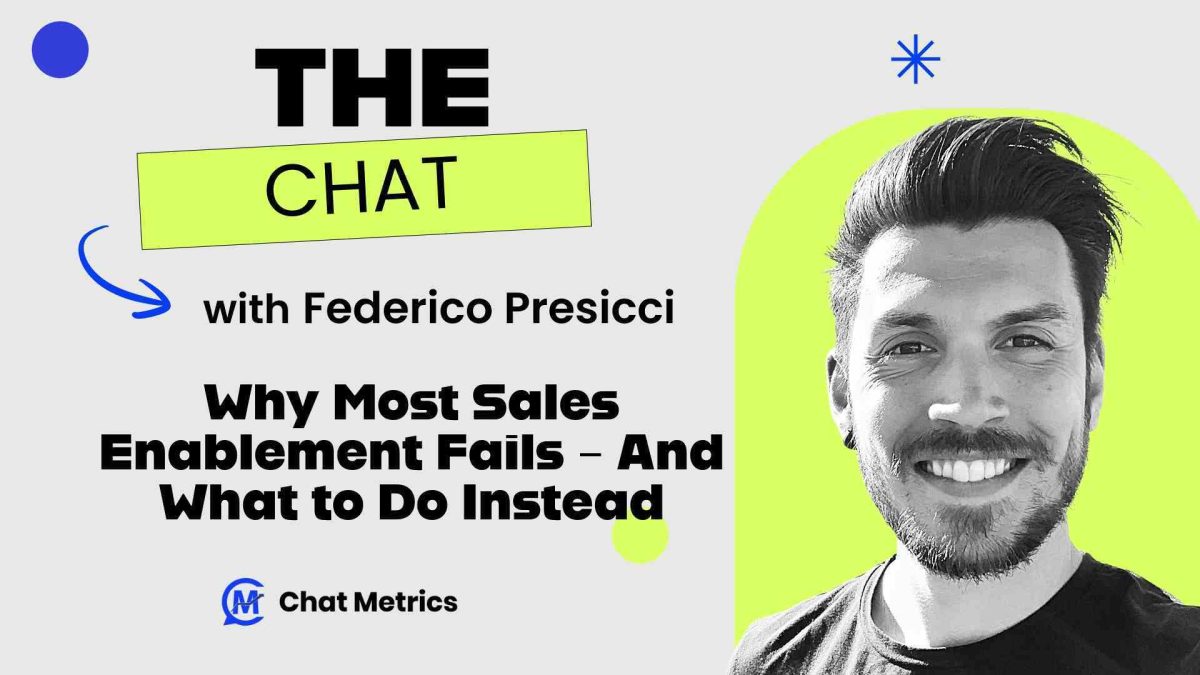
Episode Title: Why Most Sales Enablement Fails – And What to Do Instead
Host: Terry Wilson – CEO of ChatMetrics
Guest: Federico Presicci – Director of Sales Enablement at GetAccept
Federico leads global sales enablement and training strategy, helping GTM teams scale performance through smart systems, not guesswork.
Summary:
In this episode of The Chat, Federico Presicci breaks down why most enablement programs fall flat – and how to build systems that actually drive pipeline. From failed AI experiments to broken messaging frameworks, Federico shares what most teams overlook when trying to coach reps into better performance. If you lead sales or marketing in B2B SaaS, this is the one to listen to.
Key Takeaways:
[01:00] – The Limits of AI in Sales Messaging
[05:00] – AI SDRs in the Wild: A Cautionary Tale
[09:00] – Use AI as an Intelligence Layer
[15:00] – Frameworks That Drive Messaging Consistency
[20:00] – From Generic to Precision Messaging
[25:00] – Why Structure Beats Scripts
[28:00] – Coaching Won’t Fix a Broken Environment
[32:00] – Diagnose the Environment First
[35:00] – Most Reps Don’t Know What’s Expected
[39:00] – Leaders Must Design Culture
[43:00] – The Real Role of Enablement
[47:00] – How Federico Got Into Enablement
“You don’t need more enablement content. You need messaging that survives contact with the buyer.”
Links & Resources: Connect with Federico Presicci on LinkedIn
Learn more at https://www.getaccept.com
00:00-
Welcome to the chat, come behind the inbound scenes of some of the world’s fastest growing companies for the past 10 years. As chat metrics. We’ve had an exclusive inside view of how these industry leaders are revolutionizing inbound marketing and sales. Across diverse sectors. Each week we bring you conversations with top minds in marketing and sales who share insider secrets and strategies for driving inbound success.
Join us on the chat, your front row seat to the future of inbound.
Terry:
Today on the chat, I’m joined by Federico Presicci, director of Sales Enablement at Get Accept. He’s built systems that align sales messaging and coaching to drive real growth, not just more noise. In
01:00-
This episode, we’re get into what makes Positioning Stick, why most enablement fails, and how to use AI without losing clarity or creativity.
Terry:
Let’s get into it.
Federico:
Thank you having me Terry
Terry:
Welcome, welcome. Where do you think that teams should stop using AI in messaging and where can it actually make things better? Frederico.
Federico:
yeah. So, okay. Stop using AI messaging. Yeah. definitely, certainly something that, AI should not be shied away, because, I think. Still a necessary tool. And I think the more we, let’s say no work with it, the higher it is the danger of course to be left behind. Especially because AI in every front, even when it comes to writing for example, I’ve experienced how much better has become of the last 12 months as well right.
Terry:
Mm-hmm.
Federico:
I think the first important thing is to be able to have, when you’re writing messaging, have the necessary intelligence that is provided, let’s say to ai or if you’re using, for example,
02:00-
agents, if you’re using some sort of automation to create. to support messaging, for example, reps have to send out to different types of personas or customers. In such a case is the most important bit to get right is that if I’m in enablement of you’re in product marketing or marketing, is making sure that the, you know, the SEP information, the everything to do with the personas, this intelligence layer essentially that you
have refined and you’re continuing to refine over time informs the way the messaging is sent out. and that way, you can make sure that everything, there is some common threat right now. There, of course, there is a point on not only then what is the int intelligence feeding everything, but of course our DI tool is used in the first place by a rep or, you know, by anyone we’re sending out externally facing mess, you know, messaging because, the reality is of course this fits too heavy and this AI made and so forth.
Federico:
We know that now bias, you know, too tune off. and that is a problem. and. Therefore, again, there is a law enablement that can be done to people to understand how to better utilize
03:00-
those tools. In this case, probably we’ll talk AI tools, to write in a way that, it really enhances the way you would write rather than being necessarily, per se, a complete, let’s say automation of that without thought. So that’s an important consideration, I would say.
Terry:
Yeah, so, really magnifying your own voice rather than becoming a fabrication.
Federico:
Yeah, I think, and of course, there are two ways. sometimes of course, you do start with AI that has what has written, and then of course you modify accordingly. And then the other side, you of course, is sometimes you just write something and then use the eye to elevate it. in most cases, I know that the second one works best, but understand in many contexts in organization, that’s not the case because of course, you’ve got the tools that is creating the ai generat generated like email messaging on the spot because we use as well, you know, ai, co-pilots, all these kind of tool, and that’s fine.
Federico:
I think also for meeting somebody, to be honest, no big deal because these things are just, automated, it’s okay, but more about communication and things like that, that are more like, especially at certain
04:00-
stages of the sales cycle where things become a little more critical. I think, that given that personal touch, the human touch is very important. so I think it has to be, that’s why it is oversight is very important still to be there in order, you know, for things to work properly. And I think businesses should not just run, especially for the, the things that are more critical in relation to customer and prospects should run entirely based on AI without human oversight.
Terry:
And so have you seen any time where AI has taken over or it’s gone a little bit too far, or it’s been used too much without a person checking it properly where there’s been some problems?
Federico:
Yeah, I mean, not in that sense, like, you know, fully, of course I had, I speak to many leaders. I speak to many, especially, I mean, a lot of the DCI stuff as well are handled by revenue operations often. I know.
Terry:
Mm-hmm.
Federico:
that, that can be things like, of course, I mean directly one thing I, we’ve tried is the AI SDRs and, you know, we, we trial it for three
05:00-
months or so, so our rev ops, director decided to test it out and see. We could basically expand our, like, let’s say reach in terms of okay, having more account perhaps not necessarily like the perfect fit, fully, but we are just expanding slightly our SAP to see how they respond. It was basically a test. And, and for the most part of course D-C-I-S-D-R often what they have is they have like a different emails.
Federico:
They have, they are warming up those emails to try and improve deliverability, and then they’re sending, you know, I dunno, it could be like some a thousand emails a day or something like that. and they, you know, are provided with documentations and everything about the company, you know, SEP and so forth.
Federico:
And then they out there doing stuff and I think they can also utilize LinkedIn, as well. So at, at the end, I mean there were a few meetings booked over this period, you know, three months. But to be fair, in relation to the actual output that was, it out there as. yeah, promising as we, we thought, or especially as, you know, the rev ops person that was really handling thought. So in the end, we didn’t really,
06:00-
progress further with the tool itself. and we are finding other better way in terms of being able to actually, rather than necessarily increase volume because of course he’s still trying to make things more efficient for the reps, but more about like, how do, can we increase precision in terms of, utilizing data signals, and all this kind of stuff to be able to basically know when someone, when a potential prosper or an account is more, let’s say warm to be reached out to because of various factors.
Federico:
So I think that is definitely a better play. And also where AI still can help because it can, AI can be a very powerful aggregator of data,
Terry:
Mm-hmm.
Federico:
and I think that’s probably a better use of data than just blasting. Out there, like in an efficient manner with the ISDR. Now, I’m sure there are probably other companies out there that have implemented it, like, andmaybe it’s working, but I do know though that there are many organizations that have tested and tried the ISDR and of course have has been very much it and miss, other situation of course are also when it comes to maybe inbound handling, like, you know, of like communication.
Federico:
Of course AI has been leveraged in
07:00-
many of those situations to try and reduce the amount of, you know, work that someone might do from support or other functions. and yeah, that as well,need to be traffic in a way, careful, because of course if AI is not very, in a way there isn’t some oversight at some point to understand how this interaction are going, what can happen is of course, maybe the AI goes off track in terms of not being able to respond in a way that it should respond to customer queries. Things like that, or just providing, inaccurate information and then what happened? That damages trust, right? And trust is, as we know, it takes a long time to build and then you lose it very quickly. So, and then you, that can really damage, interaction you are having with your customer.
Federico:
And there are stories so that I’ve read in different places like Reddit as well, where every now and then, I do check on what’s going on with AI as well, where,
Terry:
Mm-hmm.
Federico:
maybe people implemented an AI chatbot and then all of a sudden you have a 90% drop in, requests that previously came through because, you know, the buyers are now seeing, realizing this ai I don’t wanna interact with your
08:00
website or whatever that you are leveraging.
Terry:
it’s interesting. We see a similar sort of thing across our customer base as well. Whenever we test, and move away from it being obviously a live person in the live chat and having it as either a chat bot or an ai, we make it appear that way. It’s still a real person in there. We don’t wanna miss anything.
Terry:
but there’s a lot less engagement. There’s just a lot less people wanna talk to a chat bot or ai. It seems certainly across our customer base, sort of, you know, that mid-market, mid-tier, with larger deal sizes. So I think for sure it’s something that we are definitely seeing.
Terry:
Do you think that, as far as the AI SDRs are concerned. I know you haven’t had much experience with ’em directly, but are you hearing anything in terms of improving because of, I’ve heard the same thing. You know, a lot of businesses got very excited when they heard about the AI SDRs. All of a sudden, you know, these, we can get rid of 50 a, 50 SDRs and put in two AI SDRsand triple volume.
Terry:
But from what I’ve heard is that they’re burning through their total available market so
09:00-
quickly, then they’re just getting through it in such a short amount of time because of the massive volume that they can do.
Federico:
Yeah.
Terry:
Like you said, they’re booking a few meetings, but from a conversion rate perspective, it’s really, they’re not performing that well at all.
Federico:
Yeah. No, I think, the way I see it is thatI’ve actually interacted with a few companies that are, I think, approaching the problem in a different way, which is, I think, interesting. The way you can look at it is, you can have like a. An intelligence layer, as I discussed before, like what’s important for all a, any agents that is use is the intelligence layer.
Federico:
That’s the most valuable thing you ever get. And I do believe again that, for example, if you look about enablement, enablement has a big role in, in helping out, in shaping that intelligence layer that then the AI agents are deployed from. and that can, of course, AI agents can be deployed by the, you know, the robot people.
Federico:
Generally, they are the more like focused on the technical stuff and looking how everything
Terry:
Mm-hmm.
Federico:
integrates with the CRM, for example. But, you know, there are alsoenablement people that are very technical in some areas I can also intervene. but that’s the first layer, right? And then what you have, like the
10:00-
layer, which even an ISDR can, you know, immediately have, because then the ISDR could be considered agents are out there like leveraging information.
Federico:
Then active, is that you can have like an AI agents that for example, all it does is aggregating your signals. And all of the, and do the research for you. So then it provides you, for example, it provides a rep with all of the information about this company, the most important bits, and then also maybe some important information about the prospect as well.
Terry:
Hmm.
Federico:
That can be something that they can have at their fingertips and leverage and immediately to basic create messaging. Now, then you can have as well, of course, you know, generative AI that can support you with using that information, using the background information of ICP and everything to draft a message, that it can be sent out. but then there is also like, a part on the combination of those two already. Just if you take those two, the fact that you’re aggregating data, helping with the research, and on top of that, supporting with the messaging or with a baseline framework that is the company framework.
11:00-
Then already provides a higher, I think, control over the use of ai, but still is increasing output and efficiency, for example
Terry:
Hmm.
Federico:
And in a way that doesn’t need to get to the level of an AI SDR, but still will provide the results in the sense that you can have one A or one SDR, for example. They might do double their output,
Terry:
Yeah.
Federico:
quality. That’s the question, right? Because it’s a, we are trying to make trade offs.
Federico:
But the question I think is also, can we actually not make the trade off and be able to, you know, increase the output in a way, but without sacrificing the quality of it or actually even improving it compared to what, SDR without information would do. Uh, and I think, best use case as far as outreach, and again, our data is concerned is aggregating data and signals that are coming from different tools. is very, you know, super powerful that. On top of that, you can also have other use cases like where the AI agents can actually filter your accounts based on ICP automatically, right? You don’t have to do much. It just provides you directly with the thing that
12:00-
already filtered out based on criteria that, again, have been set by the company. And that’s why, again, who is ever is in charge of the intelligence layer is, that’s the most critical thing today. I think company need to understand, as we all know, like the data that you feed into eye, you know, really is, related very strongly to the output. So intelligence
Terry:
Yep.
Federico:
has to be super strong. if that’s not, then probably you get poor results, in the first place, even before you even think about training the reps on how to use it.
Terry:
There’s a recurring theme in these conversations, Frederico, where people are talking about the AI and they will mention that it’s about something that’s a fee. It’s the input. It’s making sure that the, as you’ve said, the signals are correct. That goes in at this stage. For me, AI is still a little bit like a tool.
Terry:
It’s like machine learning. it’s the old software adage, garbage in, garbage out. I think there’s so much, it’s not the AI that’s making mistakes or not doing things properly if it’s not had the
13:00-
correct input from the start, there’s not been the right effort to go into it. I mean, it’s different
Terry:
When you’re blasting a market with high volume, it’s hard to get it down to those refined pieces. But I think what you’re talking about with regards to getting the signaling in that right, then all of a sudden you’re moving away from mass multiplication back to two x or three x because the individual’s still the one that’s doing the interaction and has that final filter across the messaging that goes through.
Terry:
That seems to be the model that’s working at the moment.
Federico:
Yeah. And if you get, I mean, honestly, and also reality, don’t only that, but if, let’s say you two x your output, but also you, let’s say two x your conversion, now we are talking already, like order of magnitude that are very high. So you don’t necessarily have to, 10 x your output, right? So I thinkit’s always that play conversions versus, you know, effectiveness versus efficiency.
Federico:
I think if you play it right with both, you can really like, you know, forex your, your actual results, which at the end of the day is what actually matters. And also,
Terry:
Yeah.
Federico:
very important as well, is the buyer experience you are providing. whether you,or even call it sales experience you’re providing, because there also today, especially in
14:00-
tech where there is a lot of competition, the tool software are very similar, is actually what makes a difference, right?
Federico:
So how they have felt during the buying process, you know, the stake, whether they were the stakeholders, do does matter a lot. and people make decision based on that. At the end of the day, still is a human factor,
Terry:
Yeah, absolutely. Absolutely. And I think whatever, it’s a particularly depends a lot on the deal size as well. The, the bigger the deals, the more humans gotta be involved and yeah. Say from that side.
Federico:
Yeah, I know. That’s of course. Yeah. Then if you go, yeah, that’s a very important dimension. Yeah. Because, again, things become a lot more nuanced as you start to look at the dimensions, for sure.
Terry:
Mm. Mm-hmm.
Federico:
the other spectrum. Enterprise. Yeah.
Terry:
you, we, we might switch it up a little bit here and, and, I’m interested to talk about, you’ve got a theme, where you argue that most companies copy what others are saying instead of clarifying what only they can say. And that lack of clarity makes outbound weaker and conversions lower and funnels heavier and all of the things that
15:00-
go along with it.
Terry:
so how do you refine messaging and positioning, for your individual company so that it is standing out as the only thing that they can say
Federico:
Yeah.
Terry:
that only they can say?
Federico:
Yeah, it is an interesting topic, of course, and I don’t believe it. Like, it doesn’t need to be like, I mean uniqueness I think is also brought by individual. and also. There is an element of course, of branding and tone and how we wanna talk and so forth. I think it definitely can be embedded in your AI today.
Federico:
That’s actually a very powerful thing to do in terms of the messaging. Uh, not too long ago actually, I’ve worked on building a messaging framework for the company. And what’s interesting today is that, you can combine AI in different ways. So the way I’ve approached is first defining a framework.
Federico:
So you define a framework where the idea is to, let’s say you have segments, you might have like, you know, as we discussed before, you might have like small businesses, you might have like mid-size, and then you might have a large enterprise. So let’s say we have three segments, and then within those segments, you have different personas.
Federico:
So in the small businesses, maybe you have the
16:00-
founder, maybe you have, I dunno, the CFO. and maybe, I mean, we sell into sales, so okay, maybe sales,
Terry:
Mm-hmm.
Federico:
then have a mid-size. Of course, you start to have more structures, so you might have also operations and you got enablement, so you have more other personas and then enterprise you, but even more so within those 10, you have vertical as well if you want, slightly get more complicated if it matters to you, right?
Federico:
So you, I think those are the three main dimensions. So you’ve got like, the segment you’re in, like in terms of size, business size, then you got, you know, the persona, you got the vertical. then, normally will have conversation with your customer and the prospect on an ongoing basis.
Federico:
So if you have, for example, an AI copilot on a conversational intelligence tool today, of course, that are tracking most conversation, especially if you’re in a field where you can, then that is very valuable information. Right, and what you can start to do is that, let’s say with marketing and, and just leadership and go to market, I’ve defined already ICP, all this kind of information, right? Then that is that, and, okay, perfect, we have this information. But then when you can start doing as you like your conversation intelligence tool,
17:00-
speed recording calls now today with the combination of conversation intelligence and generative ai and just in general, like in fact you can extrapolate any insights you want from all of the transcripts. Then you can start actually using that data to truly inform what matters to the bias, right? And what is resonating well, what is not going so well, more and added, you know, question, you might want to, you know, be answered, right? So what I did in my, in my, you know, kind of approach to actually build a messaging framework is like, okay, I know already. Ps the persona information that marketing has produced in the past, all this kind of stuff. Then I built, basically, I’ve gathered data from the, our actual conversational intelligence tool, depending on, segments. So I’ve broken down by segments, then start to look by personas, and then I, slowly I started to fill my own framework that I created.
Federico:
Basically, like there were different elements to the framework where there was, you know, an initial cards that describes basically the segment and what. are the value drivers for these segments? You know, what kind of context they’re in, in most cases, all these kind of very more
18:00-
general macro information about this type of business.
Federico:
And then you start going layer deeper, right? So you start to go into the vertical, like for example, information about, you know, what, how things slightly shift for this business size within this specific vertical. And then you go even deeper into the personas. Now, the vertical I found in my experience is really, it can be really hard to reconcile the three things, the segment, the vertical, and the actual persona information.
Federico:
So I would, in general, I would suggest for company who don’t wanna have a dick to start with, to just to focus on business size that determines the way a company behaves. And then you have like personas, which is also utilizing an ai, you know, compiled is much easier to work because in some cases with industries, maybe you don’t have enough data, enough volume, I mean, unless you have a very specific industry, I work, okay, we are three main industries.
Federico:
These are the one we work in. That’s easier. But in many cases, in our case, for example, we have a lot of industries where very small, like we have a few deals on them, but you know, we maybe have it and tech that is quite a lot, a
19:00-
majority of our, let’s say deals, but the rest is very difficult to really say fully that this is how we can generalize.
Federico:
But with personas and things like that, if you’re having, thousands of every quarter, then it start to become easier because you’re interacting with sales, interacting, with sales operation, with enablement, with marketing. And that way, you know, I’ve been able to build a very comprehensive framework.
Federico:
and today of course, I’ve built on my own. But, and this is thanks to ai, but otherwise you would probably need. Multiple people to work on it, to be
Federico:
that way. now what that does is that we have integrated that into everything to do that allows us to create sequences that allows us to create, you know, calling script for example as well, LinkedIn messaging, video messaging on LinkedIn and everything.
Federico:
So the idea is that the reps gets a baseline, script that is based on this intelligence that they can start with. So it nudges them already. For example, if you don’t wanna do the work of, already like having to write your email or whatever, because today I think it should not be accessory to the
20:00-
extent you should have a head start, then they can already leverage that and then they can tweak it, right?
Federico:
So they can the sequence, they can tweak it, they can also tweak it for their core script, but they still have a core script that is based on that segment that they’re focused on. Plus the persona they’re talking to and already like that, even without doing any work, you’re already giving a better touch of relevancy and personalization to that persona world rather than, you know, just speaking more generically.
Federico:
Now, what we’re trying to do as a layer, step deeper that you can go into when it comes to messaging is that once you’ve done this baseline work, you start to use AI on top of it to actually research the actual prospect in details like, you know, it may work personally more personally, and then blend has been discovered right in a timely manner with the information that already you create for creating, you know, the sequences, the scripts, and then you kind of create an alternative version of the actual script, for example, on a coco that is slightly more, based on the same baseline, but slightly more
21:00-
refined to even be more personalized.
Federico:
that way, you know, I think you can really, truly get to a level of personalization and relevancy, without sacrificing quality, but with it much more extreme efficiency.
Terry:
Mm.
Federico:
and again, it’s all based on, as I said before, on the underlying work that you’re doing, which is, I think two most important thing.
Federico:
Number one is the framework you decide to feed the information into, because that is something that will inform everything. You, you search, everything, the question you ask yourself to answer to that, then you can put information into the framework and then the quality of the actual data you have.
Federico:
And I think if you’re a company that’s using an ICO pilot or conversational intelligence, that’s the most valuable data you’ll never get. Like, and I think many companies don’t understand that. Many companies don’t focus on really trying hard to extrapolate value information from the customer, because that can inform as well the GTM decisions that they’re making. and way it can really change the trajectory of a business, right? So if you do so.
Terry:
it’s the highest value information that any organization can have. The voice of the customer, isn’t it?
22:00- Federico:
Absolutely. You know,
Terry:
Hmm.
Federico:
without doubt. Yeah,
Terry:
in incredible, the framework that you used. Is there, is it a basic, framework that you can share? Is it something that’s very customized for where you are?
Federico:
No, no. it’s not, it’s very general, I would say. I mean, there are different components to, but to give an idea, like, you know, if, if you’re looking at, the, so if you start from the segment itself, you have information about, okay, what’s, trends, macro trends that are, affecting perhaps, you know, small businesses or something like that.
Federico:
Then you go deeper into what are the, value drivers, for that company. Of course, when I talk about value drivers, there are many value drivers for a company, but you have to look at those one that are the value drivers related to your service and product to an extent, right? So there has to be. ‘ cause that value driver could be around so many areas of the business. So of course you wanna focus on that, but still, it’s basically what is the value drivers, is that, what are the things that would make them pay attention? Right. So, thenyou can describe pains as well, more generally what kind of
23:00-
pains these companies tend to have. and you know, this is kind of a very much like the general information. there are a few other items that, you can forget more specific, apart to the framework. Then if you go into the persona part again, there, you know, you’re finding the same thing in terms of okay, what they’re measured on. What are the things that keep them at night, that are very,very prominent for them? What are the stakeholders they often work with, with the report generally into what are typical job titles? and then,you are looking at as well, like what they have found, you know, most valuable.
Federico:
For example, in a related product to you, based on the data that you have, information, what kind of language tends to resonate with them. All this kind of information are in that card. So it’s a bit like having, you have a cardfor the segment. You have a card for the persona, and then, you know, you can also have a card for the vertical within that, a segment.
Federico:
But it’s all within the context of the general segment, right? So the segment is the umbrella. Then you have under that embraces everything. And then
24:00-
you have the, these other cost to it. And then these three things combine as a stack that then AI can use to generate if for then ai, you give him a very effective framework for, email writing, which I do have as well.
Federico:
We have a good, a very solid framework to be able to know, to start with an observation, you know, to go slightly deeper into what is you know, potential likethe pain that you have observed in other companies, and then what is the value that you provide. And then you have a a soft CTA, you have that framework, then you combine the segment information and all the cards. With the framework and email and then you can generate a really good email and then you can have a sequence of those emails. And then you get same thing. You can have a framework for the phone prospecting core call script, which we do have as well, a methodology essentially
Terry:
Yep.
Federico:
That’s why I think methodology matters.
Terry:
Yep.
Federico:
methodology matters today because it provides a very consistency in the way communication can be leveraged. and then AI can be, you know, leverage AI to basically fit things into that methodology so that everyone is on the same page in the structure. I say it to my reps all
25:00-
the time, is not necessarily about saying things with exactly with the words.
Federico:
A script is most important thing of a script, let’s say, is the structure. It will provide you so that when you’re in a conversation, can follow a flow and if I get off track because I get an objection or something, come back on track in the flow and know where I am. Because otherwise you start winging it.
Federico:
You dunno anymore where you are, you dunno what you need to do and then you lose yourself.
Terry:
Yep.
Federico:
Structure gives youa sort of something to do fall back on. And the same is for objection. You know, providing frameworks and methodology on how you handle them more than how you respond to this objection because people have to memorize those things and it’s really hard.
Federico:
But if I give you the methodology of how you approach any objection, then I can, you can actually deal with that correctly. Now this is powerful because AI then when you provide templates framework to ai, it does a great job, right? Because he has some guardrails and guidelines, and that can be con made more consistent across the organization.
26:00- Terry:
Absolutely. Absolutely. So tell me, in your role in enablement, sales enablement, if there was just one lever that you could pull or one thing you could do to start with into new into an organization, what do you think would be the one that would have the biggest impact?
Federico:
I, believe there isn’t, that decision has to be made based on the, analysis you do. I don’t think every organization is different. One thing I would say is that. it’s interesting, right, becausewhen I started my career, I’ve been very focused on, of course, doing the best job I could in terms of whatever I was trying to deliver.
Federico:
Whether it is like creating a program, for example, I would want to be as perfectionist as I am in a positive, you know, connotation, but still perfectionist. I guess the idea was, okay, I can build the best program, like the best discovery program or the best like, you know, cold calling program and so forth. So very much focused on the content, the training, design, learning and development, so forth. What I learned over time is of course, that, often even if you build the best program and so forth, unfortunately performance doesn’t move and that because as so many other factors
27:00-
involved. Because the bandwidth for rep is very limited.
Federico:
Bandwidth for sales managers are limited. So often the reinforcement doesn’t happen. Often the environment or the lending culture isn’t there yet, and you’re already going too much. I it compared to where the comp the organization is. So for example, I already start to take into account and now when I join a company, what is the level of maturity the company is in from a sales organization perspective, in terms of processes and so forth.
Federico:
But also from, just generally learning, right? How people are, how people used to learn ongoingly, how they used to use e-learning, for example. because I’ve been in organization where I come in, I try to leverage e-learning, and then it doesn’t really engage much because people are not used to learning.
Federico:
I’m used on live session all the time. So then in that case, you wanna maybe go a bit more hybrid and start with a heavier. like one, you know, kind of live, but with LLM, elements of e-learning. So you start to introduce the concepts slowly, right? And you focus on Lessing rather than more. Now what I’ve learned in over time is that
28:00-
environment is the most powerful thing. So when I’m looking at performance and if, what I would recommend people is that when you join a company, rather than thinking too much about, necessarily immediately like skills and knowledge, to think in terms of environment. And when I say, you know, environment, I mean looking at processes and looking at the most important areas of the business that generate revenue.
Federico:
And they are a competitive advantage for the business. Understanding whether we do, we have and processes defined, because if we don’t. already the, a good step to start with, especially, let’s say if you’re a medium organization talking about maybe at least a scale up in the process, scale up where processes start to become more important. In that case, you wanna start to define those processes with the stakeholder, and you can be the one orchestrating that so that everyone is on the same page of what’s expected in those processes. And that informs how people that do the steps in the processes have to, you know, are measured on and the standards.
29:00- Federico:
Another area is incentives and consequences. For example,
Terry:
Mm-hmm.
Federico:
Are the incentives, like, financial incentives, but also non-financial incentives? Like, do leaders recognize people? Do we have a culture where we celebrate the wins on an ongoing basis? Basic questions, but again, if you notice that these things are in place. Most likely great place to start because we know any system works based on incentives and consequences. You know, if I do this and I do wrong, there is some consequences. And consequences doesn’t need to be necessarily like very negative. Like build a fear culture yet, you still want to have some consequences in terms of maybe it’s like, being, given a strong feedback, constructing feedback in relation to something still there.
Federico:
I would say you can be considered a consequence in the sense that I’m suggesting you an adjustment with some sound feedback that can really change the behavior. Incentives instead is more like how do I reinforce positive behavior? So this is, another layer for example, that you can look at, at an environment.
Federico:
Then there is also the managerial
30:00-
layer as well. what is the ratio between like manager and reps? Is there a good ratio? Is there a bad ratio? If we have a bad ratio, we have to make a decision that what do we do? Another question enablement should be like, do we try and increase,improve that ratio?
Federico:
Discussing this with leadership. Giving a sound, let’s say narrative about why, or do we do something where we can increase capacity of managers by using tech, for example, that are put in. But what’s important there? I say that because I can also build the best training in the world, but then if the manager doesn’t have capacity to coach and support the reps, then that is pointless. As a result of that is about the order of things. And that’s why I believe like you better off looking at the overall, environment in which you are operating in. Look at this levers. And actually I have,developed a, like a sales environment assessment. What the idea is when I work with CROs, I just say, take this assessment. You do, they do it. There are different areas in it. Then I see where they’re
31:00-
weaker, right? And then from there we decide, okay, you by changing actually this thing you’re probably gonna get for the least amount of effort. The biggest. And I think that’s what I’m looking at right now. So the first thing I’m looking at, you wanna look at the things that you can do with the least amount of effort that provides you the biggest return.
Federico:
And that’s to be found in the environment of an organization rather than on the actual, in the people itself. because people itself takes time to change. You know, people takes time to change. So if you work on an individual level you, okay, I’m trying to develop these skills, this attitude, this mindset, but then the company around it or the culture around it, the environment around it doesn’t support a behavior, such a attitude, such a mindset, then it is, you are basically wasting your time because it’s not gonna have, you might change a couple of people, but on an organizational scale, the bulk of the people won’t change because they will go along with the system and that’s what you’ve got to change.
Federico:
And then you will see that everything else changes as a result of that.
32:00-Terry:
Absolutely. Absolutely. the environment that you talk about, the culture, the climate of the organization is probably the single biggest determinant factor on the output of the individuals within the organization. And you mentioned consequences. Consequences don’t need to be negative.
Terry:
Consequences are simply what happens after behavior generally. Sometimes they’re good, sometimes they’re bad. No consequence is also a consequence. If you don’t deliver any consequence, then that’s not gonna have an effect either.have you read the book called Getting the Most Outta People by Aubrey Daniels?
Federico:
No, never.
Terry:
I can strongly recommend that for you. I think you would enjoy it. it talks very much about the impact of consequences on behavior and how best to decide which type of consequences to give. and whether they should be, you know, near or in the future. Are they certain or are they uncertain?
Terry:
It’s quite a good book. I think you’d enjoy it.
Federico:
Yeah, no, I just wrote it down now and there is so much work that has been done actually in the nineties, end of the nineties, which is, is interesting how some of the
33:00-
best book on performance as there is a field called performance engineering.
Federico:
Right? Which I think, that, that has already emerged towards the end of, you know, the, the nineties. And I think it’s crazy how in some ways we moved away from some of these models and now some of them are returning and I think they are an exceptional pieces of work, from like, honestly I would say geniuses or of, organizations and. And again, I think, yeah, there is so much that we can, you know, learn from, from just by looking at the environment and our overarching system, basically system thinking. And I think today, especially with ai, and as, as it does more of a, of the, you know, of the individual task and, and increasing that with AI agents and so forth, like system thinking, strategic thinking, all this kind of stuff are Like for us to be able to run things effectively. And it become more and more importantfrom even entry, like more lower level like roles.
Terry:
Absolutely.
Federico:
Go up. Right. So,and, and final thing I would say in terms of the environment piece that it just came to mind is the fact as well, that often, you know, you work out in an organization and you know, they’re doing so many things.
Federico:
So then if you ask the
34:00-
simple question, okay, can you tell me exactly what are the expectation for, let’s say the reps, what are the standards that the the key performance indicator you’re looking at? maybe they tell you that, oh, we’ve got targets. They’ve got like a number of, you know, booking meetings they have to do.
Federico:
But then that is, that is it. But what’s important to understand is that if you, people know exactly what’s expected of them, not just for the outcome or, you know, the,what needs to be achieved, but also partly to how to guide the actual how of the process too.
Federico:
Just to showcase them. What is a baseline of good and then. You have that baseline of good, and then around that baseline of good, you can provide feedback. You can coach people because you’ve got a standard, most organization. What they miss is that they don’t even know what’s expected. Like reps don’t even know what’s expected of them.
Federico:
Managers don’t even know what’s expected of them.
Terry:
Hmm.
Federico:
Of that, you cannot give feedback up properly. You cannot coach, you cannot create a performance management system around it. You’ve got to define standards that, people are held accountable to. And
35:00-
those standards depend upon the value of the organization. You know, depends on things that are unique to the organizations, but they have to be defined. So simple work that is very basic in a way, but an organization don’t have, and that undermines everything, like absolutely everything. so that’s another, for example, environmental factor that you would take into account.
Terry:
Can I ask you a question? You’ve got a, a blog that you’ve started to write. How’s that going for you?
Federico:
It’s gone well. it’s, you know, it’s a project started about. Two years ago. and the reason I started is because I did notice that on, Google when I was searching for enablement related materials, there weren’t really very good content. And, you know, often as you as we know, like things start from our own pains, right.
Federico:
And I read loads of books on enablement already. There weren’t too many. and then, you know, several, and then I will search things on Google, try to find them. And I’ve noticed that everything was dominated basically by company that are trying to sell into enablement or sell into sales.
Terry:
Okay.
Federico:
You know, and you will have the HubSpot, the Salesforce, and as well, like
36:00-
all, every time coming up because they’re so strong as a website. I’ve noticed that, hey, you know, I think there is no practitioner that basically is writing and, and is ranking on Google. Why is that? And I said, and then I made some research. I’ve always been interesting in SEO, and that’s what led me to start the block. And I said, okay, you know what?
Federico:
I’m gonna try and. I’m gonna stick to it, write, you know, five, six articles long form like a month. and on topics that I find interesting, and I document also my journey. And I did it with the way like that I was trying to also to rank for keywords on this, on Google. And then, you know, first year of course, very little, right?
Federico:
But then what happened is the last, probably eight months, things started to pick up and at some point, you know, we reached, 1000 just clicks on organically, just, without doing any, you know, like, spending any huge money on SEO just by quality content. And now things are growing really well.
Federico:
Then of LinkedIn is a big driver of traffic as well on my websites. So. Right now, we can get to almost 2000, uh, 1,500 to 2000, uh, you know, visitors a month,
37:00-
uh, that come to, to look and there’s a lot of recurring people on the blog. And, yeah, newsletter is going well as well, you know, reaching, almost a thousand subscribers or like, leaders in enablement operation and, you know, and also like, uh, yeah, mostly just sales, of course revenue leadership. Yeah. So it’s been a fun journey and I still continuing and I feel privileged to be in a position where now I’m writing and actually people are reading. so that’s a nice feeling, uh,
Terry:
Yep. Yeah,
Federico:
to reach.
Terry:
Absolutely. Absolutely. We’ll have the link at to the blog, obviously underneath the podcast, the link to your LinkedIn and the blog. is there anything that you, I’ve not asked you yet that I should have asked you? Something that, you really, a message you want to put across?
Federico:
Uh, no, I think I’m very glad you asked around the, the question around what would you do in your organization if you get, you know,
Terry:
Hmm.
Federico:
you get in. I think it’s a, is a very good question. I think I, something that I will have, you know, in this point, if you didn’t ask me, I would have really shared in terms of the importance of at the environment, I
Terry:
And can I say the answer you gave? you know, in my mind is absolutely perfect. I’ve had a
38:00-
long ex experience, a long career in executive level roles in sales and marketing roles throughout my life, and I’m a firm believer that it’s the leadership in an organization that there’s an old saying that goes, the fish rots from the head.
Terry:
And so, in the organization, it’s the leadership that determines the culture and the environment that the people are in. And it doesn’t matter how good the attitude, personality, skills, and knowledge of any individual, if it’s not an environment that’s gonna allow them to perform to their best, then you have the normal to be expected outcomes.
Terry:
You’re gonna have underperformance, you’re gonna have increased churn, you’re gonna have stars leaving, you’re gonna have underperformance staying. Andit’s not a good, outcome for anyone. So I think you, you’ve hit the nail right on the head there and obviously the approach of, you know, there’s not one cookie cutter for any organization because always the climate’s different, the people are different, where they’re at in the stage of development, the scale of the organization, everything’s different.
Terry:
So it was very, very, very good. Nice.
39:00- Federico:
ability appreciate it. and I think that’s where the most important skill set is, especially if you’re a leader that is coming in a function, like how do you do the analysis at the beginning, right? So, and because that at the time is the decision you make and the time is where you put your resources and effort.
Federico:
And of course in a world, especially also as I talk from enablement perspective, where we are really limited in resources, that becomes even more valuable becauseif you’re able to get it right, when you make the decision and the call, and then you’re able to provide impact early to an extent, then that allows you to get more budget, more resources, which then leads to better things, you know?
Federico:
And when you have more resources, of course everything gets, a little bit easier in a way, because you can tackle more things. And even this, the smaller things. And then final thing, I think what’s interesting when you said that consequence is still a consequence, I think that’s very interesting because when we talk about values and behaviors, For example, we say in a company that these are our values, but then what happens is when someone is behaving in a way that doesn’t align with the values, nobody says anything, then what’s gonna happen? You think because we are not basically from an action perspective those values and we’re
40:00-
not correcting it as we see it as a result of that, then what takes place is just what happens that people are seeing, and it might just be completely the wrong thing. and that is on the job, on the, as you say, leadership and management, but also peers. And that’s something you can instill into them, unlike actually calling it out in a constructive way so that the right behaviors are reinforced. And if there is something that is under someone is undermining those values, even if they’re giving a good performance.
Federico:
Sales-wise, I believe companies should, cut that because it’s very contagious and it doesn’t, it won’t help you in the long run. Right. it won’t really help you in the long run and it will just cause more damage than anything. Right.
Terry:
Most definitely. it’s a phrase I always use is the standard you walk past is the standard you set.
Federico:
Yeah.
Terry:
So when you’re silent. That’s, that’s ratification silence is effectively ratificationthat’s acceptable.
Federico:
Yeah,
Terry:
And the people that are trying to do the right thing, you know, if the leader doesn’t stop the wrong behavior, then what chance of the
41:00-
peers and coworkers got to be able to
Federico:
Exactly.
Terry:
up and have an input.
Terry:
And like you said, conversely, the ideal environment is one where you’ve got it so that the peers and coworkers feel comfortable in, in speaking out, knowing that it’s not the way things are done around here, but that comes from leadership. It all comes from leadership.
Federico:
Yeah, yeah. No, for sure. It’s, and also the debate around as well. I think one other thing for last thing I will ask, I will leave like people with this, like the difference between management and leadership, I think that’s a very interesting one because, you know, after a manager is called a leader, vice versa.
Federico:
Another question is, is it management the same thing as leadership? Like it’s not, but however, the two things can work very well together because. the reality is that first and foremost, you don’t need to be a higher up person to be a leader, you know, as probably know that, right? and the manager is more related of cost of opposition you’re having in an organization, but it’s all about the balance between structure.
Federico:
So a manager or management is the art of bringing structure into the execution of what we are doing,
Terry:
Hmm.
Federico:
You are having like clear measurement system, you’re having clear performance management systems, and those allow you to
42:00-
basically hold. Like a certain set of processes and tasks is done to the standard that is required.
Federico:
That’s management. Then you have the other side, which is leadership, is that it is a lot more about people and it’s all about people. And the end, it is about, you know, how you’re inspiring your people, how you’re talking from a why perspective, how you are, you know, also coaching with a human, you know, with a human element into it.
Federico:
How you take into account the person, not just, you know, looking at them as, you know, as a number, you know, again, purpose, values, all these elements are all pertaining to leadership. Now, the best leader call it, let’s say leader or anyway, the best manager you can say as well are the one that combine both. And if you’re able to combine both, that’s when you know, magic happens because you’re having, you’re providing the inspiration, motivation, support, resilience that comes from leadership combined with the structure, you know, the actual clarity and expectation that comes from management.
Federico:
And you can operate as an organization, especially again. When you are at a stage where you’re moving away from a [00:43:00] startup, you start to become a scale up and onwards. so you start to become more and more important.
Terry:
And such managers who are also leaders are the ones that we think about in our career who have been the best bosses we’ve ever worked for.
Federico:
For sure. Yeah.
Terry:
Yeah.
Federico:
I agree
Terry:
Yeah. Very good. Federa, look, I thank you. I’ve gotta say the conversation’s been outstanding. I’ll, really appreciate you, coming along and joining us.
Terry:
Is there any books that you’d recommend that anyone should read?
Federico:
Books. Yeah, I mean, I think, is it like you’re looking for any books in any area or,
Terry:
So anything, whether it’s, I mean, look, I would normally say that something relevant for the audience, but quite frankly, I mean, even if you’re reading a good fiction book at the moment, then just share, share that. But yeah, I mean, any books in any area’s, fine.
Federico:
So I think I would recommend to people, like there’s a book that is not necessarily extremely popular, let’s say, or what is this? One of those, bestselling, but it’s called The Possible Mind. And in short, it’s called again, the Possible Mind. And the book is simply about what, outstanding business people have in common, and what are some of the underlying
44:00-
patterns of their thinking. And what they talk about is this idea of integrity thinking. the idea that these people have been able to take extreme ideas that might, sometimes it might think like as a trade off, as we discussed before, sometimes you can be extremely efficient. You’re extreme efficient, then lose effectiveness as a trade off, or you are extremely effective, but you lose efficiency as trade off.
Federico:
The question becomes, can I actually be very efficient and very effective at the same time, example? And that’s an idea of like integrative thinking of how you bring extreme into a, mold them into something that is unique and is like in the middle. And that can really provide you a competitive advantage as an organization.
Federico:
So yeah, as I’ve been, I found it fascinating in terms of like, deconstructing some of the thinking of these people or very successful organization in the world. So highly recommend it to people for, because it’s very useful for our CEOs, you know, executives, but also if you are like someone who is building a business. really cool. So the possible mind
Terry:
Impossible mind. Excellent. I’ll have a look.
Federico:
Or
Terry:
Opposable mind. And
45:00-
do you know who, who the author is?
Federico:
Oh, it is not coming up. I don’t have it
Terry:
That,
Federico:
I,
Terry:
That’s fine.
Terry:
That’s fine. We’ll find it and put it in the link. That’s fine. Um, so is there anyone that’s really influenced you through your career? Someone that you look up to who’s, who that’s inspired you?
Federico:
Yeah.
Terry:
Definitely, I mean I think I’ve been very lucky that, I mean I haven’t had like a huge amount of mentors, but to be fact, I’ve been always a big reader and I found in books actually being my mentors, you know, I dunno, I’ve always been a big reader. I’ve enjoyed, you know, always like reading and I think since, Reading has been the thing that in the difficult times or when I didn’t know what to do, ask, gimme the answers. and so in a way I haven’t been like, I’ve of course sought out, you know, a mentor I think is a, is an important thing to do for all of us. But at the same time, I do believe I wanna, you know, I stress this fact that I think, books have something unique to them, which is basically someone has spent probably sometimes even decades to, or the lifetime to write their words and thoughts into a book. And then you have a right in front of you, like, you know, in your hands. And I think if you
46:00-
approach the book from that perspective, you can really take a lot more from the book because it just brings your mindset over, like more attention, more care, more focus into what you’re learning because it’s coming from actually, you know, the experiences of this person.
Federico:
So in a way, it’s a bit like this person is sitting with me, sharing the experience with me, then I have to do the make them, mine. but then, you know, I think, there is, that have been different, you know, some bosses that I’ve had, especially one that us. Really allow me to progress faster in my career.
Federico:
And that has given me most important thing I really appreciate is, understanding the value of the right attitude and the right approach to things and gave me the space to grow. Despite on paper, I might not have had the right amount of experience. Right. And I think that is something that, I think, today, especially to, I think that today, especially in today, environment where things change so fast, experience is good, but at the same time it can be a detractor. Because you might still be stuck on your own old ideas and you’re recycling, you know, the same
47:00-
thing over and over again. when instead you need to adapt. So I think, e experience is still important, especially as it relates to people, stakeholder management, leadership, you know, and all this kind of stuff.
Federico:
But when it comes to actually get the job done and so forth, it’s not necessarily the case. and I think it’s, if you find people that are really, you know, have the right attitude, especially they’re coachable. They are, you know, can they feel, they believe they can learn anything. That’s the critical one.
Federico:
You know, I’ve always been someone, one person that, you know, thanks to different experiences, you know, I got to the point where, you know, I know that I can learn anything if I get my mind too, and I get stuck in it. So once you have that, I think everything else is open, you know, is,
Terry:
I think having that and a curiosity. To learn. you ever get to the situation where there’s, you know, you don’t have that humility and you think that you know, it’s you. That you are the one that’s gonna make the change here. You’ve got your frameworks in place. I’m gonna impose that.
Terry:
That’s why I like your approach so much. It’s the, the humble approach of, well, we’ve gotta find out where everything’s at first. That’s the, the smart way to do it. The, comment you made with
48:00-
regards to attitude. There’s a sur research was done by the Harvard Business School in terms of what makes how much you can trust an employee.
Terry:
And by trust, I don’t mean trust in terms of dishonesty, but trust. How much can I trust this employee to deliver for the role that they’re being employed for? And the three components they looked at were skills, knowledge, and attitude
Federico:
Okay.
Terry:
and attitude accounted for 80% of the level of trust that would be delivered.
Terry:
Skills and knowledge is something that can be learned and taught. but the attitude is something that is intrinsically from within and you have the right attitude then that accounts for 80% of your trustability, which is effectively your performance.
Federico:
Yeah, no, it’s very interesting and I think as well, like the Embark talking about before, like if you get, that’s the thing as well, like if you have a big enough number of people that have the right attitude and the environment and the culture of the organization is something that reinforce that type of attitudes and, you know, approach, then you have a chance as well that you can actually make change and improve the attitudes of some of the people that might not have been the perfect fit from an
49:00-
aptitude perspective. Simply because attitude at the end of the day is a pro a product. If you think about it in a way we grow up and then,you know, the childhood that we have, how we’ve grown up, the society we have around. are the things that shape our attitude in a very, like, intrinsic manner, but still has been shaped over time. It’s just that now of course it’s gonna be harder to change by just going into an organization, but still again, that shows the power of that environment as to, to the individual. and this is interesting for me because I come also from a, a place where I’ve be, I’ve trained myself as a coach as well because I’ve always been interested in coaching and being able to do, you know, personal development, coaching to business coaching and so forth. you know, work with executive, with managers, but also with pass people that are trying to do, I dunno, better in life, let’s say. And what’s interesting, I always have that mindset of, okay, you change the person and you focus on, you know, how do you facilitate change via coaching? And I think it’s a great tool coaching and I think more managers should have great skills in coaching. and it’s very important. But then, you know, when I start to read things that are more focused on actually away from the person and completely to the environment, to extreme levels that sometimes I was like, oh
50:00-
wow. You know, it’s very like opposing idea in that respect. I found it that. I realized that actually it’s about the order of things and that’s the more I think that I’m realizing more and more that it is not you.
Federico:
There is many things you can do in a business and they will all have somewhat of a difference. However, the skill, is the order you do things and to figure out the order you need to be able as well, to analyze correctly. Because if you figure out the order of things in a correct manner, you then know that you do first this, and then if you do the thing you wanted to do before, like a great training programs and so forth, have like 10 x the impact because you’ve done, you’ve sort out the foundation first. So that’s, and the past. Instead, I will go in, build the greatest programs, don’t take into account some of these environmental factors, then, stay with a, a feeling of, you know, great program, but not really what I expected, you know? So.
Terry:
So what was it that actually drew you into enablement? you were in sales roles early in your career. Yeah. what was it that drew you into EN the enabler aspect?
51:00- Federico:
What drew me, I think it was, it just happened. First of all, it happens naturally that, I was in an organization where, was growing very fast and they was, were asking me to do some training, sales training to people. So that’s something that. I really, you know, welcomed and I said, yeah, sure.
Federico:
I, you know, I’ll help out, you know, I want to help. and I started to do it and I found it, enjoyable. You know, it was nice, but, you know, it wasn’t really like, I didn’t know anything about training design. It was more be me going into a room and then sharing how I was doing things
Terry:
Mm-hmm.
Federico:
were ask questions, typical things.
Federico:
Right? And then at that time as well, I got interesting into, I was already interested in personal development journal as an individual, and then, I started to notice that basically when people were asking me question about things, or even friends, and I will provide maybe advice, especially because they, the reason why they will ask me is because I’ve been, when I was, after university, I actually moved to England on my own and I could not speak any English.
Federico: .
I was on my own, all this kind of stuff. So it was a big challenge that then really propelled me in terms of growth, but, and people were asking me all sorts of advice, and I realized that even if I provide
52:00-
advice, things will not change.
Terry:
Mm-hmm.
Federico:
Won’t change. So then as I was, maybe there’s something about the approach that can change as well to help people better become more aware of what they want to do and the step they want to take.
Federico:
And that’s what led me to coaching. Then coaching was a, as I mentioned, coaching, because coaching was a big, like I would say to you like catalyst for me to getting into enablement because once I got the coaching certification, my business that I was in realized that I was the only one having some sort of coaching background. And as a result of that, said, Hey, you know, we want you now to spend some of your time, like, you know, you can reduce, let’s say quota spend some of the time actually coaching one-on-one in group, apart from doing any, some trainings. And that’s where I started. And then at some point organization, I hired a VP of sales enablement, which was, it was my first boss essentially.
Federico:
And because I also going into this direction already. I made the decision to transit into his team. took a, you know, a relatively big pickup because I was doing very well as a salesperson, but I had faith that was the right direction for me. And then from I’ve learned, start to learn things about, you know, first
53:00-
from learning and development, training and development, how do you build onboarding? How do you build great training, uh, et cetera, et cetera. And then moved into other organizations where I started to learn more about the tech stack. you know, how you create a great tech stack. then I go into as well, like sales methodology implementation, like, co company wide, you know,
Terry:
Okay. You want some more?
Federico:
companies. And then, you know, I kind of started adding different elements of enablement into the, the equation. And then when I look at enablement, I think the way that I, I say to people to look at it for some place
Terry:
You some more dinner.
Federico:
it, is that enablement has some pillars. And the pillars are sales training. Sales coaching, then you’ve got sales content that what you send
Terry:
You have that tomorrow.
Federico:
but also like what is internally for the
Terry:
Tomorrow, okay.
Federico:
implementation
Terry:
Paul?
Federico:
Like in a way. And then you have, as well technology enablement technology that you’re leveraging. And finally, cross-functional collaboration is the overarching thing that allows you actually to get job done in enablement because.
Terry:
Hmm?
Federico:
are by nature, is extremely cross-functional. so in a way, like if someone is starting career enablement, generally you want to expose in all
54:00-
these areas once you want to get into a more leadership role, because that way will allow you to build the best function you can build because you understand all the different moving parts of the function.
Terry:
Yeah.
Federico:
but yeah, but I love, you know, I’m deeply, I’m very lucky. I think I consider myself very lucky, and as I said before, privileged, because I, I love, you know, the field I’m in, so multidisciplinary, and that’s something that I really, I’ve been able to bring all of the things I’ve learned in so many areas, even mindfulness and into what I do.
Federico:
So it’s, yeah, it’s a privilege I think to, yeah,
Terry:
Well, it’s a privilege to have you with us today. I can see your passion about this topic. I can see it, it jumps through the screen at us, so
Federico:
Thanks.
Terry:
You. Thank you very much. So, so thank you very much for joining us on the chat.
Federico:
Great to have this conversation and, yeah, for sure.
Terry:
Alright, thank you, sir.
2026 © All rights reserved Chat Metrics
Made with ❤ in Melbourne, Australia


